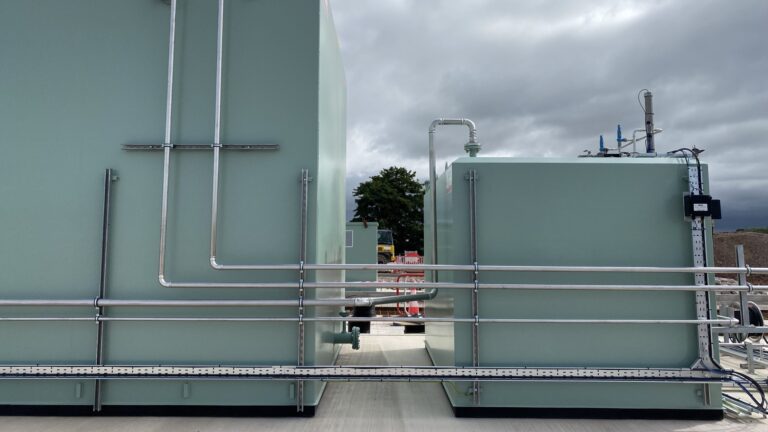
As the pressure grows to minimise downtime and meet evolving fuel demands, the role of pipework systems has never been more important.

Antony Corbett, Product Applications Engineer at Geberit, explores how manufacturers are prioritising product development and offering specialist engineering support to help shift the balance in order to optimise fuel transfer systems and installation practices.
Installation matters
Durability has often been the benchmark for piping system performance in fuel handling environments. Material choice and component lifespan have dominated specification decisions, following a mantra of ‘if it lasts, it’s successful’ – and rightly so in high-risk environments where safety is critical.
However, with greater pressure on cost, compliance and risk, that balance is changing.
Even the most robust materials can be undermined by inconsistent jointing methods or poor installation standards. Across diverse industrial sites, from power generation facilities to transport infrastructure and fuel storage depots, there’s an increasing focus on how a system is installed, not just what it’s made from.
The reasons for this shift are varied. Stricter regulatory requirements, evolving environmental standards and the increasing cost of downtime are placing greater scrutiny on every stage of a system’s lifecycle. In addition, material and labour costs have risen, shaping the decisions made around installation methods. Engineers are increasingly seeking ways to prioritise efficiency and consistency, without compromising on quality, reliability or safety.
Press-fit solutions
Another reason for the change, of course, is the continued research and development from manufacturers in installation technologies. Modern press-fit systems, for example, eliminate many of the variables associated with traditional pipe joining techniques – such as welding – and unlock new benefits for engineers in the process.
With press-fit systems like Geberit Mapress, there’s no need for hot works – instantly reducing risk, insurance obligations and safety on site – an especially important consideration in hazardous environments where flammable fuels and vapours are present.
They also ensure consistency. Pressed connections deliver uniform joint quality, which reduce the risk of human error and ensure reliable, long-term durability. For installers working under time pressure or in challenging site conditions, the simplicity and repeatability of press-fit offer a critical advantage.
If that’s not enough, press-fit systems are also quicker to install. In high-hazard environments, reducing time on site is not simply a matter of efficiency, it’s a matter of safety and cost control. Faster installation minimises exposure to risk, shortens project timelines and helps limit disruption to ongoing operations.
Full lifecycle technical support
Product innovation alone is not enough. As systems become more complex and regulatory expectations continue to evolve, the role of manufacturers is expanding beyond product supply.
Increasingly, manufacturers are offering specialist support that spans the entire project lifecycle, from early design and specification through to installation and commissioning.
At the design stage, this means working closely with engineers and consultants to ensure that systems are correctly specified for the intended application, including compatibility with different fuel types and operating conditions. Material selection, corrosion resistance and chemical compatibility all play a vital role in ensuring long-term system integrity.
During installation, support can take the form of technical guidance, on-site training and quality assurance processes that help to ensure a reliable, safe install. This is particularly valuable in fuel applications, where even minor deviations can have significant implications on safety and compliance.
Post-installation, manufacturers can offer ongoing support and system validation. Ensuring that installations meet required standards, and continue to perform as expected over time, is critical to maintain both safety and operational continuity.
This level of support reflects the importance of modern pipework design within the context of the overall facility. Rather than viewing pipework as a purely functional component, there is increasing recognition of piping systems as a critical part of overall system risk management.
Meeting the challenge of an evolving future
As fuel types evolve, including the development of alternative and lower-carbon fuels, systems will need to be more adaptable than ever. This is already placing additional demands on materials, connection technologies and system design, reinforcing the need for close collaboration between manufacturers, engineers and contractors.
At the same time, the drive for greater efficiency and reduced environmental impact will continue to shape project delivery. Solutions that minimise waste, reduce installation time, reduce environmental risk and improve long-term reliability, will become increasingly valuable in meeting both commercial and regulatory objectives.
Ultimately, ensuring safe and reliable fuel transfer is about more than individual components. It’s about taking a holistic approach that considers the entire lifecycle of a system, from initial design through to long-term operation.
By combining innovative product development with practical, end-to-end support, manufacturers have a vital role to play in helping the industry meet these challenges. In doing so, they are not only supporting compliance and performance but also helping to set new standards for safety and reliability in some of the most demanding environments.
Learn more about this innovative system at www.geberit.co.uk