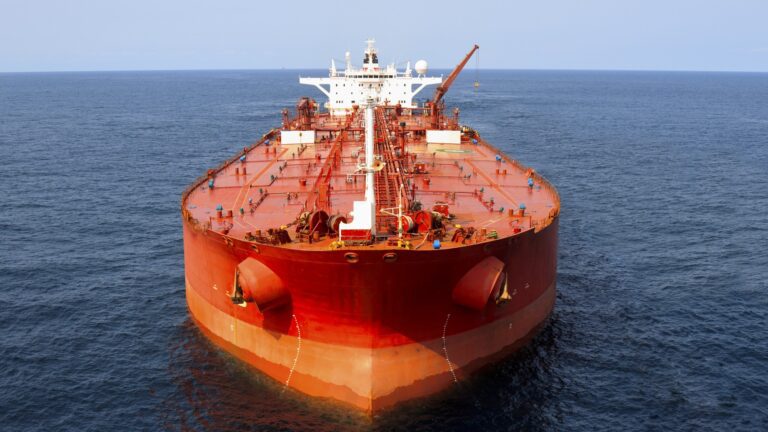
What would the impact be on oil markets, if this 100km wide stretch of water was to be closed to maritime traffic? Our monthly reports have covered the topic multiple times, but always from a hypothetical perspective.
At the beginning of March, theory became reality, and the effect on prices has been savage and deeply worrisome. The International Energy Agency has gone as far as to say that the current blockage of the Straits of Hormuz is the most severe oil and gas supply disruption ever.
First some basics on why the Straits of Hormuz matters. The main oil and gas producing nations of the Middle East (Iraq, Kuwait, Saudi, Bahrain, Qatar, UAE) are located in the Persian Gulf, which is West of the Straits. In order to get their oil onto world markets, it must be shipped eastwards via the Straits.
That volume of oil equates to 20m barrels of crude per day (bpd) or 20% of global oil consumption (100m bpd). The shipping channel also carries around 25% of the world’s Liquefied Natural Gas (LNG) and 10m bpd (10%) of global refining capacity.
Despite the oil supply glut at the start of the year, removing 20% of the world’s oil supply (effectively overnight) was always going to send prices skywards. At the end of February (before the US / Israeli attacks), Brent Crude was around $70 per barrel (bbl). As we write this report (15th March), the price has rocketed to $103 / bbl.
This 50% rise in crude prices has been surpassed by increases in refined fuels, where the situation is even bleaker. Diesel (excluding all taxes and local costs) has risen by 60% from 48 pence per litre (ppl) to 78ppl, whilst jet fuel (Kerosene) has almost doubled (up by a staggering 96%) from 49ppl on Feb 27th to 97ppl. Petrol (gasoline) has experienced the lowest price rises of the refined grades, with “only” a 40% increase, from 41 ppl to 59ppl, in the same 10 working day period.
So, what is going on here? The first obvious statement is that prices across different grades are moving at different speeds, reflecting the fact that all products have their own specific markets and levers around supply and demand. Gasoline has risen the least because most petrol in the world is produced in the Americas and West Africa.
Thus, this grade is geographically less affected by the problems in the Middle East. Jet Fuel production on the other hand is heavily focussed on the Middle East, with approximately 25% of global jet fuel and over 40% of European jet fuel, coming from the region.
“THE EFFECT ON PRICES HAS BEEN SAVAGE AND DEEPLY WORRISOME.”
This makes jet fuel (and to a lesser extent, diesel) more susceptible to price increases than the crude oil that they derive from, because they suffer from the problem of “replaceability”. In effect, markets are recognising that it is much more difficult to replace lost refining capacity, than it is to replace lost crude production.
After all, we know that there is sufficient crude oil in the world (even outside of the Middle East) to meet global demand. As we saw in the aftermath of the Ukrainian invasion in 2022 (when Russian crude was removed from the market), the crude market did rebalance in the end. Refinery capacity is a different story; you can’t just build a refinery overnight to increase supply and nor can existing refineries easily change their configurations to meet extra jet and diesel demand.
This problem is particularly acute in Europe, where refineries are basically giant gasoline processing machines (another reason why petrol is the least affected refined grade), with limited diesel and jet fuel capability.
The rapid increase in refined prices has immediately hit consumers at the pump and it would seem clear to anyone but the most diehard MAGA supporter, that President Trump has made a bad miscalculation. After 4 years of trying to tame the inflationary beast created by the Ukrainian invasion, the President has created an even bigger monster and for a politician that promised to bring US prices down, this surely spells trouble at the forthcoming mid-term US elections.
In fact, the only way for oil to fall back down to reasonable levels is for the President to somehow convince himself that the military victory he so easily promised (and seemingly announces on a daily basis) has been achieved. At that point the conflict could “cool-off”, the Straits re-open and prices should experience a sharp downturn; markets can, and do, collapse just as fast as they rally!
One final factor that the President failed to consider has been the paradoxically beneficial effect of all of this on the Iranian Oil Industry! Iran is still the 7th biggest producer in the world (4m barrels per day) and unlike every other nation in the Gulf, their ships are able to safely navigate the Hormuz channel.
In fact, shipping data shows that 16.5m barrels of Iranian crude was exported via the 24 miles of nautical Iranian waters within the Straits of Hormuz, in the first 11 days of March. And with oil prices having rocketed up to circa $100 (from $60 at the start of the year), Trump is adding around $160m per day straight into Iranian coffers.
None of this will feature in any Truth Social posts of course, and nor will the fact that at this juncture, it would seem that Iran and not the USA, holds the key to reopening the global energy market.
Image credit: iStock