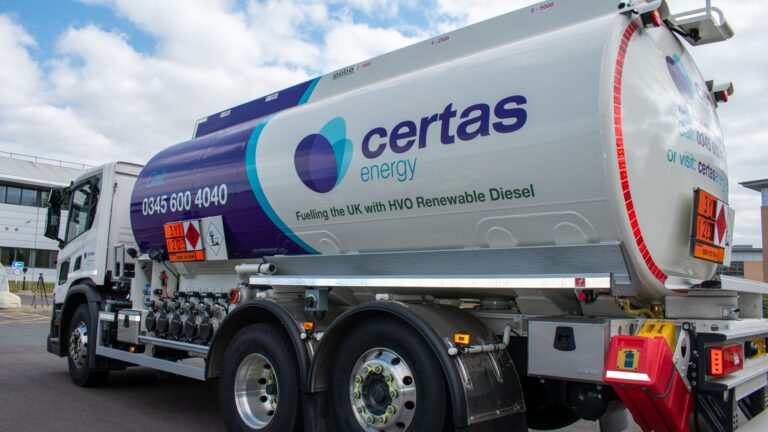
Here, Sam Allen, Renewable Fuels Expert at Certas Energy, explains why he believes Hydrotreated Vegetable Oil (HVO) will be an essential component to deliver rapid progress in fleet decarbonisation.
All sectors in the United Kingdom are required by law to reach net zero greenhouse gas emissions by 2050. Whilst technologies such as electrification and hydrogen will undoubtedly shape the long-term future, there are several barriers for businesses that may want to adopt these solutions today, for example insufficient nationwide charging infrastructure and high upfront costs.
That’s why Hydrotreated Vegetable Oil (HVO) has been such a crucial part of the transition story and will continue to be for the next decade.
As a drop-in renewable alternative diesel offering up to 90% carbon savings versus standard diesel across the product lifecycle, HVO provides an immediate, practical way to cut emissions across existing fleets without engine modifications or costly new infrastructure.
For sectors like haulage, construction, and off-road operations – where vehicle replacement cycles are long and electrification is currently unrealistic for some of the reasons aforementioned – HVO delivers measurable results immediately.
This renewable alternative to standard diesel is a short-to-medium-term solution that will be a critical bridge for the UK’s race to net zero by supporting businesses in meeting their sustainability targets, while the country continues to invest in electrification, hydrogen, and other solutions.
Ensuring a credible supply
The credibility of the HVO supply chain depends on transparency, as well as the integrity of its feedstocks.
When HVO is sourced in a responsible way and produced using verified waste and residue sources, it can offer substantial greenhouse gas savings in comparison to standard diesel.
The continued switch to HVO in the transport industry needs to be a credible one, and suppliers can play a central role by keeping trust, transparency, and traceability at the heart of this transition.
The Renewable Transport Fuel Obligation (RTFO) sets a clear legal baseline for sustainability, defining acceptable feedstocks and minimum greenhouse gas saving thresholds.
There are also voluntary certification schemes that play a vital role. For example, the International Sustainability and Carbon Certification (ISCC) is a global, independent initiative and leading certification system supporting fully traceable supply chains.
Additionally, the Renewable Fuels Assurance Scheme (RFAS) provides Renewable Fuel Declarations (RFDs), giving fleets transparent data on origin, feedstock, and emissions savings.
However, the duty to uphold sustainability standards extends beyond just regulators and auditors. It also requires honest partnerships between fleets and suppliers.
Those who insist on ISCC certified HVO with RFAS declarations, safeguard their organisations against inadvertent greenwashing and ensure that their emission reductions are fully substantiated.
Expanding supply across industries
The growing demand and adoption of renewable diesel (HVO) across transport, aviation, construction and heating has resulted in huge, immediate carbon reductions. However, what we are seeing now is a wider range of industries trialling and adopting HVO, for example; maritime and events.
One reason for this might be that the benefits associated with switching to HVO are not exclusive to any one industry. These benefits include the ability to seamlessly blend with standard diesel, the long shelf-life, the low cold filter plugging point (to -30°C), and the multiple buying options available for companies. Along with the option for businesses to hire HVO tanks, reducing the upfront costs associated with switching from standard diesel to HVO, this has resulted in a continued rise in interest and adoption of the fuel.
At the same time, while the existing supply of HVO meets the demand for the next decade, the renewable fuel industry is rapidly expanding its feedstock base beyond used cooking oil, thus significantly increasing overall supply capacity to meet future demand.
With ongoing investment and technological progress, renewable fuel production has the potential to scale sufficiently to meet growing demand across multiple sectors.
As an industry, we should be focused on continuing to increase the overall pool of sustainable feedstocks and refining capacity so that aviation, transport, and other sectors can all benefit from low-carbon fuel options as they evolve.
Driving awareness and adoption
The transport industry needs a bridge for its transition to net zero. While alternative solutions, such as electric and hydrogen, are continually being developed for broader adoption, there is a growing need for interim solutions like HVO.
Maximising its impact relies on increased awareness, education and information to challenge misconceptions associated with HVO. We will continue to invest in our nationwide distribution network and in providing flexible purchasing options for our customers, ensuring the switch is as simple as possible.
Used responsibly and sourced sustainably through a trusted supplier, HVO can deliver a meaningful carbon reduction of up to 90% across the product lifecycle in comparison to standard diesel, helping us stay on track to meet this decade’s urgent climate goals while paving the way towards a fully zero-emission future.
Image courtesy of Certas Energy