
Skilled people are essential to the success of every fuel oil distributor, but recruiting them can be expensive and replacing them even more so. With competition for drivers and other specialist roles continuing, where are your efforts best focused – on finding new employees or keeping the ones they already have?
For fuel oil distributors (FODs), having the right people in the right roles is essential to maintaining reliable deliveries, safe operations and good customer service.
Yet recruiting and retaining skilled employees remains a challenge, particularly for smaller distributors competing with larger businesses and other sectors for a limited pool of experienced workers.
Drivers may be the most visible recruitment pressure point, but engineers, depot operatives, transport coordinators and customer service teams are all vital to efficient business operation.
And every vacancy carries a cost. Beyond recruitment fees and salaries, there can be overtime, temporary cover, training, management time and lost productivity.
So, what is the true cost of recruiting and replacing staff? Are recruitment agencies worth the premium? And could investing more in existing employees prove the better commercial decision?
This month’s Delivering Insight examines the evidence and considers how SMEs can develop a more cost-effective approach to building and retaining a loyal and capable workforce.
Where are the recruitment pressures?
The wider UK road freight industry continues to experience recruitment challenges, although the acute driver shortages seen in earlier years have eased.
Department for Transport figures show that 25% of UK HGV businesses reported driver vacancies during January–March 2026, compared with 24% in the equivalent period of 2025.
For fuel distributors, the recruitment pool can be narrower still. Tanker drivers require appropriate HGV licensing, Driver CPC and ADR qualifications for the products carried. Drivers loading petroleum products at terminals also require a Petroleum Driver Passport (PDP).
Recruiting a suitably qualified and experienced tanker driver may therefore be more challenging than filling a general driving vacancy.
Other specialist skills are also in demand. Institute of the Motor Industry research indicates that online job postings for heavy-vehicle technicians increased by 5% year on year in August 2026 and were 19% higher than in August 2024.
For FODs operating in rural areas, the challenge may be compounded by a smaller local labour pool and competition for staff whose skills are readily transferable to other industries.
An ageing workforce
The age profile of the wider HGV workforce presents a further consideration.
ONS figures for July 2025–June 2026 indicate that approximately 35% of UK HGV drivers were aged 56 or over, while only around 4% were aged 16–25.
Although these figures are not specific to fuel distribution, they highlight the importance of workforce succession planning.
For an SME distributor, the retirement of one or two experienced drivers or depot employees could represent the loss of a significant proportion of its operational knowledge.
The question is therefore not only how to fill today’s vacancies, but how to develop the workforce needed in five or ten years’ time.
UK HGV businesses reporting driver vacancies

Source: Department for Transport, domestic road freight statistics. Figures cover the wider UK HGV sector, not FODs specifically.
What does recruitment actually cost?
Pay is an obvious starting point.
The ONS 2025 Annual Survey of Hours and Earnings places median full-time annual pay for UK large goods vehicle drivers at approximately £39,900. This is a national benchmark rather than a tanker-driver-specific salary.
However, salary is only one element of the cost of employing somebody.
Employer National Insurance, pension contributions, holiday entitlement, training, equipment and other employment costs all contribute to the total investment.
Recruitment itself adds another layer.
Agencies can provide a route to established candidate networks, specialist recruitment expertise and potentially faster access to suitable applicants.
But that convenience comes at a price.
Industry guidance suggests permanent recruitment agency fees commonly fall between 15% and 25% of first-year salary.
For a position paying £40,000, that would mean an agency fee of between £6,000 and £10,000.
Direct recruitment may appear cheaper, but advertising, screening applicants, interviewing, management time and onboarding all have costs.
The CIPD’s 2024 Resourcing and Talent Planning report identified a median recruitment cost of £1,500 per non-management hire, providing a broad benchmark rather than an FOD-specific figure.
The right comparison is therefore not agency fee versus zero cost, but agency recruitment versus the full cost of recruiting directly.
In this illustrative scenario, direct recruitment costs £4,500 less, although the assumed longer recruitment period results in higher temporary cover and management costs.
Neither method is automatically the better option.
If an agency can fill a critical vacancy more quickly, the additional recruitment fee may be justified by reduced disruption and avoided operating costs.
Equally, where a distributor can recruit effectively through its own networks, an agency premium may offer limited additional value.
The most expensive recruitment decision may not be the one with the highest fee, but the one that leaves a critical role unfilled for longest.
What does replacing a driver really cost?
Consider a purely illustrative example involving a distributor replacing an experienced tanker driver.
The following indicative figures are hypothetical, not industry averages.
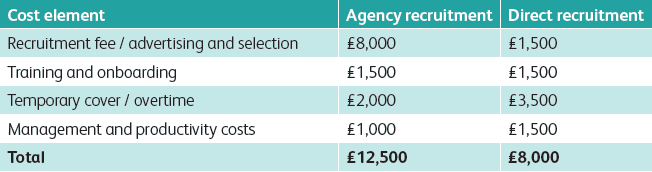
Beyond the recruitment fee
The financial cost of replacing an employee is only part of the picture.
Patrick Kirby, CEO of Tria Energy, believes that the true cost of replacing a driver is considerably greater than many businesses recognise.
While agency fees and direct recruitment expenditure are significant, Patrick points to the management time required alongside the operational consequences of a vacancy.
“My sense is that the true figure is substantially higher than most operators would estimate.
“Between recruitment, management time, training, downtime, operational disruption and the potential impact on customer retention, it can be a massive cost to a business.
“It’s probably one of the biggest hidden costs of staff turnover in our industry.”
Reduced delivery capacity, additional pressure on existing drivers and the time required for a replacement to become fully effective can all increase the cost.
But there is another, less easily measured consequence: the potential loss of customer knowledge and relationships.
As Patrick highlights: “Fuel distribution is still a very local and relationship-driven business.”
In a sector where regular drivers often understand customers’ premises, individual requirements and delivery arrangements, replacing that experience is not straightforward.
“You lose experience, local knowledge, operational efficiency and potentially some of the customer goodwill that has taken years to establish,” he explains.
For FODs attempting to establish the true cost of staff turnover, the distinction is between costs that can be calculated – recruitment fees, training, temporary cover, overtime and management time – and those that are harder to quantify, including lost capacity, operational knowledge, customer relationships and potential lost business.
Some of the most significant costs of staff turnover may be the ones that never appear on a recruitment invoice.
Reasons cited by HGV businesses with driver vacancies

Source: Department for Transport, Q4 2025. Respondents could cite multiple reasons; percentages do not total 100%.
Could alternative recruitment routes offer better value?
For smaller distributors without dedicated HR teams, recruitment may be largely reactive – beginning only when an employee gives notice.
Developing a broader recruitment strategy could help reduce both cost and disruption.
Several options are worth considering.
Employee referrals can provide access to candidates already familiar with the industry through existing staff. A referral bonus, payable after successful completion of probation, may offer a relatively low-cost recruitment route.
Direct recruitment through company websites, local job boards and social media can reduce agency dependence, particularly where a distributor has a strong local reputation.
Local partnerships with colleges, HGV training providers, Jobcentre Plus and other organisations may help reach candidates who would not otherwise consider fuel distribution.
Training and upskilling can widen the available talent pool. Rather than recruiting only fully qualified tanker drivers, a distributor might recruit suitable HGV drivers and support them through the additional qualifications required.
Apprenticeships and entry-level opportunities can help develop a longer-term pipeline for drivers, engineers and depot roles.
These approaches are not necessarily quicker or cheaper in every circumstance. Training requires investment and employees may take time to become fully productive.
However, they can reduce reliance on an increasingly competitive market for experienced recruits.
Is retaining staff the better investment?
Recruitment costs are only one side of the equation.
Every employee who leaves may take valuable experience, customer knowledge and operational expertise with them.
Their departure can also increase the workload of remaining employees, potentially contributing to further dissatisfaction and turnover.
The wider road freight data offers some insight into why employees leave.
Among HGV businesses reporting driver vacancies in the fourth quarter of 2025, the DfT recorded the following recruitment difficulties:
Pay clearly matters. Among HGV businesses that increased driver pay during the same quarter, 55% reported doing so to retain existing drivers, while 35% cited attracting new drivers.
But pay is not the only influence.
Predictable working patterns, manageable workloads, suitable equipment, supportive management and opportunities for progression can all contribute to employee satisfaction.
For FODs, this may be particularly relevant during the winter peak, when seasonal demand increases pressure on drivers, transport teams and customer service staff.
A business that repeatedly relies on overtime and extended working hours may need to consider whether its operating model is contributing to employee turnover.
What makes employees stay?
There is no single retention measure that will work for every distributor. Competitive pay and benefits matter, but work-life balance, career development, recognition, support, leadership and work environment can also influence whether employees stay.
The importance of employee engagement is illustrated by WCF, whose approach to workplace culture is explored in more detail elsewhere in this issue.
In “WCF: You said, we listened”, Head of People Strategy & Organisational Development Karen Kelso explains how the employee-owned group uses confidential staff surveys, visible leadership and employee feedback to shape its working environment.
For a geographically dispersed workforce, including drivers who start early and spend much of their working day alone, maintaining communication is particularly important.
“If I need to be at a depot at 6am, I’ll be there at 6am,” says Karen, emphasising the value of face-to-face engagement alongside digital communication.
WCF also highlights the importance of development opportunities, with employees across its fuels businesses progressing into management and specialist transport roles.
While smaller distributors may not have WCF’s dedicated people resources or be able to match larger employers’ pay packages, they may have advantages in closer management relationships, flexibility and a stronger sense of belonging.
The underlying principles are transferable: listen to employees, act on feedback, maintain regular contact and provide opportunities to develop.
The important starting point is understanding what employees actually value – rather than assuming every departure is solely about money.
What is retention worth?
If relatively modest changes to working practices can help retain an experienced employee, how does that investment compare with the cost of replacing them?
Returning to our illustrative recruitment example.
If replacing a driver costs between £8,000 and £12,500, preventing even one avoidable departure could represent a significant saving.
Suppose a distributor with ten drivers considers an annual retention investment of £5,000, covering additional training, recognition and improvements to working arrangements.
If, hypothetically, that investment prevents one departure which would otherwise have cost £8,000 to address, the avoided replacement cost exceeds the investment by £3,000.
But this calculation needs careful interpretation. Not every departure is preventable, and it may be difficult to demonstrate that a particular investment directly caused an employee to stay.
Nevertheless, the comparison illustrates an important principle:
Retention expenditure should be assessed against the potential cost of staff turnover, not simply treated as another employment overhead.
The financial case becomes stronger where retaining an experienced employee also protects operational capacity, customer relationships and valuable specialist knowledge.
What have we learned?
Recruitment remains challenging. Specialist qualifications and competition for transferable skills can make FOD vacancies difficult to fill.
The cheapest recruitment route is not always the most cost-effective. Total cost, time to hire and operational impact all matter.
Staff turnover has hidden costs. Lost capacity, experience and customer relationships may be as significant as recruitment expenditure.
Retention is an investment. Understanding why employees stay or leave can help businesses target spending more effectively.
Review your recruitment and retention economics
1. Calculate
Establish:
- Number of employees by role
- Annual staff turnover and reasons for leaving
- Average time to fill vacancies
- Recruitment costs by method
- Training and onboarding costs
- Overtime and temporary cover costs
- Total estimated cost of replacing an employee
- Current expenditure on retention and development
Calculate the full cost of your most recent recruitments and identify which vacancies caused the greatest operational disruption.
2. Compare
Compare:
- Agency versus direct recruitment costs
- Recruiting experienced employees versus training suitable new entrants
- Recruitment costs across different roles
- Staff turnover by department and length of service
- Cost of replacing employees versus investment in retaining them
- Your pay, benefits and working conditions against relevant local competitors
Consider whether particular roles, managers, working patterns or locations experience consistently higher turnover.
3. Decide
If agency recruitment is expensive but effective: Assess whether the speed and quality of appointments justify the premium, particularly for critical vacancies.
If suitable candidates are difficult to find: Consider widening recruitment criteria and investing in training, referrals or local partnerships.
If turnover is concentrated in particular roles: Investigate the underlying causes before increasing recruitment expenditure.
If experienced employees are approaching retirement: Develop succession plans and opportunities to transfer knowledge to newer colleagues.
If retention investment is lower than repeated replacement costs: Consider whether targeted improvements to pay, working patterns, training or management could deliver a stronger return.
The business question
Do we know what it really costs to replace a valued employee – and are we investing enough to avoid having to?
Image credit: iStock