Introduction
Every litre a distributor sells begins its journey at a fuel terminal. How that litre reaches your depot may only add a penny or two to its cost – but across millions of litres each year, those pennies quickly become tens or even hundreds of thousands of pounds. Yet for many distributors, the decision to collect fuel themselves or buy delivered-in supply was made years ago and has rarely been revisited.
In this month’s Delivering Insight, we examine the true economics of depot replenishment, comparing ex-rack collection with delivered-in supply to help you decide which model best suits your business.
Getting fuel into the depot efficiently is critical to operational resilience and profitability. The decision over how fuel reaches the depot is not simply a transport choice; it can impact capital investment, operational flexibility, stock control, and profit margins.
As labour, transport, and operating costs continue to increase, now is an appropriate time to review whether your current model remains the most efficient way to move fuel into your depot.
We compare the benefits of each approach, including a look at a hybrid model, review the factors influencing costs and consider how you determine which is best suited to your business.
Approaches to depot replenishment
Road fuels are supplied on either a delivered-in or ex-rack basis through a network of refineries, fuel terminals, and storage facilities operated by major fuel suppliers and independent terminal operators across the UK and Ireland.
Examples include Greenergy, EET Fuels, MB Energy, Phillips 66, Valero, Exolum and other major suppliers, refiners and terminal operators. Ex-rack collection is typically available to approved, inducted customers with the relevant supplier account and terminal access, subject to product availability at the chosen terminal.
Many of these suppliers also offer delivered-in fuel, with transport managed on behalf of the customer from terminal to depot. Delivery availability will depend on factors such as depot location, order volumes, product requirements, supplier delivery capacity, and specific commercial agreements.
The following sections compare the operational and commercial advantages and challenges of each approach.
Delivered-in
Having fuel delivered directly to the depot offers a convenient and straightforward solution for FODs. By relying on the supplier to manage transport from the terminal, distributors avoid the need to coordinate collections, vehicle availability, and driver resources. This reduces transport responsibility and allows depot staff to focus on core distribution activities.
For distributors without sufficient collection capability or spare transport capacity, delivered-in supply avoids the need to expand transport resources, including additional vehicles, drivers and the associated costs of depreciation, insurance, maintenance, wages, training and compliance.
However, delivered-in fuel typically includes a premium above the terminal price, reflecting the cost of transporting fuel from the terminal to the depot, together with the supplier’s operating costs and commercial margin. The level of premium will vary depending on factors such as delivery distance, supply location, order volumes, etc.
For contracted fuel supply, the premium may be fixed for the duration of the contract. Where delivered-in supply is secured under an agreed pricing arrangement, transport costs can be easier to forecast, as the haulage element is incorporated within the agreed premium rather than managed separately through a transport operation.
Distributors also have less control over transport scheduling, remaining reliant on supplier availability and delivery times while ensuring suitable site access and personnel are available to receive the delivery.
Finally, effective planning is also important, as issues such as insufficient tank capacity or changes at the point of delivery can result in additional costs, including Left on Board (LOB) charges where a tanker cannot fully discharge its load.

Ex-rack terminal collection
Ex-rack collection allows FODs to purchase fuel directly from a network of fuel terminals, with distributors taking responsibility for arranging transport from the terminal to the depot. This gives distributors greater control over when and how fuel is moved into the depot, allowing collections to be planned around operational requirements, changes in demand and depot stock levels. Access to suitable terminal locations can also support emergency collections and reduce reliance on supplier delivery schedules.
Not all ex-rack customers operate their own transport fleet. Some distributors purchase fuel on an ex-rack basis but appoint an independent haulier to collect and deliver fuel from the terminal to the depot. This provides access to ex-rack purchasing without requiring investment in vehicles or fleet infrastructure, although transport costs remain payable through the haulier’s charges.
Where a distributor already operates a transport function, ex-rack collection can improve the utilisation of existing vehicles and driver resources. By planning collections effectively around terminal locations and customer delivery routes, businesses may be able to reduce unnecessary mileage and make better use of transport assets already in operation.
The commercial benefits of ex-rack collection are typically greatest for distributors purchasing larger fuel volumes, where avoiding supplier haulage premiums can create potential savings. However, these savings must be considered against the full cost of managing the transport function, including vehicles, drivers, maintenance and compliance.
Operating an artic fleet requires significant investment and ongoing management. Whether vehicles are purchased outright, financed through leasing arrangements, or acquired through contract hire, distributors must consider the implications for cash flow, ownership and long-term operating costs.
The table above provides an indicative comparison of the capital investment and leasing costs associated with artic tankers and tractor units under different acquisition methods.
In addition to vehicle acquisition costs, operators must account for ongoing expenses including driver wages, fuel, maintenance, insurance, compliance and administration. The second table above shows examples of typical maintenance expenses and the average cost. For a detailed comparison of tanker ownership options and cost comparisons, see our previous article: ‘Fleet strategy for fuel distributors: when to lease, when to buy, and when to replace’.
Successful ex-rack operations also rely on effective transport planning. Vehicle availability, driver resources, terminal opening hours, waiting times and collection scheduling must be carefully managed to maintain supply continuity. Without sufficient scale or effective fleet management, the additional responsibilities and costs of ex-rack collection can outweigh the benefits of avoiding supplier haulage charges.
Load size and cost per litre
While the operational advantages of delivered-in supply and ex-rack collection differ, the economics of both approaches are ultimately determined by the total cost per litre of moving fuel from the terminal to the depot.
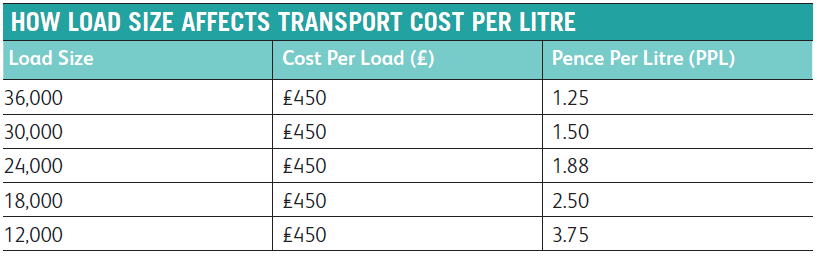
As many of the costs associated with putting a tanker on the road (e.g. driver wages, fuel, maintenance, standing charges) are incurred regardless of the volume transported, full-load movements provide the lowest transport cost per litre.
Smaller loads spread these costs across fewer litres, increasing the transport cost per litre. For delivered-in supply, this is generally reflected in a higher delivered-in premium (many suppliers implement small load premiums), while for ex-rack collection it increases the cost of each litre collected because the same collection costs are spread across fewer litres.
This is illustrated below by converting a fixed transport cost into a pence per litre (ppl) cost at different load sizes:
Choosing the most suitable approach
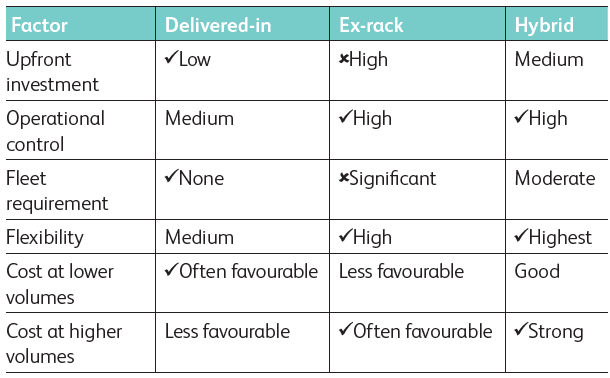
There is no single replenishment model that is best suited to every FOD. The right approach depends on balancing cost, operational control and flexibility, with factors such as annual fuel volumes, fleet utilisation, terminal proximity and transport costs all influencing the decision.
Typically, the economics of ex-rack collection improve as fuel volumes increase, allowing the fixed costs of operating an artic fleet to be spread across more litres moved. As a result, delivered-in supply may remain the more economical option for lower-volume distributors or those without sufficient vehicle capacity or driver resources to justify dedicated fuel collections. Conversely, larger distributors with established transport operations and consistently high fuel volumes may be better positioned to realise the benefits of ex-rack collection.
For many distributors, the most effective solution is a hybrid approach, combining ex-rack collection with delivered-in supply. This enables businesses to utilise ex-rack where it is commercially advantageous, while retaining delivered-in supply to provide additional flexibility during peak demand, fleet constraints or other operational pressures. Used together, both approaches can help optimise costs while maintaining continuity of supply.
Conclusion
The answer to “Which is best for my business?” is unlikely to be the same for every distributor. The most profitable solution depends on your volumes, transport operation, terminal access and commercial priorities. This review is not about finding a universal answer – it’s finding the right answer for your business.
Rising labour costs, increasing vehicle costs, changing supplier relationships and advances in fleet technology mean the economics are continually shifting. A model that made perfect sense five years ago may no longer be the most profitable today.
The question isn’t whether ex-rack collection or delivered-in supply is better; it’s whether your current approach is still the right one.
Review your depot replenishment strategy
1. Calculate
Gather the information you need:
- Annual litres moved into the depot
- Average tanker load
- Number of collections/deliveries
- Distance from terminal
- Delivered-in premium
- Fleet operating costs
- Driver costs
- Fuel costs
- Maintenance
- Waiting time
Then calculate your true cost per litre into the depot.
2. Compare
Now compare your current model with the alternative.
If you’re buying delivered-in, ask:
- How much of my premium is transport?
- Would ex-rack become viable if volumes increased?
- Could another supplier reduce haulage costs?
- Would a hybrid model save money?
If you’re collecting ex-rack, ask:
- Are my vehicles fully utilised?
- How much do empty miles cost?
- What is waiting time costing me?
- Would delivered-in be cheaper at quieter times?
3. Decide
Finally, ask: Is the cost difference meaningful?
If the difference is only a fraction of a penny per litre, it may be worth considering whether the operational flexibility, resilience and reduced management burden outweigh the potential financial saving.
Ex-rack is clearly cheaper
> Review fleet utilisation and collection opportunities.
Delivered-in is clearly cheaper
> Consider reducing or outsourcing collection.
Neither option is compelling
> Explore a hybrid strategy.
Summary of influencing factors
Every distributor should periodically recalculate the true cost of getting a litre from the terminal gate into the depot. Only then can they be confident they are making the best commercial decision for their business.
Business question:
“If we were starting this business today, knowing what we know now, would we choose the same depot replenishment model?”
Delivering Insight is your monthly business‑critical briefing. Designed to give SME distributors clear, actionable guidance to work smarter and more profitably. Although larger distribution groups may have in-house HR teams, fleet managers, compliance officers and analysts, many SME FODs operate without those resources. Delivering Insight is your virtual support team – a growing knowledge base that builds into a valuable reference library for your business, helping you make informed decisions that safeguard your business today and strengthen it for the future.
Image credit: Shutterstock