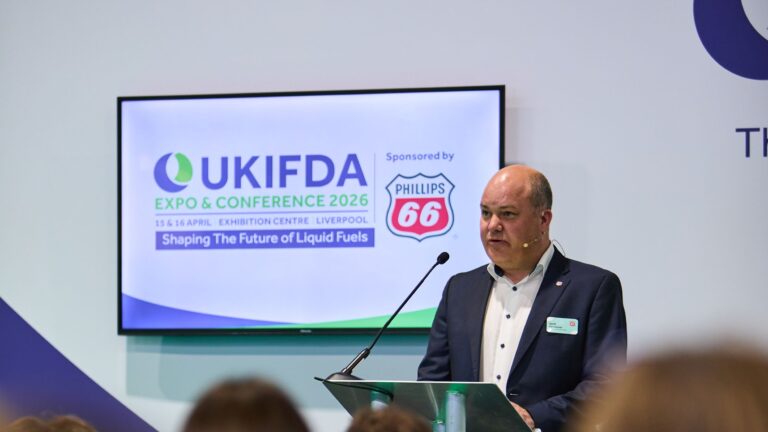
Bringing together distributors, suppliers, technology providers, equipment manufacturers, compliance specialists and policymakers under one roof, the Liverpool event reflected an industry that remains firmly focused on delivering today’s energy needs while actively preparing for a lower-carbon future.
As explored in our online event report, the atmosphere throughout the exhibition hall was one of professionalism, innovation and pragmatic optimism, with conversations spanning everything from logistics efficiency and fleet technology through to renewable fuels, compliance, electrification and future energy pathways. The event also highlighted the depth and diversity of expertise that continues to underpin the UK and Ireland’s liquid fuel supply chain.
Opening the EXPO, UKIFDA CEO Ken Cronin welcomed delegates and thanked exhibitors and headline sponsor Phillips 66 before introducing keynote speaker Geoff Henderson, Wholesale Manager Phillips 66. Geoff’s address set the tone for many of the discussions that would follow across the two-day event.
Describing the EXPO as an opportunity to connect “the full chain of decision makers responsible for ensuring fuel reaches all end users”, Geoff emphasised the scale and complexity of the network operating behind the scenes every day to maintain reliable energy supply.
His keynote also reflected one of the dominant themes emerging across the event: that the industry’s challenge is no longer framed simply as “liquid fuels or not”, but rather how to reduce carbon intensity while maintaining resilience, affordability and energy security.
That balance between operational reality and transition ambition resonated strongly throughout the EXPO.
Geoff pointed to the continuing importance of liquid fuels within the UK economy, noting that more than 40 million vehicles still rely on liquid fuels, while many homes and businesses remain dependent on them for heating and operational continuity. At the same time, he acknowledged that markets remain highly exposed to geopolitical instability and volatility.
Yet rather than presenting volatility purely as a threat, the keynote suggested it also serves as a reminder of the sector’s resilience and strategic importance.
Much of the speech focused on the need for a practical and commercially realistic transition pathway. Geoff outlined three core areas of focus for Phillips 66: maintaining supply resilience, lowering carbon intensity and supporting electrification “where it makes sense”.
On refining, he stressed the importance of domestic production capacity at a time when only four UK refineries remain operational, arguing that maintaining a competitive refining sector is essential to national energy resilience (more on this subject on the next page).
He also referenced the proposed Lindsey refinery transaction, noting that Phillips 66 aims to integrate the assets in a way that strengthens supply resilience while supporting the competitiveness of the Humber region.
On decarbonisation, Geoff highlighted the company’s role as the UK’s only at-scale producer of sustainable aviation fuel (SAF), alongside its supply of renewable diesel and wider investments linked to lower-carbon energy systems.
Importantly, however, the keynote avoided simplistic transition narratives. Instead, it called for what Geoff described as “sensible decarbonisation” – a pathway that is resilient, low carbon and fit for future needs.
That pragmatic framing mirrors many of the conversations currently taking place across the fuel distribution sector, where businesses are increasingly balancing immediate operational pressures with long-term strategic adaptation.
Policy also featured prominently. Geoff argued that the policy environment must support a resilient and competitive domestic refining sector, pointing specifically to mechanisms such as the Carbon Border Adjustment Mechanism (CBAM), alongside the continued importance of the Renewable Transport Fuel Obligation (RTFO) and SAF mandates in supporting lower-carbon fuel development.
Perhaps the most significant message from the keynote came in Geoff’s observation that “the future of liquid fuels will not be decided by a single company, technology or policy decision.” Instead, he emphasised the need for industry and government to work together to navigate the next phase of the energy transition.
That collaborative spirit was evident throughout EXPO 2026.
Across the exhibition floor and conference sessions, discussions repeatedly returned to the same core themes: resilience, operational excellence, innovation, workforce development, digitalisation and the evolving role of liquid fuels within a changing energy landscape.
Over this issue and the coming months, Fuel Oil News will continue exploring many of the key insights and themes emerging from EXPO 2026. From technology innovation and compliance, to fleet strategy, depot operations, renewable fuels and transition planning, we will be taking a deeper look at the conversations shaping the future of the downstream liquid fuels sector.
If EXPO 2026 demonstrated anything clearly, it is that this remains an industry not standing still, but actively adapting – focused on supporting today while preparing for tomorrow.
Image courtesy of UKIFDA