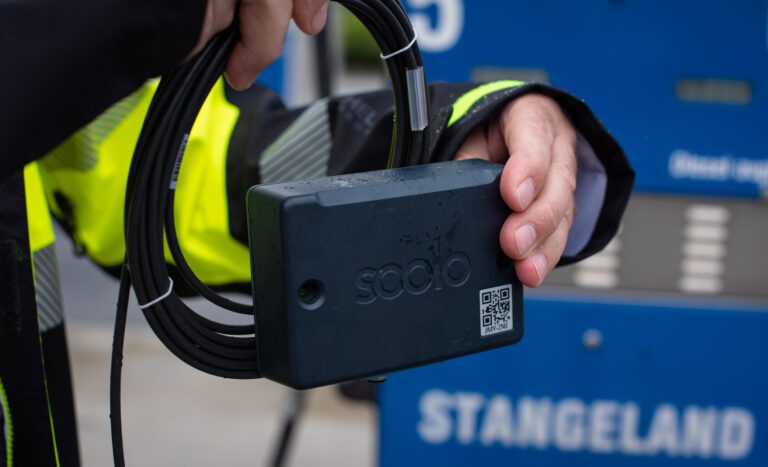
Launched in Norway and adopted by an ever-increasing number of companies, the solution is available worldwide and distributors in the UK and Ireland are already among those experiencing its transformative benefits.
Backed by IoT connectivity from Com4, the solution is cutting transport costs in half, eliminating emergency callouts, and enabling a new generation of service models built around guaranteed fuel availability. For an industry that has long operated on instinct and fixed routes, it is a fundamental shift in how distribution works.
An industry built on uncertainty
Ask any fuel distributor about their biggest operational headache, and the answer is often the same: not knowing. Not knowing how much diesel is left in a tank at a remote construction site. Not knowing whether a delivery truck is heading to a tank that is still half full. Not knowing, until it is too late, that a critical facility has run dry.
The traditional model of fuel distribution has always carried this uncertainty at its core. Tanks were filled on fixed schedules or based on estimated consumption patterns. Drivers would arrive at sites with no real knowledge of what they would find. In many cases, they were making partially unnecessary trips, filling tanks that did not need filling, while others ran dangerously low.
The numbers tell a stark story. In a typical operation without real-time monitoring, tank truck utilisation can be as low as 50 percent. That means half of every kilometre driven, half of every hour worked, and half of every litre of fuel burned in logistics is wasted. For a sector already under pressure from rising costs and sustainability expectations, that is simply not sustainable.
The cost of getting it wrong
The consequences of poor visibility run in both directions. Over-servicing wastes resources and inflates costs. Under-servicing risks something far more damaging: operational downtime.
When a fuel tank runs empty at a construction site, work stops. When a generator fails because no one noticed the diesel running low, penalties follow. When a heating system cuts out mid-winter because a monitoring gap was missed, the human and financial cost can be severe. A tank running dry can result in penalties and lost production, incurring significant financial costs.
These are not hypothetical risks. They are the everyday reality for fuel distributors operating without real-time data.
How Soolo solves it
Soolo has developed a sensor and software platform built from the ground up for this challenge. At its core is a battery-powered sensor that uses hydrostatic pressure to measure liquid levels with high precision. A probe sits at the bottom of the tank, registering the pressure from the liquid above and converting that reading into an accurate volume figure, calibrated to the specific shape and contents of each tank.
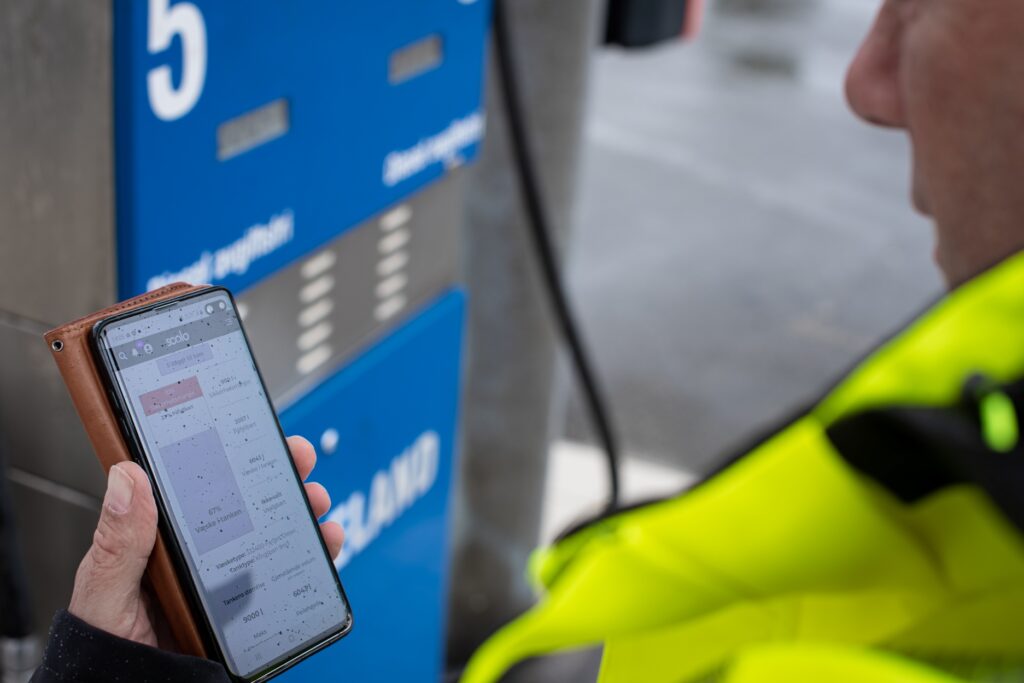
That data is transmitted via mobile networks to the cloud, where it becomes immediately accessible to customers through dashboards, automated alerts, and direct integrations with logistics and ERP systems. The result is a complete, real-time picture of every tank in a customer’s network, regardless of location, size, or contents.
“The product is not just the sensor,” explains Rein Anders Apeland, System Architect and Co-founder at Soolo. “It’s the information the customer receives.”
The platform is used primarily in fuel distribution, but its applications extend to industrial tanks, wastewater systems, and emergency preparedness. Any setting in which knowing the level of a liquid in a tank has operational significance, Soolo delivers the answer in real time.
From reactive to predictive
The shift Soolo enables is not simply replacing manual measurements with digital ones. It is a fundamental change in how fuel distributors plan and operate.
With real-time tank data, route planning moves from fixed schedules to demand-driven logistics. Drivers go where they are actually needed, not where they were scheduled to go. Deliveries are timed to when tanks genuinely require filling. Fleet capacity is used efficiently, with utilisation rates rising sharply from the industry baseline.
Beyond logistics, the data enables something even more valuable: prediction. By tracking consumption patterns over time, the platform can project when a tank will next require filling, allowing distributors to plan ahead rather than react to emergencies. For distributors, it means the ability to offer a new class of service built around assured availability rather than scheduled visits.
“When customers know exactly what they have, they can plan better,” says Hatlestad at Soolo. “That has a direct impact on the bottom line.”
Real customers, real results
The impact of Soolo’s platform is not theoretical. Across Norway, a growing number of organisations have already made the transition, and the results are consistent.
Knapphus Energi, a fuel distributor supplying petrol stations and other customers, has installed Soolo sensors on multiple tanks in its network. The results have been a direct reduction in unnecessary callouts, less time spent on manual measurements, fewer kilometres driven by tank trucks, and a significantly improved ability to plan deliveries based on actual demand. Operations manager Konrad Ree summed it up simply: “No one comes close to you on service and support.”
UCO, a machinery rental company managing several large fuel tanks across its sites, previously relied entirely on manual measurement and guesswork to decide when tanks needed filling. Since deploying Soolo, tank status is updated daily on a digital platform, removing the burden of manual checks entirely. “Previously there was a lot of chaos keeping track of different tanks,” says Rune Eriksen, Department Manager at UCO Kjeller. “Now I don’t even think about them. Soolo just works.”
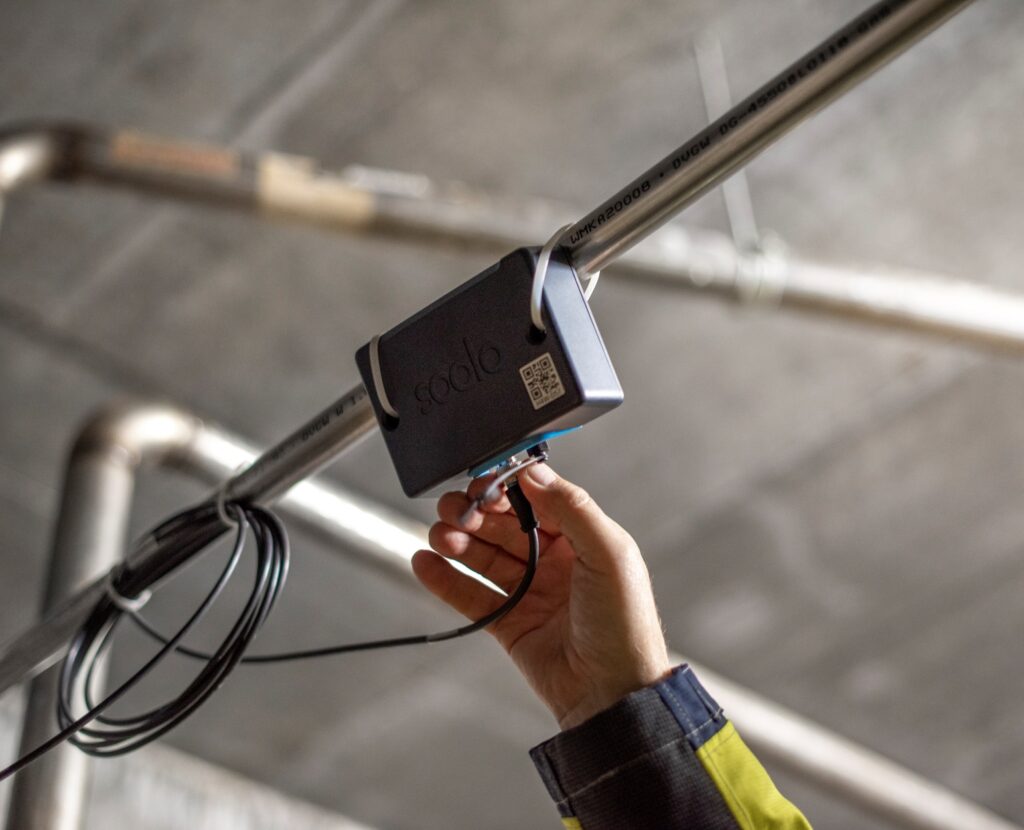
Bane NOR, the Norwegian state railway operator, offers a compelling example of how the platform extends beyond fuel into broader industrial applications. The organisation uses Soolo sensors across its workshop facilities on the Bergen and Sørlandet railway lines to monitor tanks containing acids, alkaline cleaning agents, flange grease, gear oil, and various lubricants. Before Soolo, staff had to travel to each location to check levels manually. Now, the app alerts them when supplies are running low, and suppliers are automatically notified to send replenishments. As operations manager Morten Sæløen Danielsen Holvik explains, the system ensures that trains do not stop simply because a washing machine ran out of detergent. “We have more overview and control, and we save time, reduce emissions, avoid downtime, and cut costs,” he says.
The Bane NOR case is particularly telling. The organisation’s confidence in the system grew to the point where daily app checks gave way to simply trusting that it would work. “Now I don’t feel the same need to check the app anymore, because it has worked so well and is very stable,” says Holvik.
The role of Com4: Connectivity that cannot fail
A platform built on real-time data is only as good as its ability to deliver that data reliably. This is where Com4 plays a critical role.
Soolo’s sensors are not installed in convenient, well-connected locations. They sit at the bottom of manholes, inside sealed containers, in remote rural areas, and in industrial environments where signal penetration is poor. The data volumes involved are small, roughly 100 kilobytes per device per month, but the requirement for reliability is absolute. A sensor that fails to report, even occasionally, undermines the confidence the entire system depends on.
Com4 supplies the SIM cards and managed IoT connectivity that make reliable transmission possible in these exact conditions. Using LTE-M and NB-IoT technologies, specifically designed to penetrate difficult environments and maintain connections where standard mobile networks struggle, Com4 ensures that every data point from every sensor reaches the cloud without fail.
As Com4 explains in its guidance on NB-IoT connectivity, the technology is built for stationary devices that need to operate for years without maintenance, often placed in basements, underground utility rooms, or deep inside industrial complexes. For a sensor sitting at the bottom of a fuel tank in a rural field, that capability is not a nice-to-have. It is essential.
“We transmit very little data, but it must be 100% reliable,” says Apeland. “Our sensors can be buried underground or placed inside containers, so robust coverage is absolutely essential.”
The partnership has delivered stable communication across challenging environments, multi-IMSI solutions for improved coverage across different network operators, and the kind of technical support that keeps performance consistent across markets. Battery life of five to ten years per sensor means that once installed, the hardware largely takes care of itself.
“Com4 was the first provider that was both honest about limitations and able to answer our technical questions,” says Apeland.
Part of a wider sector shift
The Soolo and Com4 partnership reflects a broader transformation taking place across the energy and utilities sector. As Com4 describes in its analysis of IoT in energy, distributors and utilities are moving away from periodic reporting and manual intervention toward real-time intelligence across distributed assets. This shift is fundamental to operational resilience and long-term efficiency.
Fuel distribution sits at the heart of that shift. The sector has the assets, the infrastructure, and the customer relationships. What it has often lacked is the data layer to bring it all together. That is precisely the gap that Soolo, underpinned by connectivity from Com4, is closing.
A quiet revolution
The transformation happening in fuel distribution does not announce itself loudly. It is driven by small sensors sending small amounts of data through mobile networks to cloud platforms that turn raw readings into operational intelligence. The technology is invisible. The impact is not.
For distributors willing to make the transition, it means lower costs, fewer emergencies, and the ability to offer customers something the industry has never been able to guarantee before: the certainty that the tank will never run dry.
In an industry where the worst outcome is a customer who runs out of fuel, that certainty is worth more than any fixed route or manual measurement ever could be.
For more information about Soolo’s tank monitoring platform and customer references, visit soolo.no. For IoT connectivity solutions tailored to the energy sector, visit com4.net.
Images provided by Soolo