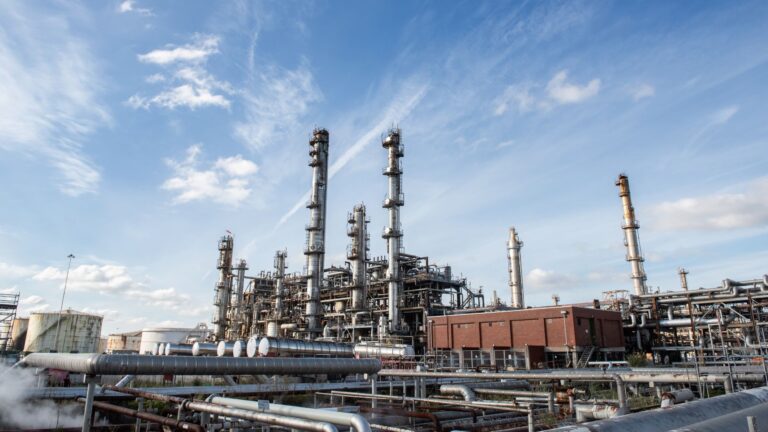
In a significant milestone for the North West industrial cluster, Essar Energy Transition has completed the Pre-Front End Engineering Design (Pre-FEED) stage for its planned Stanlow Methanol-to-Jet (MtJ) SAF facility, positioning the project as one of the UK’s largest advanced SAF developments.
Integrated within the Stanlow refinery complex, the proposed facility is designed to produce more than 200,000 tonnes of SAF annually using renewable e-methanol and bio-methanol feedstocks. Crucially for the downstream fuels sector, the project is built around existing refinery, blending, storage and distribution infrastructure.
That integration is a defining feature of the project’s proposition.
Realising the value of existing infrastructure
By co-locating SAF production within the Stanlow manufacturing complex, the facility would be able to utilise established blending capability and existing logistics infrastructure, including access to the Manchester Jet, Midlands and UKOP pipeline systems alongside road and marine distribution routes.
For the wider liquid fuels sector, the announcement reinforces how existing refining and terminal infrastructure could continue to play a strategic role as fuel markets evolve.
The Pre-FEED study, supported through the Department for Transport’s Advanced Fuel Fund, assessed site suitability, technology readiness, refinery integration, carbon intensity and environmental compliance. According to EET, the work confirmed there are “no material barriers” to permitting and identified significant opportunities to lower both project costs and carbon intensity through integration with existing infrastructure.
Importantly, the project is also designed around future SAF mandate compliance requirements. EET said the facility would support both its own anticipated obligations under the UK SAF Mandate while also supplying the wider UK aviation market.
The company is now preparing to move into the FEED stage later this year, with Final Investment Decision targeted for early 2028.
Ruth Herbert, Managing Director and Chief Business Development Officer at EET, described the project as a “fully integrated, delivery-ready solution built for scale”.
“By embedding advanced SAF production directly within a large-scale refinery system, with existing blending, logistics and offtake in place, we have fundamentally reduced risk, cost and complexity,” she said.
Broader progress
The Stanlow announcement comes amid broader signs that SAF projects are beginning to progress beyond early-stage concepts and into increasingly defined technology, feedstock and infrastructure partnerships.
In a separate development this week, Bristol-based SAF developer Firefly announced a partnership with Turkish engineering company Altaca to provide hydrothermal liquefaction technology for its planned UK facility.
Firefly’s proposed process uses treated sewage sludge as a feedstock to produce SAF – an approach the company describes as “wet-to-jet”. Under the agreement, Altaca will supply the upstream processing technology required to convert biosolids into crude oil ahead of downstream refining.
The company said securing the technology partnership completes the final major link in its intended SAF supply chain, enabling the project to move towards commercial scale deployment.
Firefly plans to source feedstock from UK water companies, while downstream refining technology will be provided by Chevron Lummus Global. Airline Wizz Air has already signed a 15-year offtake agreement for the fuel.

The agreement was formally signed at the British Embassy in Ankara during a ceremony attended by representatives from both UK and Turkish government and industry.
Diverse pathways
James Hygate OBE, CEO of Firefly, said the partnership gives the company “an end-to-end platform and a new category of waste-to-fuels infrastructure”.
Collectively, the two announcements highlight the increasingly diverse pathways emerging across the SAF sector.
While projects such as Stanlow focus on refinery integration, logistics capability and large-scale mandate delivery, companies like Firefly are targeting alternative feedstocks and new conversion technologies designed to expand the future supply pool for low-carbon liquid fuels.
The progress also reflects the growing influence of the UK SAF Mandate in shaping long-term investment decisions across the sector. As mandated SAF blending obligations increase over the coming years, developers, refiners and airlines are under mounting pressure to secure credible future supply pathways and demonstrate deliverable production capacity.
However, while policy direction is becoming clearer, many in the sector continue to view the proposed SAF Revenue Certainty Mechanism (RCM) as critical to accelerating final investment decisions and unlocking wider project financing. For developers pursuing capital-intensive SAF facilities, greater clarity around long-term revenue support mechanisms is widely seen as an important next step in moving projects from development into construction and commercial operation.
For the downstream fuels industry, the developments also underline a broader shift taking place across the energy transition landscape: increasingly, the conversation is moving away from theoretical SAF potential and towards practical questions around infrastructure, feedstock security, scalability and commercial delivery.