But with Ireland reporting surging retrofit demand, Scotland already offering stronger support pathways, and analysts warning the UK remains hampered by high electricity costs, this latest move may represent more policy catch-up than meaningful change.
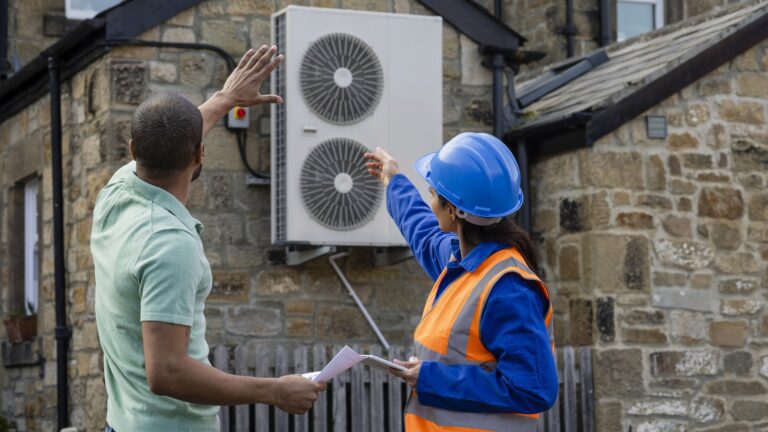
In a move to strengthen support for heat pump adoption, ministers have increased Boiler Upgrade Scheme grants for eligible off-grid homes to £9,000.
The measure forms part of a wider package aimed at protecting households from volatile global fossil fuel markets while accelerating the shift toward lower-carbon heating. It follows recent price increases linked to international commodity shocks.
The message is clear: electrification remains the preferred long-term route for homes currently reliant on delivered fuels.
But for many off-grid homes, the key question is whether a larger grant is enough to overcome the real-world barriers to switching.
Catching up
While England and Wales have chosen to increase heat pump support, both Ireland and Scotland have already been moving through broader retrofit strategies.
In Ireland, ministers last month reported that overall home energy upgrade applications are up 96% so far in 2026, with applications for individual measures up 186% compared with the first quarter of last year.
Backed by €640 million in funding, Ireland is targeting 73,000 home upgrades in 2026.
Rather than relying on one technology, the Irish model combines clear messaging on affordability with multiple upgrade pathways, allowing households to improve homes step-by-step depending on budget and property suitability.
For many rural older homes, that flexibility may feel more practical than an immediate full system switch.
Scotland already further ahead
Scotland has also operated a more interventionist support model for several years, with available funding including stronger support for many rural and off-gas properties.
Against that backdrop, the latest UK announcement is significant – but far from pioneering.
The affordability challenge remains
There is another obstacle that subsidy may not solve: the comparative cost of electricity.
New analysis from LCP Delta’s Household Electrification Index recently ranked the UK last among eight major European markets for overall household electrification progress, and bottom specifically for heat pumps.
A key reason cited was the UK’s spark spread of 4.6 – the highest in the study – meaning electricity remains significantly more expensive relative to gas than in competing markets.
In a simultaneous announcement the government has pledged to weaken the historic link between gas and electricity pricing.
This implicitly acknowledges a longstanding weakness in heat policy: persuading households to switch to electric heating is far harder when electricity remains comparatively expensive. Even official BUS guidance has previously acknowledged that, in some properties, the higher cost of electricity relative to gas can mean a heat pump initially leads to higher running costs.
If ministers are serious about mass electrification, reducing the running-cost disadvantage may prove just as important as increasing upfront grants.
Today’s announcement recognises that off-grid properties often face a tougher challenge than urban gas-connected homes. It also underlines how firmly the government remains committed to an electrification-first pathway.
The grant increase is not a broadening of the technology debate. It is an attempt to make the same preferred route more financially acceptable.
Is £9,000 enough?
For some oil-heated households, the answer may be yes.
The larger grant could bring forward decisions already under consideration, particularly where homes are well-insulated and owners have the means to cover installation costs.
But many off-grid homes present more complex economics. Older housing stock may still require insulation upgrades, radiator changes, hot water cylinder replacement or electrical works before a heat pump performs effectively.
That means the challenge is often not the grant itself, but total cost and complexity.
This is where Ireland’s recent experience may offer lessons. Homeowners appear to respond strongly when governments frame support around warmer homes, lower bills and multiple practical pathways – not solely around one mandated technology.
What it means for distributors
For the liquid fuel sector, the grant uplift is unlikely to create any sudden demand impact.
Heating system replacement cycles remain slow, many households will delay major decisions, and a significant share of off-grid homes are likely to continue relying on oil for years to come. However, the reinforced policy direction is clear.
Across the UK and Ireland, governments are increasingly using subsidy frameworks to reduce reliance on delivered fuels – through electrification, efficiency measures, or both.
The bigger long-term industry impact may therefore be less about how many install heat pumps, and more about a gradual reduction in domestic fuel demand as homes become better insulated and less energy intensive.
Conclusion
The UK’s £9,000 grant increase is a meaningful policy signal. But viewed alongside Ireland’s retrofit demand surge, Scotland’s longer-established support and Europe’s more competitive electricity pricing, it also highlights how much further Westminster has to go.
The debate is no longer whether governments will subsidise the move away from delivered fossil heating fuels. It is which policies households trust, can afford and are willing to act on quickly enough to change the market.
At a glance: Why UK uptake still lags
• High electricity-to-gas price gap
• Upfront installation costs
• Rural property complexity
• Limited consumer confidence
• Policy uncertainty
Image credit: iStock