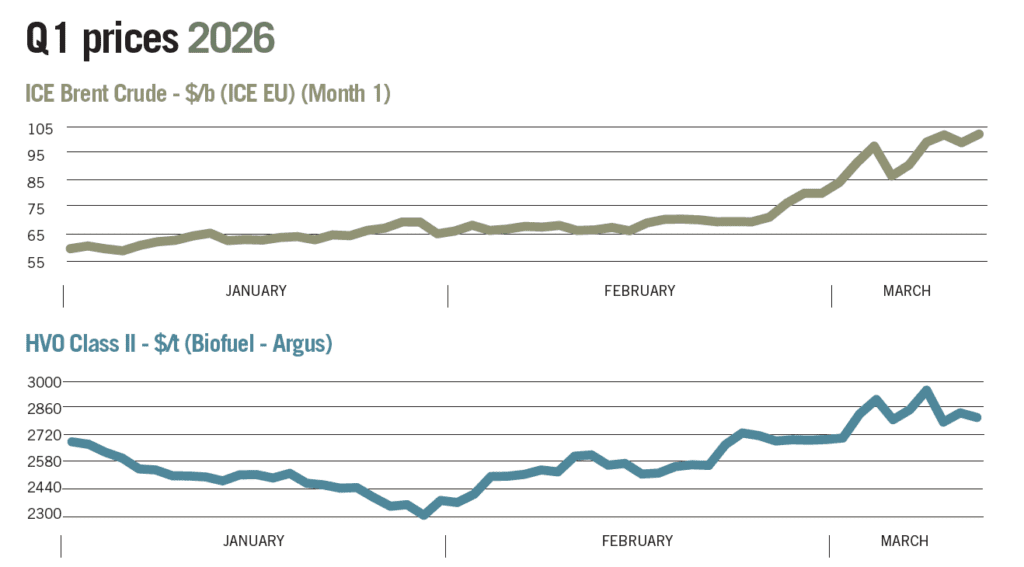
A quarterly review of the movements of, and impacts on, Brent crude and HVO diesel prices. With insight and data supplied by The Oil Market Journal, we highlight some of the key events that have impacted pricing over the quarter.
World on the brink: U.S. strikes, Iran conflict and oil shock rock global order
From Venezuela to the Gulf, US and Israeli attack on Iran sends energy markets spiralling and raises fears of a prolonged war
The world is facing its most dangerous geopolitical crisis in years, after the Israeli and U.S. military action in Iran, escalating tensions in the region, and retaliatory strikes on key energy infrastructure sent shockwaves through global markets and diplomacy.
In just over two months, events stretching from Latin America to the Middle East have redrawn the geopolitical landscape, raising fears of prolonged conflict and a severe global energy shock.
From Caracas to confrontation
The upheaval began on January 3, when U.S. forces launched a surprise mission into Venezuela, disabling its air defences and capturing the country’s president and his wife in a dramatic escalation of American intervention abroad.
Just days later, on January 7, tensions with Russia intensified after the United States seized a Russian-flagged oil tanker in the North Atlantic between Iceland and the United Kingdom.
Washington quickly moved to reshape Venezuela’s oil sector. By January 9, President Donald Trump had convened major oil executives to draft plans for reviving the nations vast but troubled oil industry.
Iran unrest and a warning
Attention soon shifted to Iran, where anti-government protests turned deadly. By January 13, an estimated 2,000 demonstrators had been killed.
In a move that further inflamed tensions, President Trump publicly backed the protesters, declaring that “help is on the way” – a statement widely interpreted as a warning to Tehran.
Greenland gambit and military build-up
At the World Economic Forum in Davos on January 21, Mr Trump announced that the United States was seeking ownership of Greenland for “world protection,” though he insisted force would not be used. He later claimed a “framework” agreement had been reached with NATO.
The following day, the U.S. significantly expanded its military presence in the Middle East, deploying the USS Abraham Lincoln carrier strike group – a move seen as preparation for possible confrontation with Iran.
Markets rattle, courts intervene
Financial markets began reacting sharply in February. On February 2, gold and silver prices fell steeply, dragging oil lower after Kevin Warsh – a critic of quantitative easing – was nominated as Federal Reserve chair.
In Britain, the Bank of England held interest rates steady on February 5 but warned of rising unemployment and downgraded its inflation outlook, fuelling expectations of a looming rate cut.
Political turbulence deepened in Washington when the U.S. Supreme Court struck down Mr Trump’s tariff measures on February 20, complicating the administration’s economic strategy.
Diplomacy collapses into war
A brief diplomatic opening emerged on February 26, when U.S. and Iranian officials met in Geneva.
But hopes of de-escalation quickly evaporated.
On February 28, U.S. and Israeli forces launched coordinated strikes on Iran, marking a dramatic turning point and triggering fears of a wider regional war.
Energy shock and retaliation
Iran responded swiftly.
On March 2, it launched an attack on Saudi Arabia’s largest oil refinery at Ras Tanura, while attacks on Qatar’s Ras Laffan complex forced QatarEnergy to declare force majeure, disrupting twenty percent of global gas supplies.
The impact was immediate. Energy markets surged amid fears of prolonged disruption across key oil and LNG infrastructure with the extremely important Straits of Hormuz closed, According to Platts 20-21 million barrels per day of crude oil and refined products is shut in. Some 1,000 tankers are now waiting to transit the Straits. Europe has lost 37% of European jet kero import supply and Africa has lost 47% of jet kero import supply.
By March 3, the International Energy Agency had convened emergency talks in Paris, as governments scrambled to stabilise markets.
That same day, President Trump met with senior energy officials to assess the rapidly deteriorating situation. However, the decision to release 400 million barrels of oil did little to cool the market and prices continued to rise.
$150 Oil warning
With supply chains under strain, warnings of a price shock are growing louder.
On March 6, Qatar’s energy minister cautioned that crude oil prices could spike to $150 per barrel, a level that would likely trigger inflationary pressures worldwide and threaten economic stability.
A world at a crossroads
What began as a successful, targeted intervention in Venezuela, encouraged President Trump to embark on a rushed campaign in Iran and has spiralled into a multi-front crisis involving major powers and critical energy infrastructure.
With diplomacy faltering and military activity intensifying, analysts warn that the coming weeks will be decisive.
The risk now, they say, is not just regional instability – but a war that could reshape the global order.
Q1 2026 Key dates
January
3rd January: US military launch special mission into Venezuela, disabling the Venezuelan air defences and take the Venezuela President and his wife captive.
7th January: US seizes a Russian flagged tanker in the North Atlantic between Iceland and the UK.
9th January: President Trump holds talks with the leaders of oil companies to formulate to general plan on how to revive the Venezuelan oil industry.
13th January: President Trump tells Iranian anti-government protesters that “help is on the way” after 2,000 protesters were killed.
21st January: President Trump tells the World Economic Forum in Davos, Switzerland that the US wants ownership of Greenland for world protection but will not use force to take it. Later he said that he had reached a “Framework” agreement with the NATO on Greenland.
22st January: US military continues to build up assets in the Middle East including the deployment of the USS Abraham Lincoln Carrier Strike Group.
February
2nd February: Gold and silver prices fall sharply, dragging oil lower following the nomination of Kevin Warsh as the FED chairman. Mr Warsh is an experienced FED official and opposed to QE. (Massive QE during the COVID crisis caused a large rise in inflation and an asset price bubble.)
5th February: Bank of England leave interest rates unchanged but lower inflation outlook and highlight rising unemployment, raising expectations of a March rate cut.
20th February: US Supreme Court rules against Trump’s tariffs.
26th February: US and Iran hold talks in Geneva.
28th February: US and Israel attack Iran.
March
2nd March: Iran attacks Saudi’s largest refinery at Ras Tanura.
QatarEnergy declares force majeure on gas exports from an attack on the Ras Laffan complex.
3rd March: IEA meet in Paris to discuss taking action to stabilise energy markets.
President Trump to meet US Energy Secretary tonight to discuss global energy markets as a result of the military campaign against Iran.
6th March: Qatar Energy Minister warns crude prices could spike to $150/b.
All data and analysis provided by The Oil Market Journal. To find out more and request a free trial: +44 (0) 28 6632 9999 info@the-omj.com www.the-omj.com
Image credit: iStock, Oil Market Journal