
Fixed-price fuel offerings, which allow customers to lock in a set rate for a defined period or volume, promise certainty for customers and stronger retention for distributors. But they also introduce exposure that, if not carefully managed, can quickly erode margins.
So, should FODs be offering fixed price contracts – and if so, how can they do it safely?
This article explores this question – outlining the key benefits and considerations for both distributors and customers before offering practical recommendations.
Section 1: Wholesale Pricing – Volatile Markets
Wholesale prices are based on published settlement prices (the price at which the market closed on a specific day) that reflect product trading in Northwest Europe. As demonstrated all too well by recent global events, prices can fluctuate sharply due to factors beyond the control of either the customer or the distributor.
Influencing factors include geopolitical events, shifting supply and demand dynamics, and even the performance of the Great British Pound (GBP); as oil and refined products are traded in USD, the stronger GBP performs against USD, the lower the price for the UK buyer.
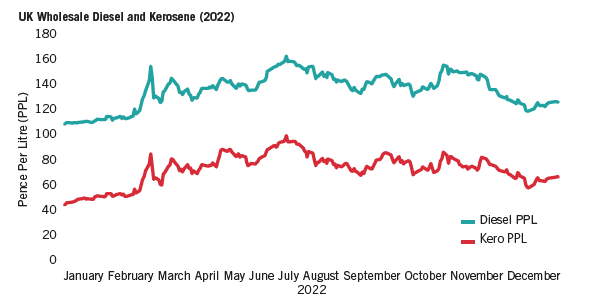
Key examples of significant volatility in recent years include the COVID-19 pandemic, which caused an unprecedented demand shock and led to a collapse in oil prices. In contrast, Russia’s full-scale invasion of Ukraine caused prices to surge in March 2022.
The following chart shows the volatility of UK wholesale diesel and kerosene prices in 2022, as a result of the Russia-Ukraine war.
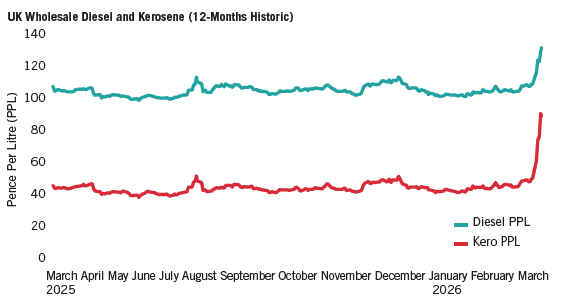
More recently, prices surged after US-Israel strikes on Iran on the 28th of February 2026, marking the start of the Iran war. Conflict in the Middle East has severely disrupted global energy markets, with Iran effectively closing the Strait of Hormuz, a vital chokepoint for approximately 20% of the world’s oil exports, by targeting vessels attempting to transit the waterway.
The chart below shows UK wholesale diesel and kerosene prices over the last 12 months, highlighting recent volatility.
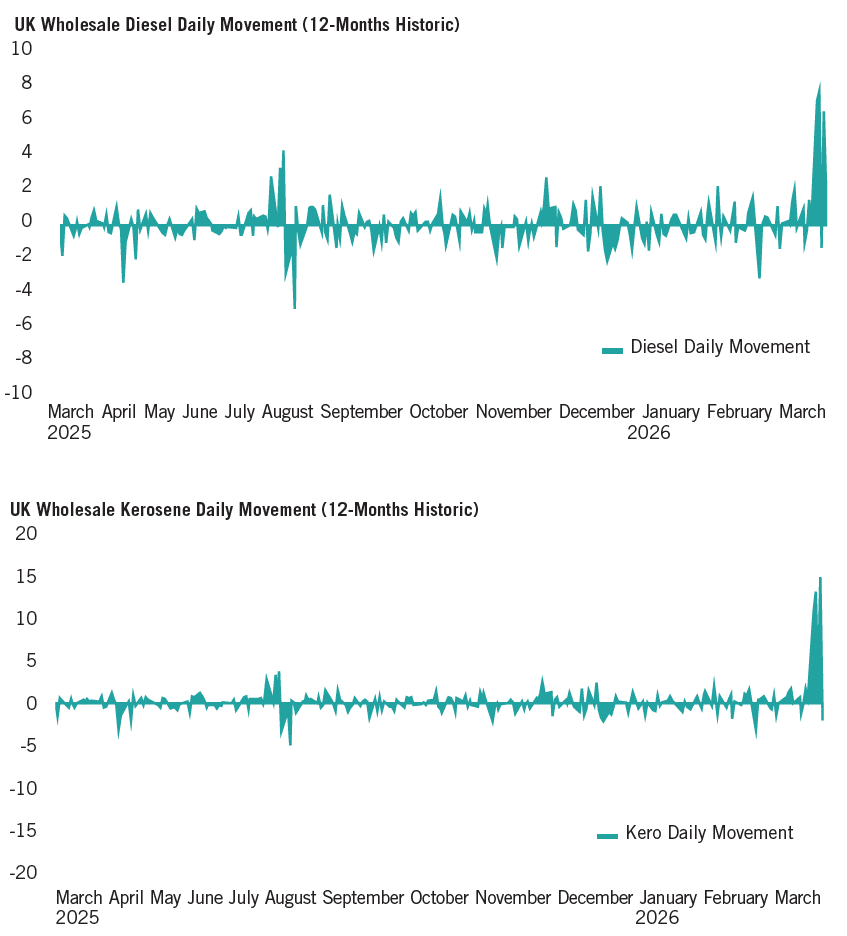
During periods of peak volatility, intraday prices (which fluctuate minute-by-minute) can change dramatically, causing published settlement prices (the official closing price for the day) to also vary significantly day-to-day.
In the last 12 months, the largest daily variance for wholesale diesel was ~8ppl and ~15ppl for wholesale kerosene at the beginning of March, as a result of the Iran war.
During the first week of the war, UK wholesale diesel rose roughly 22ppl and kerosene by 38ppl, demonstrating how rapidly prices can surge in response to geopolitical events, even over a short period. (charts below)
Section 2: Fixed Price Offerings
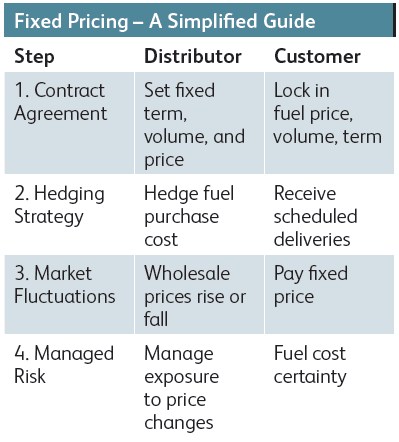
FODs may offer fixed price contracts, allowing customers to lock in the cost of fuel for a predetermined period and volume. A wholly fixed or ‘hedged’ price, whereby the total ppl cost is agreed for the contract duration, differs from contracted supply priced at a fixed premium above a published wholesale benchmark, commonly known as index-linked pricing.
In a fixed price offering, customers typically nominate the expected volume (either annually or monthly) and contract period upfront. Agreements commonly range from three to eighteen months, although some providers offer terms of up to twenty-four months.
Once agreed, the price remains fixed for the duration of the contract regardless of movements in global oil and wholesale markets, no matter how volatile, giving businesses greater certainty over their fuel costs and budgets.
Fixed price contracts can take several forms depending on the supplier and the customer’s purchasing strategy:
- Short-term or long-term fix: Contracts may cover a few months to manage short-term price risk or extend across a full year or longer to provide longer-term cost certainty.
- Partial fix: Customers may fix the price on only a portion of their expected usage, purchasing the remaining volume on an index-linked or spot basis. This approach allows them to balance price certainty with market flexibility.
- Seasonal fix: A price is locked in for a specific period, such as the winter heating season, helping customers manage peak demand and budget exposure.
In practice, the choice of structure is less about product design and more about risk appetite – both for the distributor and the customer. The more volume and duration that is fixed, the greater the exposure if wholesale markets move sharply in the opposite direction.
Exposure management
To offer a fixed price option, FODs need to manage their exposure to market volatility, ensuring they are protected if wholesale fuel prices rise above the agreed customer rate.
FODs can do this by using one of the following strategies:
- Transactional/paper hedge: Entering a financial agreement with a counterparty to lock in the price for the volume expected to be supplied under fixed price contracts.
- Existing rack agreements: Continuing to lift fuel from existing supplier agreements, holding stock and setting customer pricing accordingly.
- Fixed price agreements for lifting at the rack: Entering a new agreement for lifting at a fixed rate and setting the customer’s fixed price higher.
In reality, access to these options varies significantly. Larger distributors may have established hedging relationships or supplier-backed agreements, while smaller FODs may rely more heavily on supplier pricing structures or limit fixed-price offerings to manageable volumes.
Section 3: Benefits and considerations for customers
Recent market volatility has again highlighted how unpredictable wholesale fuel prices can be, with dramatic and rapid swings. The key benefit of fixed pricing to customers is the provision of budgetary certainty, safeguarding against changes in fuel pricing and significantly reducing their exposure to the market.
Without such controls in place, volatility in the oil market means that budgets are impossible to plan and the profitability of any business can be jeopardised.
While wholesale prices can rise, they can also fall below the fixed rate, and customers remain obligated to pay the agreed-upon price. However, a fixed price mechanism should not be used to try to ‘beat the market’ e.g. fixing with the expectation that the daily market will rise. Fixed pricing should only be used in circumstances where locking in the cost can be beneficial for the customer.
For example, a farm might choose a short-term fix which covers the harvest period, enabling it to plan fuel costs in advance and forecast revenue more accurately. Similarly, a residential customer may seek budgetary certainty to guard against potential spikes in heating oil prices during peak winter months, helping to manage household heating expenses.
Another advantage for customers is security of supply: those on fixed price contracts often receive priority during supply shortages (refinery outage, supply chain disruption, etc.).
In 2025, two major refinery closures, Petroineos’ Grangemouth refinery (April) and Prax Lindsey Oil Refinery (August) reduced the number of operational UK refineries to just four, down from nine fifteen years ago. These closures have cut domestic fuel production by around 25%, increasing reliance on imports and heightening supply chain vulnerability.
While suppliers aim to prioritise contracted customers, exceptional circumstances may still impact supply. For example, a “Force Majeure” event may delay, hinder, or prevent a supplier from fulfilling its obligations.
Such events typically include any unforeseeable events beyond a party’s control, including natural disasters, war, terrorism, strikes, epidemics, or government actions, and are usually addressed through a dedicated Force Majeure clause in the contract.
In less severe cases, supply constraints may lead to temporary reduced or partial allocations, affecting a supplier’s ability to deliver the contracted volumes. Amid the ongoing Iran war, disruptions to key shipping routes (Strait of Hormuz) and persistent attacks on energy infrastructure have tightened supply, meaning customers may experience temporary shortfalls.
Understand obligations
Customers must also consider certain legal and operational factors before entering into a fixed price agreement. One key consideration is volume forecasting, as contracts usually require the customer to commit to purchasing a defined volume of fuel over a set period. If actual consumption is lower than expected, for example due to milder weather, reduced operations, or efficiency improvements, the customer may still be liable for the committed volume.
Many agreements include a “take-or-pay” clause, meaning the customer must pay for the contracted fuel even if it is not taken. This protects the supplier, who may have already secured the fuel or hedged the price in advance. Customers should therefore review the contract terms carefully, particularly those relating to volume commitments and flexibility. They should also be aware of early termination clauses, as exiting a fixed price contract before the agreed end date may trigger break or termination fees.
“FIXED PRICING SHOULD BE ABOUT CERTAINTY – NOT A BET ON WHERE THE MARKET IS HEADING.”
Section 4: Benefits and considerations for FODs
Offering a fixed price option can deliver commercial advantages for FODs. In a competitive market, it gives customers an alternative to index-linked contracts or spot-price deliveries that fluctuate with wholesale prices. By providing price certainty, distributors can differentiate themselves from competitors and appeal to customers who value predictable fuel costs and prioritise budgetary certainty.
This offering may also be digitalised, with a streamlined sign-up process, online ordering platform, and automated pricing tools, making it easier for customers to access fixed-price contracts while enhancing operational efficiency for the distributor.
Fixed pricing can also support stronger customer relationships, loyalty, and retention, as customers are ‘locked-in’ for the duration of the contract. This can provide a more stable customer base and greater visibility over future demand. Contracted volumes may also help improve revenue and cash flow forecasting, which is particularly valuable for smaller businesses that need to manage working capital and stock purchasing carefully.
However, if a customer encounters financial difficulty and cannot accept deliveries and make payments, FODs may face delayed or irrecoverable revenue. Smaller distributors with limited cash reserves are particularly vulnerable, making thorough credit assessments and appropriate financial safeguards essential before offering fixed price agreements.
Smaller distributors may also have more limited access to financial instruments or counterparties to hedge effectively. However, FODs must carefully manage their exposure to market volatility in order to offer fixed prices to customers, protecting themselves against any rise in fuel prices, which as current market conditions show, can be substantial.
Also, if fixed prices are set too aggressively in a competitive market, distributors risk locking in contracts at levels that become unprofitable if wholesale prices rise. In volatile conditions, even small miscalculations in margin can quickly scale across contracted volumes.
Finally, if a FOD’s customer base is predominantly made up of residential consumers ordering in smaller quantities and at irregular intervals, FODs may be required to aggregate multiple customer commitments into a single larger volume before executing a hedge, enabling the distributor to reach minimum required trade sizes.
Summary and recommendations
Fixed price fuel contracts can offer advantages for both customers and distributors. Customers gain budget certainty and protection against sudden price spikes, while distributors can strengthen customer retention, stabilise demand forecasts, and improve cash-flow planning.
To mitigate risk, FODs should take a conservative, phased approach: begin by offering fixed price contracts to a small test group of reliable customers. Use simple spreadsheet modelling to calculate break-even margins against supplier costs and build in contingency buffers for potential price swings. For example, a 10,000-litre contract at 80ppl could be stress-tested against wholesale fluctuations of 5ppl to gauge financial exposure.
Finally, providing a hybrid mix of fixed price, fixed premium, and spot pricing allows FODs to offer flexibility, meet diverse customer needs, and strengthen commercial relationships, while carefully managing risk and safeguarding margins.
Conclusion
For most FODs, fixed pricing is not a default offering – but a strategic tool. Used selectively, it can strengthen customer relationships and improve visibility. Used carelessly, it can expose the business to risks that are difficult to recover from.
Image credit: Dreamstime