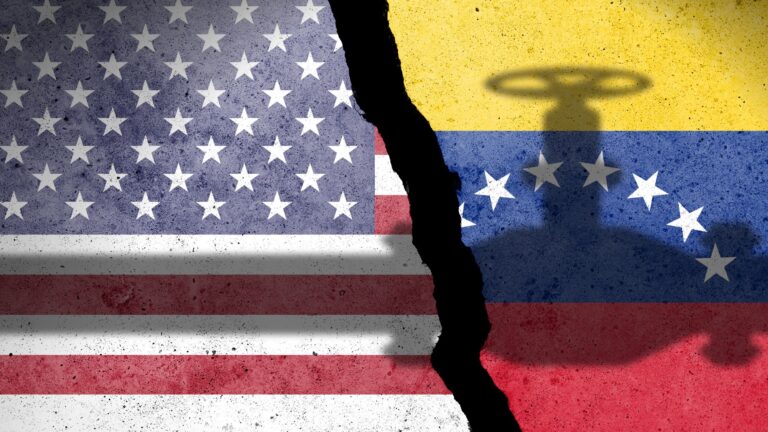
The assets of private US oil companies had been forcibly taken over by the corrupt state oil company PDVSA and production had plummeted. In the 1970s Venezuela had been an oil behemoth, producing almost 4m barrels per day (bpd), but by the time that the dictator Hugo Chavez had died (2013), that figure had halved.
“The decision to get rid of Maduro was as much about getting access to Venezuelan oil as it was about narcotics”
Fast forward to 2026, and Venezuela is in the news again, with President Trump deciding to capture Chavez’s successor (Nicolas Maduro) and bring him to the USA to face charges of drug trafficking. Unlike previous US Presidents, who have uncomfortably denied the oil-based raison d’etre behind much of US foreign policy, Trump predictably had no qualms on this front. He was happy to point out that the decision to get rid of Maduro was as much about getting access to Venezuelan oil as it was about narcotics.
The problem here of course, is that no amount of Trump bullsh1t (things will be the biggest, greatest, richest, shiniest etc.) can mend overnight an industry that is so completely in tatters. Back in 2013, our report was decrying the fact that Venezuelan production had dropped by circa 50% in a period when global oil demand was consistently rising.
But guess what, under Maduro’s rule, things got worse. Much, much worse in fact. For the last 12 years, the country has experienced annual (and sometimes monthly!) triple digit inflation, and the local currency (Bolivar) is now worth 7% of what it was in 2014. In the 10 years up to 2024, living standards (in what was once South America’s richest country) plummeted by 74%, the fifth largest fall in modern economic history and the kind of drop that would more usually be associated with countries suffering from war or catastrophic famine.
Untold numbers of Venezuelan businesses closed down, daily power cuts became the norm, and shops often didn’t even have the most basic goods to sell. Perhaps most damaging of all, it is estimated that 7.7m Venezuelans left the country – almost 25% of the entire population.
In the midst of all this chaos stood the once mighty oil industry; still the lifeblood of the ailing economy because of its ability to bring in desperately needed foreign $ reserves (97% of export earnings come from oil). However, as the economy self-destructed, so did the oil industry and it simply became another part of Venezuela’s collapsing infrastructure.
Starved of foreign investment and technical expertise and then hit by US sanctions in 2019, oil production in Venezuela hit a low of 750k bpd in 2025. Forget being an oil behemoth. Venezuela had become barely the 5th largest producer in Latin America (Brazil, Mexico, Argentina and Guyana all produce more).
That the oil in Venezuela exists and is plentiful is not in doubt. Indeed, the country still has the largest crude reserves in the world (about 20% of proven reserves), with approximately 350 years of oil under the ground. But what is in doubt is the ability of the industry to extract and sell even a smidgeon of these vast reserves any time soon. Quite simply, the industry has been so hollowed out, that even if the rate of oil extraction can be increased, it will be years before the product can be efficiently moved (pipelines), stored (tanks) and exported (export jetties).
For their part, the US oil industry has hardly been quick to embrace the new situation in Venezuela. ExxonMobil have declared the country “uninvestable”, which is perhaps an understandable position considering their assets have been appropriated by the Venezuelan Government on two separate occasions in the last 50 years!
And the rest of the industry will no doubt be waiting until legal, contractual and tax arrangements are in place, before progressing any investment programmes. The only positive noises have come from Chevron who, for various reasons, were able to maintain operations in Venezuela throughout the Maduro years. They have committed to a 50% increase in their current production levels of 240k bpd.
“The revival of Venezuela’s oil industry, after 30 years of neglect, will be a slow and piecemeal process.”
President Trump has been quick to praise Chevron’s “smart reaction”, but an extra 120K bpd on top of the existing 750k bpd, is a far cry from the 4m bpd of yesteryear. In the same manner, Trump’s announcement that 30-50m barrels of oil would go “straight to the USA from Venezuela” (“to the benefit of both countries”) sounds impressive until you realise that this basically equates to around 2 days of US consumption.
The harsh reality is that even with the President’s proposed $100bn reconstruction fund (as ever, no details have been provided!), the revival of Venezuela’s oil industry, after 30 years of neglect, will be a slow and piecemeal process. So don’t expect the oil market to pay too much attention for a while…
Image credit: iStock