As vehicle build lead times lengthen, compliance requirements increase, and operating margins remain under pressure, FODs face more complex choices than ever around whether to buy, lease, or rent their fleets – and when to upgrade ageing assets.
This article explores the strategic considerations behind leasing versus purchasing of tankers and support vehicles, comparing cost structures, service life, maintenance requirements and upgrade cycles. With additional consideration of long-term reliability, fuel efficiency and regulatory compliance, it aims to help fuel distributors – particularly budget-constrained SMEs – make informed, resilient fleet strategy decisions.
Section 1: Sourcing and cost comparison
Leasing options
1. Contract hire – use without ownership
- Terms are typically 2-5 years
- Ownership is retained by the leasing company, with the customer paying a fixed monthly charge
- Maintenance is most often included
Best suited to support fleets and predictable mileage operations where cost certainty and outsourced maintenance are priorities.
2. Operating lease – asset use for a fixed period (usually a term shorter than the economic life of the vehicle)
- As above but with the customer taking responsibility for maintenance
- The customer may be registered as the vehicle keeper (NOT owner)
- Lower monthly payments
Often used where monthly cost minimisation is key, but places greater operational responsibility on the distributor.
3. Finance lease – customer-owned lease for the economic life of the vehicle
- Risk and rewards of ownership transfer to the customer so it is treated as owned for accounting and tax purposes
- The customer pays via a fixed-term financing contract
- The asset value is paid in full over the term of the contract with no residual value
- Monthly payments are therefore higher than an operating lease
- At the end of the lease, the asset is sold by the lessor, and the lessee receives a rebate of most of the sale proceeds (typically 95%), pre-agreed
- Other options (general UK offering) typically include: Extending the lease / restructure the agreement (This also applies to an ‘operating lease’)
Remains a common choice for fuel tankers, where operators want full control over specification, lifecycle and residual value.
4. Hire purchase (HP) / Lease purchase – a purchase plan
- Suited to customers who ultimately want to own the asset and assume all associated costs of maintenance
- A commercial vehicle finance arrangement where the value of the asset plus interest is paid in instalments over a fixed term
- Ownership passes to the customer at the end of the term
Most appropriate for long-life tanker assets where ownership and extended service life are planned.
5. Spot hire / Short‑term rental
- Short-term, suitable for seasonal peaks
- Rent for several months at a time
Increasingly used as a risk-management and contingency tool rather than a primary strategy.
6. Sale and leaseback
- Option to sell your owned tanker fleet to a leasing provider, and then lease them back
May be used to release capital from owned tankers to funding business development or investment costs.
In practice, fuel distributors rarely rely on a single funding model. Core tanker assets are typically owned or long-term financed, while contract hire and short-term rental are increasingly used to manage support fleets, seasonal peaks and unplanned downtime.
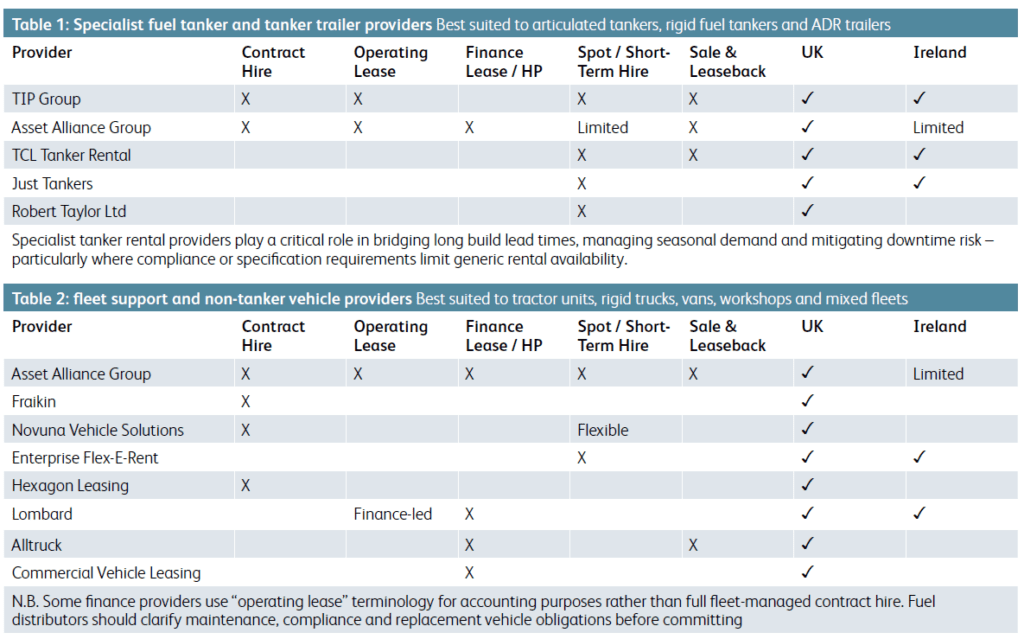
The tables on the following page outline some of the commonly used UK and Ireland providers, split between specialist tanker assets and wider fleet support vehicles.
Purchasing options – providers
There are numerous tanker suppliers in the UK and Ireland and these are not exhaustive lists.
Manufacturers include:
- Central Tanker Services
- Cobo Tanker & Services td
- Crossland Tankers
- G Magyar
- Morrow Tanker Services
- Road Tankers Armagh
- Road Tankers Northern (RTN)
- Tankquip
- Tasca Tankers
- Vallely Tankers
Used Tanker platforms and sellers include:
- Autotrader
- Commercial Motor
- Compton Tankers
- Just Tankers
- SOS Sales
While purchasing offers control and long-term value, fuel distributors should be cautious when comparing headline prices. Specification, compliance status, residual value and remaining service life can vary significantly – particularly in the used tanker market.
FODs should be wary of condition, maintenance history and specification when purchasing 2nd hand, checking:
- Vehicle history and paperwork
- Full-service history
- Compliance and certification
- Fit-for-purpose specification
Estimated cost comparison
Indicative costs vary significantly depending on specification, compliance requirements, maintenance inclusion and market conditions. Figures below should be treated as broad order-of-magnitude estimates.
Buying
For new vehicles, the price is usually quoted on application and primarily determined by size, capacity, type (e.g., rigid vs. trailer), and equipment specified)
Tankers (artic)
- New: £80k-£140k / €90-160
- Used: £10k-£30k / €12-35k (depending on age, condition and specification)
Truck
- New: £80k-£200k+/ €90-230+
- Used: £10k-£70k+ / €12-80 (depending on mileage, age, condition)
Leasing (prices not publicly available)
Tankers
- •£300–£700 / €345-800 p.m.
Truck
- Hire prices estimated at £1,400 / €1600 p.m.
- Leasing monthly costs tend to be competitive with or below hiring costs
Section 2: Lease vs Buy pros and cons
The primary consideration for the lease versus buy decision is cost, dependent on your company’s financial situation, which may change over time.
i. Leasing
Pros
Financial
- Predictable monthly cost of lease payments and maintenance costs, leading to better cash flow management and budget (crucial for SMEs)
- More accessible capital for other business requirements
- 100% of lease payments tax-deductible as operating expenses
- Faster tax relief, aligned with monthly cash outflow
- VAT spread across lease payments, improving cash flow
Maintenance
- Limits the responsibility and removes the administrative burden or unexpected expenses of maintenance and repair (however, FODs should note that not all lease agreements work in this way)
- Track and monitor repair information, performance reporting, maintenance records and scheduling with one-click online access to your fleet
Upgrades
- Disposal of old vehicles without wasting time, money or energy
- Required to return (or purchase) vehicles/tankers at the end of the terms, meaning FODs will upgrade to newer models more frequently
- Upgrade since lease terms are short (2 to 5 years); better access to the latest technology, safety features, and fuel efficiency
Leasing can also reduce operational risk by transferring residual value exposure, compliance administration and replacement vehicle responsibility to the provider.
Cons
- Restrictions or mileage/hour limits determined by the lease agreement (to manage vehicle depreciation), could result in additional charges
- Pay more over time compared to buying (interest)
- No ownership or residual value.
- Locked into a contract for a fixed duration, with exit penalties
ii. Buying
Pros
- Own the tanker/ support vehicle as valuable assets
- Fleet independence / greater control and flexibility
- Customise the vehicle, promote your company, etc.
- Fleet optimisation
- Control over when and how frequently to upgrade
- Unlimited usage
- No restrictions, ideal for high mileage
- Resale value
- Capital allowance
- Writing down allowances
- Annual Investment Allowance (AIA)
Cons
Financial
- Significant upfront cost (deposit, purchase price, financing charges)
- Ongoing costs: repairs, maintenance, insurance
- Costly routine vehicle maintenance and unexpected pricey repairs
- Depreciation of the asset
- Whilst purchasing fleet vehicles puts assets on your balance sheet, it can also impact your debt-to-equity ratio, making your company appear less attractive to lenders or investors
- Annual Investment Allowance (AIA) may allow 100% first-year relief, but limits often restrict use for large fleets
- VAT paid upfront on the full vehicle cost, then reclaimed
Maintenance
- Administrative demands: fleet maintenance management responsibilities
- Purchased vehicles tend to be on the road longer and can experience more damage or simply start showing their age
Disposal/Upgrade
- Owner must arrange for the disposal of the vehicle
- Capital tied up in owned vehicles is capital unavailable for depot upgrades, digital systems, or fleet decarbonisation initiatives.
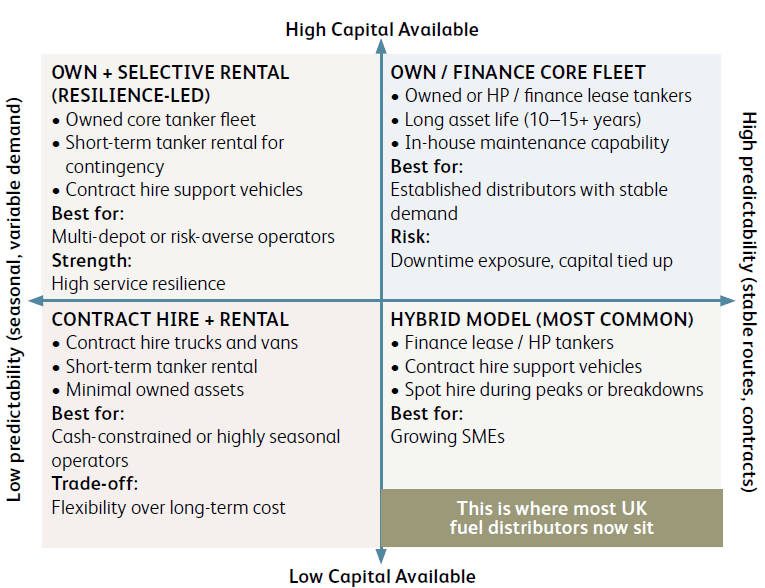
Fleet strategy matrix for fuel distributors
There is no one-size-fits-all approach to fleet strategy in fuel distribution. The right balance between owning, leasing and renting assets depends on your access to capital, stability of demand and tolerance for downtime risk.
Most distributors operate a hybrid model, combining owned or financed tankers for core capacity with contract hire and rental to manage peaks, breakdowns and delayed new-builds.
The matrix helps you assess where you sit today — and how your fleet strategy may need to evolve as your business grows.
Section 3: Upgrade Cycle / Plan
Decisions around repair, replacement and upgrade cycles sit at the heart of fleet strategy, balancing capital availability against reliability, compliance and downtime risk. FODs must assess the fleet/tanker lifespan, repair vs replacement costs, etc.
Lifespan
- In the UK/EU, there are no rules or regulations stipulating that commercial vehicles must be taken out of service after a certain age
- Articulated 36,000 litre tankers: 10–15 years is a baseline for these vehicles in heavy commercial use, with the upper range extending to 20 years in well-maintained fleets
- Rigid tankers (18-23,000 litres): 12-18 years (lower weight)
- Average HGV age on UK roads ~8 years (as of recent Department for Transport data), including all HGV types in commercial use
- ~30% of licensed HGVs in the UK are more than 10 years old. (DfT, 2020)
- ~25% of UK HGVs are 11+ years old, and ~12% are over 15 years old
Maintenance and Repair
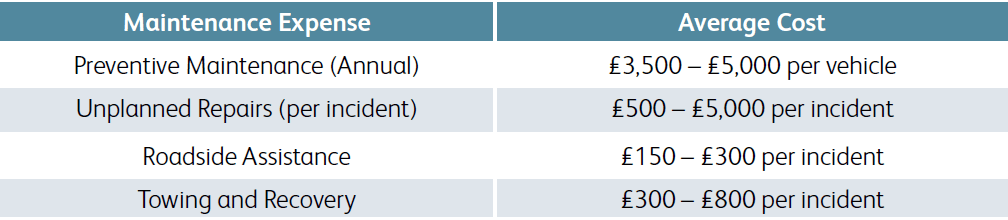
- Preventative maintenance could save HGV operators £545 per vehicle on average (Logistics UK)
- Average £545 per vehicle in unplanned repairs and downtime
- Almost 60% of HGV inspections identify at least one defect
- The average repair cost of a heavy good vehicle (HGV) has increased by almost 12% (2024-2025)
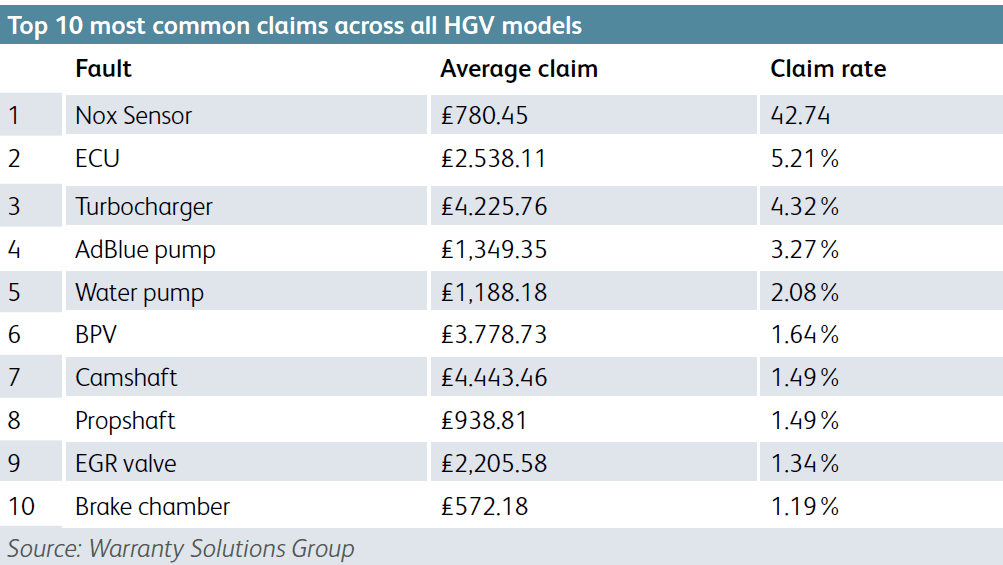
However, repairs can exceed these levels as can be seen in the below table of the most common claims.
The data set included a sample of 300 truck warranty claims settled between May 2024 and April 2025.
- The most expensive single claim reached £10,800 for major engine repairs
Repair vs Replace
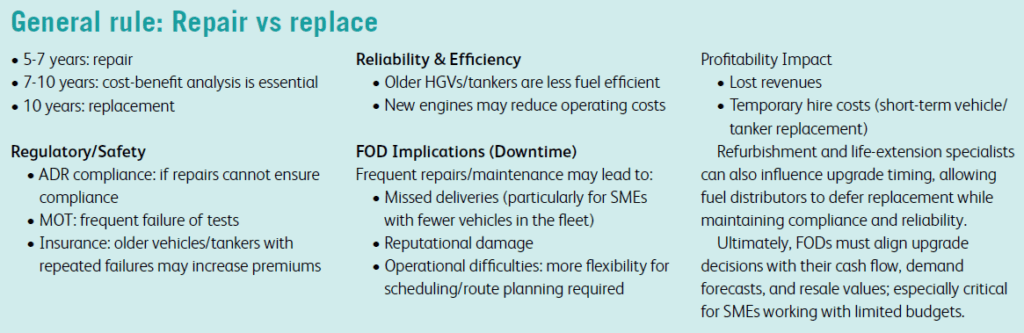
Upgrade cycles should consider average lifespan of HGVs/tankers: 10-15 years
FODs should consider:
- Age of the vehicle/tanker
- Based on expected lifespan 10-15 years
- Level of repair required
- Minor repairs (e.g. brakes, suspension) could be worth doing
- Major failures (engine, transmission replacement, structural, tank integrity), require
- Cost of repair
- Cost-benefit analysis required
Summary of findings
- Leasing offers predictable monthly costs, lower upfront capital, maintenance support, and easier upgrades
- Buying provides ownership, fleet control, and potential resale value
- Preventive maintenance reduces unplanned costs and improves fleet performance
- Repair vs replacement decisions depend on the severity and cost of faults, impact on operational downtime, regulatory compliance, and fuel efficiency
Recommended actions for FODs
- Assess the current age of the vehicle/tanker vs. average lifespan, residual values, and maintenance/repair costs
KPI modelling:
Compare leased versus owned.
- Cost per mile/litre analysis
- Annual running cost
- Downtime days per year
- Impact on cash flow/ profitability
Upgrade cycle
FODs (particularly SMEs) should consider aligning their replacement/upgrade cycle with business growth, cash flow, etc.
- Fleet upgrades should be planned in advance
- Phased upgrade: replacing vehicles/tankers gradually, minimising capital strain whilst keeping the fleet up to date
- A mix of vehicle leasing and owning may be the best approach for some FODs
Conclusion and recommendations
Fuel distributors face increasingly complex fleet decisions, shaped by capital constraints, compliance pressure and operational risk. There is no single “right” approach: leasing offers cost predictability and flexibility, while ownership delivers control and long-term value where assets are well maintained.
The most resilient fleet strategies typically combine owned or long-term financed tankers for core capacity, contract hire for support vehicles, and selective short-term rental to manage peaks and downtime.
By modelling total lifecycle costs, downtime risk and upgrade timing, FODs – particularly SMEs – can build fleets that support both operational reliability and financial sustainability.
Fleet strategy in practice
Many fuel distributors now operate a blended fleet model:
- Owned or long-term financed tankers
for core delivery capacity - Contract hire for support vehicles to
control cost and administration - Short-term tanker rental as insurance
against downtime and delayed new
builds
Image credit: Dreamstime