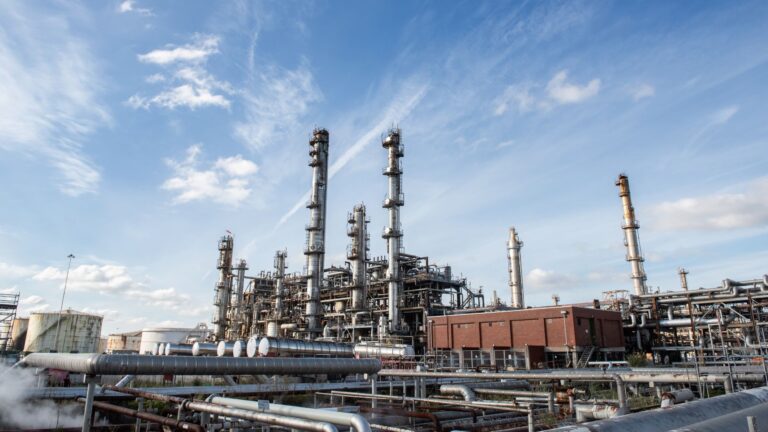
With the recent closures of Grangemouth and Prax Lindsey refineries raising concerns over the impact of decarbonisation policy on domestic industry, EET’s economic impact report reframes domestic refining infrastructure in the context of industrial transition.
It also lands in a strategically sensitive moment for UK energy policy as government struggles with the tension of delivering energy transition without deindustrialisation.
For years, the debate around UK refining has largely been framed as a question of fuel demand decline. But EET’s report argues the future of domestic refining may have as much to do with industrial resilience, jobs, hydrogen, carbon capture and regional competitiveness as it does with liquid fuel supply.
So, what does industrial transition actually look like in practice when it involves strategic infrastructure, thousands of jobs, regional economies and essential energy systems?
More than a refinery
- One of only four remaining in the UK, Stanlow represents a critical component of UK energy infrastructure:
- Supplying 18% of UK road fuel demand
- Supplying 12.5% of UK jet fuel demand
- Maintaining the key Manchester Airport pipelineIn addition, the refinery’s current economic impact is significant:
- £4.2 billion in VAT and fuel duty was collected in FY 2025
- Contributing £55 million in employee tax and business rates to the UK economy
But key insights from the report indicate that, beyond its vital role in UK fuel supply, Stanlow also supports wider manufacturing ecosystems.
EET’s hydrogen hub is the heart of HyNet North-West – a major strategic initiative aimed at strengthening the UK’s energy security while advancing large‑scale industrial decarbonisation of the region. This role is one that is frequently overlooked in energy policy debate. Refineries are often discussed in isolation rather than acknowledged as enabling infrastructure for chemicals, logistics, aviation and manufacturing ecosystems.
The closure or decline of refining capacity therefore has implications far beyond fuel supply, potentially affecting wider industrial competitiveness, regional employment and strategic manufacturing resilience.
Transition as industrial survival
A central point of the report is that “decarbonisation doesn’t have to mean deindustrialisation”.
Rather than a purely progressive strategy, EET’s decarbonisation investment is as much about ensuring the company’s future as the energy landscape evolves.
The development of large-scale low-carbon hydrogen production, CO₂ capture capabilities, and hydrogen-based energy systems positions Stanlow at the forefront of industrial decarbonisation.
By preserving industrial activity at the site, project investment will protect existing jobs and supply chains, while supporting the transition toward a cleaner, more secure energy future.
The broader sector
It is becoming apparent that the downstream fuel distribution sector increasingly sits at the intersection of energy security, industrial policy, resilience, transition infrastructure and future fuels.
As the UK energy mix diversifies, liquid fuels will continue to play a key role in domestic energy security and as noted in the report, the sector also plays a vital role in retaining supply capability during this transition.
EET suggests hydrogen will play a role in decarbonising industrial processes, and that future demand for SAF and other renewable liquid fuels will see refining sites pivot to become multi-energy hubs.
The combination of refining, hydrogen and SAF production, carbon capture, power generation, storage and logistics is a very different proposition from the traditional image of a refinery. And one which has clear implications for infrastructure investment and logistics development.
The policy tension
If the UK wants strategic energy resilience, what domestic industrial capability must it retain? Does current UK policy realistically support both decarbonisation and industrial competitiveness? EET suggests not.
Arguing that UK refiners face a competitive disadvantage compared with higher-carbon imported fuels, EET used the report launch to renew calls for refined products to be included within the UK Carbon Border Adjustment Mechanism (CBAM) to avoid carbon leakage.
With domestic carbon taxes penalising British production while high-carbon imports enter the UK untaxed, industry voices are flagging concerns around imported emissions as well as the resultant risk to UK jobs and domestic energy security.
Policy uncertainty is also a barrier to investment progress.
EET highlights the need for government decisions on access to CO2 transport and storage networks as well as a wider roll out of hydrogen infrastructure to support investments in hydrogen, carbon capture and advanced sustainable aviation fuels.
The wider signal
This is not just about Stanlow.
It reflects the way the role of refineries is evolving from fuel supply to multi-energy hubs underpinning the decarbonisation of wider manufacturing clusters.
Traditional fuel infrastructure is repositioning itself to drive industrial decarbonisation, and transition narratives are shifting from the idea of replacement to industrial transformation.
The transition is not abandonment; it is a continuum: the future value of these sites comes not from shutting refining down, but from leveraging existing industrial capability, pipelines, engineering expertise, logistics infrastructure and customer demand to support lower-carbon systems.
But will this shift come quickly enough?
Whether policy, infrastructure and investment frameworks can evolve quickly enough to support that transformation remains one of the defining industrial questions facing the sector.
The EET strategy suggests the future of refining may not simply be about producing fewer fossil fuels, but about whether existing industrial infrastructure can evolve into the backbone of a lower-carbon energy system while continuing to underpin economic resilience, employment and supply security along the way.
Image credit: Essar/EET Fuels