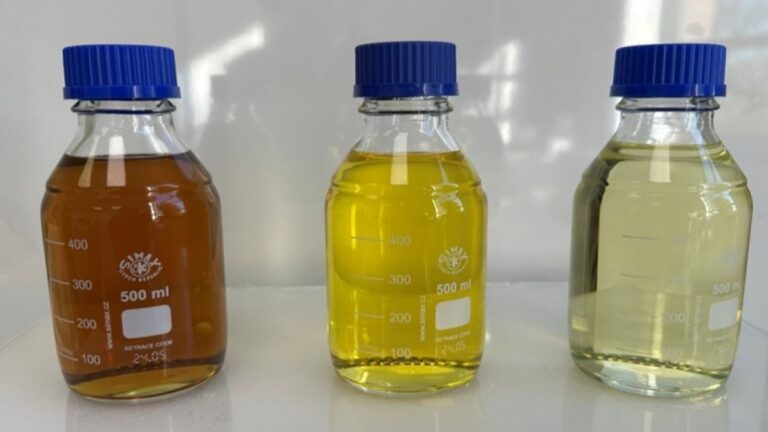
The Kent-based business has previously demonstrated the process at test scale, but this latest step confirms that its technology can operate using production-scale systems, moving it closer to commercial deployment.
The achievement builds on steady progress over recent years as the company has advanced its technology and positioned itself for wider industry engagement.
From pilot to production
The oil was produced at QMRE’s headquarters and facility in Hoo, Rochester, where two VIXLA processing systems are operating alongside a Q20 pre-treatment unit.
Plastic waste is first cleaned and size-reduced before being converted back into its core hydrocarbon form – oil – which can then be further refined into new plastic products.
This transition from test output to sustained production marks a key step in demonstrating that plastic waste-to-oil conversion can move beyond concept into practical application.
Scale, efficiency and emissions
CEO Tim StClair-Pearce said the company is now entering a critical phase of development: “With our technology partner Eagle Technology of Norway, we are now operating 24/7 in a 1,000-hour continuous run to fully prove the concept.”
The focus is now on improving system efficiency and environmental performance, with the current systems around 50% energy self-sufficient and a target to move closer to full self-sufficiency. Additional technologies are also being explored to further reduce emissions.
Supporting a circular approach to hydrocarbons
While still at an early commercial stage, QMRE’s approach reflects a growing interest in recovering value from waste streams and reintroducing it into the hydrocarbon cycle.
By converting plastic waste back into oil, the model points towards new feedstock opportunities, while also aligning with efforts to manage hard-to-recycle materials and make use of existing infrastructure.
The company has spent several years developing the technology and now plans to build on this milestone with the ambition of establishing a wider network of systems across the UK.
Next steps
QMRE says further work is needed to ensure consistent product quality and sufficient production volumes as it moves towards full commercial rollout.
However, this latest development represents a notable step forward – not just for the business itself, but for the broader conversation around the ways in which waste, fuels and materials may combine in a more circular energy system.
Image provided by QMRE