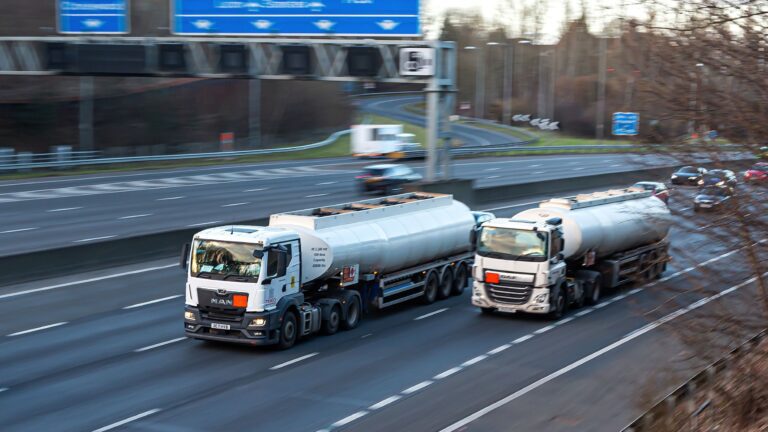
In November 2024, Logistics UK published The UK Logistics Network, a landmark attempt to map the country’s most critical freight corridors across road, rail, maritime and air.
Twelve months on, its Progress Tracker suggests momentum has been limited. Of the ten recommendations made in the original report, only one – the establishment of the National Infrastructure and Service Transformation Authority (NISTA) – has seen what the organisation describes as “substantial progress”.
The conclusion is stark: while the case for formally identifying a National Logistics Network has strengthened, delivery has yet to follow.
A system built on a small number of corridors
The original report sets out a clear structural reality: the UK’s supply chains are highly interconnected, but heavily dependent on a relatively small number of key routes
The evolution of these corridors reflects long-term economic patterns – linking:
- Major ports and international gateways
- The South East, Midlands and Northern conurbations
- Cross-border routes to Scotland and Wales
- Distribution hubs clustered along motorway and rail spines
This is not a loose web of infrastructure; it is a concentrated system. When congestion or disruption affects one of these corridors, the impact is magnified across multiple sectors.
The report argues that only by identifying this network formally – rather than addressing individual schemes in isolation – can government and industry align investment with economic ambition.
Road: growth without capacity
Road remains the dominant freight mode, carrying 81% of domestic freight by tonnage.
Almost one third of traffic on major roads is logistics-related, rising to 47% on the busiest sections of the Strategic Road Network.
Between 2015 and 2024, the annual cost of congestion on the SRN imposed on HGVs rose by £936 million
Average speeds have declined, while delays – particularly around Birmingham, Manchester and London – continue to intensify. The report highlights ten years of uneven freight growth, with significant increases along core corridors such as the M1, M6, M25 and A14.
Severe delay “hotspots” cluster at major motorway junctions, underlining how infrastructure has struggled to keep pace with economic concentration.
The report makes clear that this is not a short-term fluctuation. Congestion levels have returned to – and in many cases exceeded – pre-pandemic patterns.
Rail: growth ambitions meet structural bottlenecks
Rail freight is positioned as central to decarbonisation strategy, producing up to 76% less CO2 per tonne kilometre than road.
The government’s target to increase rail freight by 75% by 2050 is ambitious but achievable, according to the report – provided capacity constraints are addressed.
High-volume routes account for just 2% of network length yet carry 15% of rail freight tonne kilometres.
Bottlenecks persist on the West Coast Main Line and the Felixstowe-Nuneaton corridor, while the cancellation of HS2 north of Birmingham increases pressure on shared lines.
The report calls for electrification infill, junction upgrades (including Ely), and corridor-level planning rather than mode-by-mode intervention.
Ports: concentrated gateways
The mapping of principal ports highlights how specialised the UK system has become.
Container flows concentrate at Felixstowe, Southampton and Liverpool
RoRo traffic at Dover and Holyhead
Dry bulk at Immingham, Hull, Tees and Bristol.
Each port’s growth trajectory carries implications for inland connectivity. Road access constraints around Dover, Felixstowe and the Thames Gateway are particularly visible, while rail capacity from east coast ports to the Midlands remains constrained.
The report stresses that infrastructure planning must reflect commodity flows and port specialisation – not simply geography.
Decarbonisation and infrastructure alignment
A recurring theme throughout the report is the need to align transport planning with energy and net zero strategy.
The logistics sector faces simultaneous pressures:
- Managing rising demand
- Addressing ageing infrastructure
- Investing in zero-emission tailpipe technologies
- Improving resilience to extreme weather
Without clarity on which corridors are nationally critical, investment in charging, refuelling and low-carbon freight solutions risks becoming fragmented.
The report calls for cross-government coordination between the Department for Transport and the Department for Energy Security and Net Zero to ensure infrastructure deployment matches freight reality.
Competitiveness under pressure
International benchmarking adds urgency. The UK has fallen from 4th in the World Bank’s Logistics Performance Index in 2014 to joint 19th in the most recent ranking.
Oxford Economics modelling cited in the report suggests that with the right strategic investments, logistics-led productivity improvements could boost the economy by up to £8 billion per year by 2030.
The argument is straightforward: logistics efficiency and economic performance are intertwined.
The recommendations: a strategic shift
The ten recommendations set out in the report revolve around three core shifts:
- Formal identification of the UK Logistics Network
- A 30-year, cross-government infrastructure strategy
- Corridor-level investment planning aligned with decarbonisation
They also call for swift delivery of major schemes already in the pipeline – including the Lower Thames Crossing – and accelerated rail capacity and electrification upgrades.
The Progress Tracker suggests that while some strategic frameworks have been introduced, corridor identification and delivery remain incomplete.
Sector relevance: infrastructure, cost and the energy transition
For suppliers and distributors of transport and heating fuels, the implications are practical and immediate.
Liquid fuel distribution is inherently corridor dependent. Tanker fleets rely on predictable access to ports, refineries, storage terminals, inland depots and customer sites. The same routes identified in this report – the M1/M6 spine, the A14 to east coast ports, the M25 orbital, the M62 across the Pennines, cross-border links into Scotland and Wales – are the arteries through which product moves daily.
Three structural considerations stand out:
1. Congestion is a margin issue.
The reported £936 million annual increase in congestion costs imposed on HGVs over the past decade is not absorbed in isolation.
For fuel distributors operating high-value assets with tight delivery windows, delays translate into reduced vehicle turns, higher fuel consumption, driver overtime, increased wear and diminished fleet productivity. Reliability on core corridors is not simply a logistics metric – it is a commercial one.
2. Port connectivity shapes supply resilience.
As commodity flows concentrate through specialised ports, inland connectivity becomes critical. For liquid fuels and blending components – including renewable products – efficient links from import gateways to inland terminals underpin both availability and price stability. Constraints on access routes such as the A14, M20 or M62 ripple quickly into downstream markets.
3. Transition requires infrastructure certainty.
The report’s emphasis on aligning transport and energy infrastructure is particularly pertinent. The freight sector is navigating multiple transition pathways – from zero tailpipe emission vehicles to increased rail use and alternative liquid fuels. Each pathway depends on infrastructure located where freight actually flows. Without clarity on which corridors will be prioritised, investment risks fragmentation.
Ultimately, the identification of a formal UK Logistics Network is not simply a transport planning exercise. For the liquid fuels sector, it intersects with cost control, supply security and decarbonisation strategy.
The fuel distribution community underpins both domestic energy supply and the wider movement of goods. Ensuring that the corridors on which it depends are clearly identified, protected and enhanced is therefore central not only to logistics performance, but to broader economic resilience..