In your view, which parts of the UK mobility system are most at risk of being left behind in the transition, and what could be done to address this?
I believe small fleets are most at risk. This is mainly due to the low margins haulage and logistics companies are making and this especially applies to small fleets.
Changing fuel type costs money, no matter what that new product is. Although HVO is a low carbon drop in alternative to diesel, therefore, no equipment upgrades, it is 10-20% more expensive.
Currently e-HGV charging is still in its infancy stage in the UK, with a handful of electric trucks on the road and limited charging stations. The government has funded several electrification schemes to install charging stations and offer grants to purchase electric trucks, however, much more needs to be done if this is to be the long-term preferred option.
One of the largest issues I have found in the e-HGV transition, is grid connection and costs associated with it. As an example, when looking to install e-HGV chargers at The Hollies Truckstop, costs were estimated to be between £1m-£2m to bring in the connection which made it unviable. This needs to be addressed and supported by government.
Government has, so far, refused to offer tax incentives for any future fuels, so this additional must be borne by the haulier, or passed on to their customers. Government needs to address this, if it is to reach its low emission targets by offering price parity for using sustainable fuels, or worthwhile credits to the haulier.
Larger fleets using HVO, have often done so to secure contracts, bids and tenders where the haulier is expected to be sustainable as part of the Scope 3 emissions. Therefore, companies are selecting logistic partners who can provide low-carbon data and sustainable fuels to support this.
Do you expect the energy transition to change where and how people refuel in the UK?
I believe that traditional forecourts will still exist in the short to medium term future, especially for cars and vans, and there is strong evidence to support this, in that investors are still purchasing forecourts at peak multiples.
Although many forecourts do offer EV charge points, the ones that do best are purpose built destinations, with a selection of facilities for drivers to use as they wait, to include restaurants, retail, leisure and good quality washrooms.
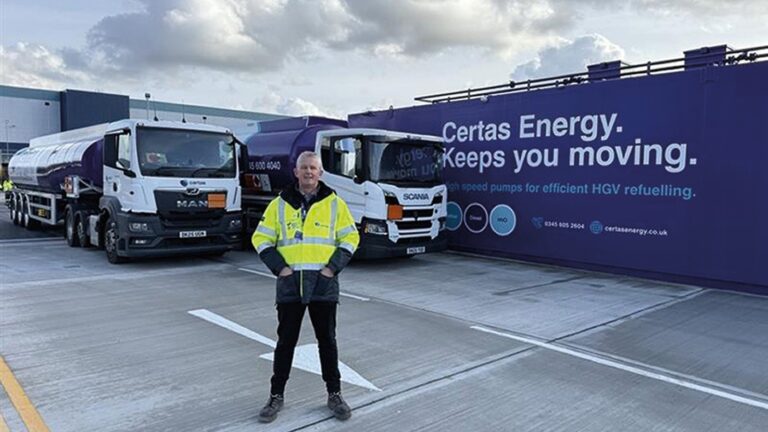
For the HGV sector, dedicated HGV refuelling stations and bunkers will remain for medium to long term, with high-speed nozzles offering traditional and renewable future liquid fuels. These are best located at Truckstops, allowing a ‘one stop shop’ for the haulage industry to refuel the vehicle and the driver at the same time.
Truckstops can also futureproof the destination, by installing both fast chargers and slower overnight charge points for electric trucks, where vehicles can be trickle charged overnight in the parking bays, which will help with power demands and constraints.
What does the UK’s future vehicle-fuelling mix look like in 10-15 years? Do you believe liquid fuels, EV charging and hydrogen will coexist or compete?
The UK will embrace a variety of future refuelling solutions, with the most sustainable, viable, proven and sought after winning the race. Cars and vans will be forced to transition to hybrid and then full electric. I don’t believe hydrogen will play a part in this sector, although other future liquid, gas and solid fuels may.
The HGV sector will take longer on this transition journey, with diesel and renewable diesel remaining the main fuel source for many years to come. Although I believe that e-HGV will gain some momentum in the next 5-10 years, this will be delayed due to investment and power constraints in addition to battery weight and range.
It seems sensible that Battery Electric vehicles (BEV) will be used for short journeys and last mile delivery, as depot recharging can support this, then medium to long journeys with HVO/ renewable diesel and a smaller percentage using public charge points in Truckstops.
With regards to hydrogen, again this is currently being trialled, with the Hydrogen Fuel Cell allowing faster refuelling and a better range. The main challenge is with regards to the cost of producing ‘green’ hydrogen and an almost non -existent infrastructure.
Which constraints do you think will shape future fuelling infrastructure as much as or more than technology?
The transition of future liquid fuels (e.g. diesel to HVO) is quite straight forward, as far as estate development is concerned. Certas uses above ground Multiserve tanks, so a compartment within the tank, can and has been used for the new product.
Simple labelling of this new product at the point of dispensing is also upgraded, as is the product on a traditional fuel card or digital fuel card (FuelTapp).
EV and e-HGV is a lot more complex, firstly the large cost of bringing the power into the site and then the location (safe zone) and build out cost of the equipment. Dedicated bays are required for rapid charging and slower chargers can be installed in existing HGV overnight parking bays.
Again, hydrogen would require its own infrastructure and dedicated area, with either product piped in from a main hub, or transported by vehicle. Verification of true green hydrogen production would need to be proven, as would demand in both infrastructure and new vehicle purchase due to large costs.
Hydrogen is described by some as ‘the fuel of the future’. In your view, is that future mainly about passenger vehicles, heavy transport, or even non-road uses?
I believe that hydrogen has a place in the future, but not for road transport.
It could be used as a clean fuel type for hard to electrify sectors, such as heavy industries, residential heating, or shipping.
Image credit: Mike Heaton, Certas