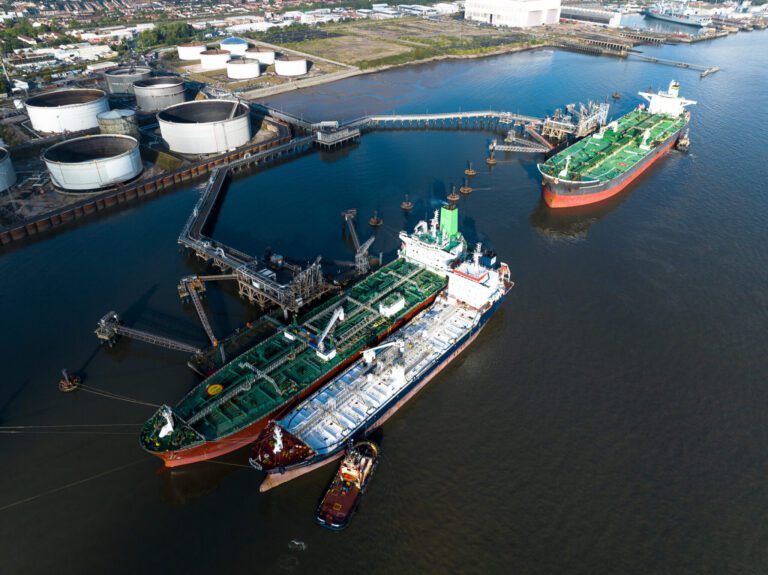
The funding will support a pre-FEED study for the project, due for completion in Q2 2026.
The initiative forms part of the LCR Freeport’s focus on maritime decarbonisation and sustainable port infrastructure, delivered in partnership with Mersey Maritime. STL’s proposed terminal would act as a hub for non-pipeline transfer (NPT) of captured CO₂, handling imports from domestic and international sources via ship, road and rail.
The Department for Energy Security and Net Zero has identified NPT as an essential enabler of a UK-wide carbon capture, utilisation and storage (CCUS) market, particularly for emitters located outside existing pipeline clusters. NPT is intended to increase system resilience and offer flexible, lower-cost transport options by allowing CO₂ flows to be redirected, supporting merchant storage and enabling eventual cross-border CO₂ movement.
Decarbonisation plans
STL says its existing infrastructure, combined with access to the North West’s sequestration capacity, positions the Tranmere–Stanlow project to become one of the UK and Europe’s leading CO₂ receiving facilities. The pre-FEED phase will build on earlier concept work to assess technical and commercial feasibility ahead of a full FEED stage.
The project aligns with Stanlow Terminals’ role in the Essar Energy Transition programme and wider decarbonisation plans across the North West.
Chief executive Michael Gaynon said the Freeport support would help accelerate development of a terminal “critical” to both regional and national net-zero ambitions, adding that Stanlow’s location and infrastructure made it well suited to act as a central hub for CO₂ handling. “This grant represents a key milestone in advancing this vision.”
Mersey Maritime CEO Ruth Wood described the study as a significant step in the region’s CCUS deployment, while Olivia Powis of the Carbon Capture and Storage Association said the project exemplified the infrastructure needed to enable a nationwide CCUS industry. Phillip Hall, Port Director Mersey at Peel Ports Liverpool, said Freeport investment was key to positioning the region as a leader in the transition to a net-zero economy.
Image provided by Stanlow Terminals