
A quarterly review of the movements of, and impacts on, Brent crude and HVO diesel prices. With insight and data supplied by The Oil Market Journal, we highlight some of the key events that have impacted pricing over the quarter.
Q3 Review
After a turbulent first quarter, marked by the outbreak of the US-Iran war, price consolidation and frequent talk from President Trump of peace deals, Q3 became a story of a conflict spreading across the Middle East’s energy network. What began as a threat to shipping in the Gulf evolved into a broader campaign targeting refineries, pipelines, ports and critical supply routes, driving oil prices sharply higher and leaving markets on edge.
The quarter began with hopes that tensions might ease after the Strait of Hormuz briefly reopened in June. Those hopes quickly faded as talks between Washington and Tehran stalled once again. Attacks resumed between the US and Iran, while Chinese crude buyers returned to the market after largely relying on domestic stock drawdowns during Q2. The return of Chinese demand removed a key buffer that had helped contain prices earlier in the year.
As tensions intensified, the conflict moved beyond Hormuz. Following a Saudi bombing raid on a Houthi airstrip, the Houthis ended their four-year truce with Saudi Arabia and resumed attacks on the kingdom. What began as a crisis focused on the Strait of Hormuz soon expanded westward into the Red Sea and Bab al-Mandab, broadening the threat to global oil trade and regional energy infrastructure.
The Houthis expanded their campaign in the Red Sea, attacking Saudi energy infrastructure and seizing the strategic port of Mokha, strengthening their control of Yemen’s western coastline and increasing risks to shipping transiting the Bab al-Mandab Strait. At the same time, Ukraine stepped up attacks on Russian refining infrastructure, while refinery outages, record-low Rhine water levels and declining diesel inventories added further strain to global fuel supplies.
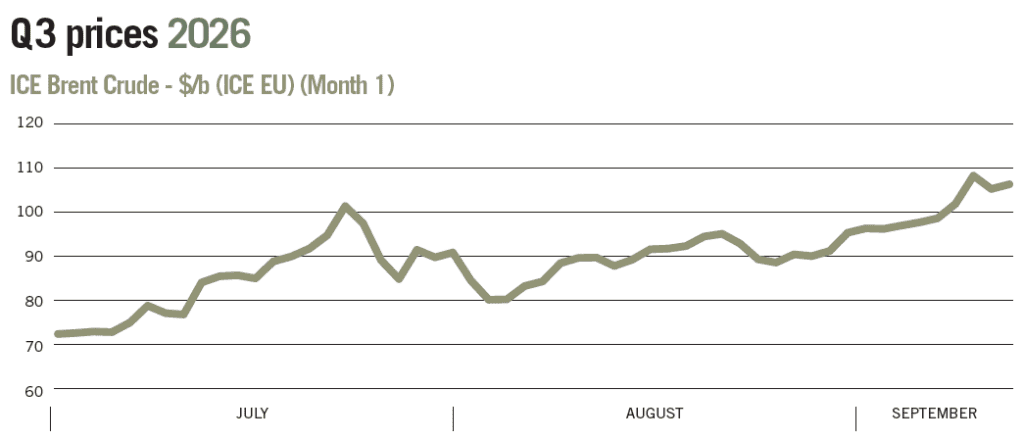
Oil markets responded accordingly. Brent climbed from around $70/b at the start of the quarter to over $100/bl, while ICE gasoil surged as diesel markets tightened. Although periodic reports of US-Iran negotiations briefly pressured prices lower, every diplomatic breakthrough proved short-lived and was quickly overtaken by fresh military escalation. As oil prices surged, President Trump regularly signalled that progress towards a deal remained possible, creating brief waves of optimism that were ultimately overshadowed by renewed conflict and disruption across regional energy markets. More often than not, however, the comments failed to deliver any meaningful progress.
The most significant development came in September, when Iranian-backed forces operating in Iraq attacked Saudi Arabia’s East-West pipeline near Medina. The pipeline, which can carry up to 7mb/d of crude 750 miles from Saudi Arabia’s eastern oil fields to the Red Sea export terminal at Yanbu, had become a critical supply route since the Iranian crisis began in February. More importantly, it allowed Saudi Arabia to bypass the Strait of Hormuz altogether.
Its closure marked a major escalation. With Hormuz already under pressure and Red Sea risks continuing to grow, the attack removed one of the region’s most important alternative export routes.
By the end of Q3, the market was no longer simply pricing disruption in Hormuz. Instead, attacks on refineries, pipelines and export routes transformed a regional conflict into a global energy security concern.
HVO Q3 Review
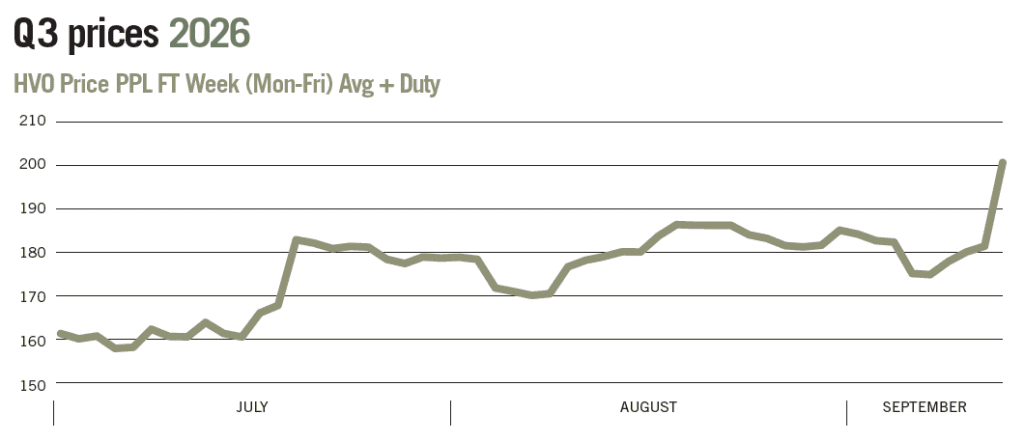
The European HVO market experienced a volatile third quarter, shaped by logistical challenges and shifting demand patterns. The quarter began with plentiful supply as weak diesel consumption weighed on market sentiment. Conditions worsened when record low water levels on the Rhine disrupted fuel deliveries into Germany, Europe’s largest HVO consumption market. With river transport severely restricted, some buyers delayed physical purchases and instead met renewable fuel obligations by relying on compliance certificates rather than buying physical product.
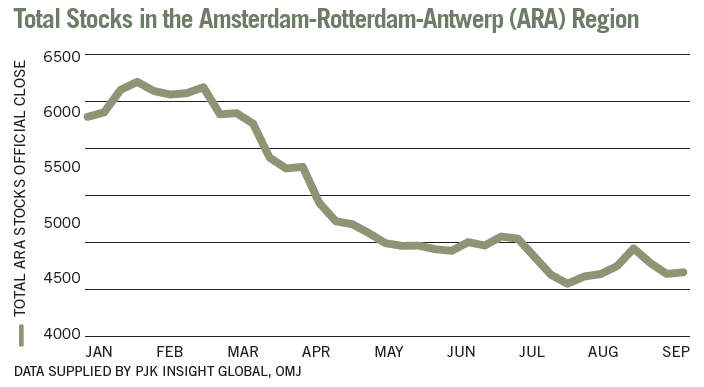
Product accumulated in storage hubs, particularly in the Amsterdam-Rotterdam-Antwerp region, as rail capacity proved limited and road transport remained uneconomical.
Despite these weak market fundamentals, HVO prices were supported at times by broader movements in the diesel market. Tensions in the Middle East, concerns over shipping through the Strait of Hormuz and continued restrictions on Russian diesel exports drove significant volatility in conventional fuel markets. While these developments lifted outright HVO values, they did not result in a sustained improvement in demand, and price gains were often offset by weakening premiums.
Feedstock markets showed mixed performance during the quarter. Used cooking oil (UCOME) prices in Asia increased modestly, supported by steady demand. Regulatory developments also played an increasingly important role. Spain’s implementation of RED III is expected to support future demand for some advanced renewable fuels, while limits on the use of certain feedstocks in Germany reduced demand for HVO derived from used cooking oil.
By the end of the quarter, the market remained highly volatile. Although overall HVO prices finished higher than where they began, supply chain disruptions, elevated inventories and regulatory constraints continued to weigh on demand, leaving the sector increasingly fragmented and uncertain.
Q3 2026 Key dates
JULY
1 July: US days of supply cover fall to lowest level since February.
6 July: OPEC+ agrees to increase August output to 180,000bpd.
7 July: Iran attacks two tankers in the Straits of Hormuz, including a Qatari LNG tanker. Ukraine attacks the largest refinery in Russia, the 460,000bpd Omsk refinery in Siberia. Ukraine also attacks the Russian oil export ports at Ust-Luga and Vysotsk on the Baltic Sea.
8 July: US distillate days cover fall to the lowest level since October 2022.
Trump says the ceasefire with Iran is over. The US revokes the licence allowing the sale of Iranian crude.
14 July: US CENTCOM deploys sea drones for the first time in combat operations, attacking various Iranian marine facilities.
The Houthis end their four-year truce with Saudi Arabia and attack Abha airport.
17 July: ARA stocks fall to a 12-year low
20 July: Kuwait’s power and water desalination plant sustains significant damage due to Iranian missile and drone attacks.
Argus reports European diesel cracks hit a 28-year high because of strong product demand and reduced supply.
21 July: Houthi rebels announce an immediate ban on maritime navigation linked to Saudi Arabia. CPC loadings halt after a drone attack on the “Nelsa” oil tanker in the Black Sea.
24 July: ARA stocks fall to a new 12-year low with fuel oil stocks 48% below the five-year average. President Trump says the U.S. is seriously considering major combat operations in Iran.
27 July: Oil moves lower as the US pauses attacks on Iran.
The Houthis attempt to attack oil refineries at Yanbu in Saudi Arabia but the missiles were shot down by Greek defence forces.
AUGUST
2 August: Oil slumps on news that the US and Iran resume talks, after President Trump threatens Iran with the largest bombing campaign since World War II.
Two vessels come under attack, including the GasLog Shanghai LNG tanker in the Gulf of Oman.
4 August: Rhine water levels fall to an eight-year low. The Houthis attack Najran airport in Saudi Arabia. Saudi Aramco chief executive Amin Nasser warns that oil buffers face prolonged strain.
5 August: The Houthis attack a Saudi oil tanker near Yanbu.Global oil stocks run low after five months of very few oil tankers exiting the Persian Gulf.
6 August: Iran and Oman agree a Strait of Hormuz transit agreement. Ships are to enter the Persian Gulf via the northern route close to Iran and exit via the southern route close to Oman.
7 August: Iran seeks to prevent US and Israeli ships entering the Straits, and seeks compensation from hostile countries before vessels are allowed to transit.
10 August: Rhine water levels fall to a record low, with the level at Kaub reaching just 17cm. Oil flows from ARA to southern Germany and Basel halt, hitting demand for ARA oil supply.
11 August: Expectations of a US-Iran agreement continue to fade. President Trump signals that the US will maintain its blockade on Iranian shipping and pursue a long-term strategy of economic pressure rather than a near-term deal.
14 August: An explosion at the Gunvor refinery results in the death of a worker, while a power outage affects the ExxonMobil refinery following a fire at a power substation.
19 August: Iran fires two missiles at the UAE, but both are intercepted.US Under Secretary Haustveit says the US is now buying more than half of Venezuela’s crude output.
20 August: Egypt offers five jet cargoes for September.The UAE suspends economic and financial ties with Iran, as traders await further details on the US economic blockade plan.
25 August: The US unveils additional sanctions on Iran, including secondary sanctions on nations doing business with Iran.
SEPTEMBER
7 September : Iran fires ballistic missiles at two US warships and the US sinks three Iranian oil tankers.
Argus-reported vessel traffic through the Strait of Hormuz fell to three crossings on Wednesday, about 2% of the pre-war daily baseline of 135.
9 September: The US attacks five Iranian tankers near the main Iranian oil terminal of Kharg Island as Houthis attack oil facilities in southern Saudi Arabia, causing injuries and fires.
12 September: Oil moves higher as the Houthis advance towards the Red Sea. Prompt delivery Brent crude reaches $120/bl.
ARA jet fuel stocks fall to a five-year low.
Saudi supply falls to the lowest level since 1990.
14 September: The Saudis close the key East-West pipeline, which transports oil across Saudi Arabia to the Red Sea port of Yanbu.
The Houthis expand control of Yemen’s west coast, increasing the risk of further attacks on Red Sea shipping. The Houthis take the coastal towns of Dhubab and Mocha and reportedly reach the Red Sea island of Perim.
Prompt delivery Brent crude reaches $130/bl.
All data and analysis provided by The Oil Market Journal.
To find out more and request a free trial:
+44 (0) 28 6632 9999
info@the-omj.com
Image credits: The Oil Market Journal, iStock