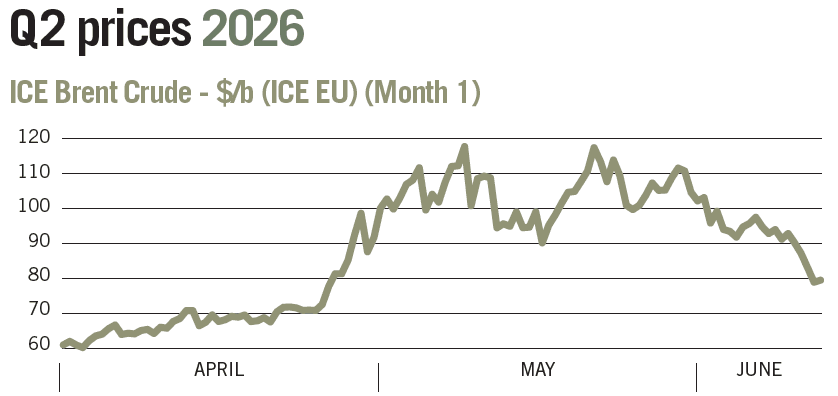
With insight and data supplied by The Oil Market Journal, we focus on the movements of, and impacts on, Brent Crude prices over an exceptionally volatile quarter.
Q2 Review
Oil traders had just returned to work in January, after the Christmas holidays, expecting a well-supplied year ahead. However, that peace was shattered on Saturday 3rd January, when news broke that the US had seized Venezuelan President Nicolas Maduro in a daring mission. The market was initially shocked, but when it became clear Venezuelan supply would not be negatively impacted, attention returned to the expectation 2026 would see continued oversupply of about 2m barrels per day.
This oversupply was forecast to lead to significant stock builds not seen since the COVID shutdowns of 2020. Then, on 28th February, at 6:45 GMT the Western World woke up to the dramatic news the US and Israel had attacked Iran, and killed the Supreme Leader. It is likely President Trump expected a similar outcome to Venezuela. However, it became clear after just a few days the US had made yet another Middle Eastern miscalculation and the world’s most important shipping lane – the Straits of Hormuz – was essentially closed.
Sixteen weeks later, on 20th June 2026, the Straits remains largely closed but an agreement has been reached and signed by President Trump in Paris on 17th June 2026, to reopen the key shipping channel within 30 days.
While Asia has lost a large volume of crude and LNG supply over the duration of the blockage, Europe has lost an important source of refined product supply.
The secondary supply loss is also important. Crude exported to Asian nations was then refined into products needed here, and there has been a sharp reduction in Chinese and Indian refined product exports to Europe.
The net result for global oil markets is dramatic. Instead of oversupply in 2026, we are now experiencing serious undersupply – which the US Government’s EIA forecast suggests will be 8.5 million bpd in Q2 2026, and will average 2.6m barrels of undersupply per day in 2026. This compares to an EIA forecast in Jan 2026, of 2.57m bpd oversupply for the year. OECD Stocks were forecast to hit a 10 year high in 2026, but are now forecast to fall to the lowest level since The Gulf War in 2003.
If we compare the supply / demand deficit forecast for 2026, with other supply crises we can see that the 2.6m bpd shortfall forecast for 2026, far exceeds the Libyan crisis shortfall of 2012-2013, and the COVID refinery recovery shortfall of 2021. On both those occasions Brent Crude exceeded $100/b.
The US Government EIA also forecasts OECD stocks will fall to 2,413 mb in Q3 2026, lower than the levels seen in both the post COVID recovery and the Libyan Crisis, when crude was between $100-120 /b.
Past performance is always a good indicator of future performance. The OECD stock data is published on a regular basis and is reliable input for assessing market fundamentals. When we divide stocks by daily demand we get ‘days cover’ which provides us with a good metric taking into consideration both supply and demand. The 10-year average is 62.50. Historically when OECD days cover falls to 57 days or lower, crude prices exceed $100/b. 2026 OECD days cover is forecast at 53.90. This implies that the market is too optimistic with Brent Crude at just $77/b on 18th June.
So how does this affect European refined product prices?
In the early stages of the crisis Jet Kero prices surged higher than other refined fuel prices. However, this surge in Jet Kero prices attracted both extra supply and production, with US stocks higher than normal in April and May.
After the initial price shock, prices have stabilised and eased due to successful attempts by President Trump to talk up the prospect of peace and also the important fact that we are using up the massive stocks of oil built up during 2025 and early 2026.
We see the draw-down in stocks as a three-stage process
1) Firstly, Local Middle East stocks.
2) Secondly, European stocks
3) Thirdly, US Stocks
The first stocks to deplete were local stocks in the Middle East at the Fujairah Oil Terminal.
This terminal is strategically located outside the Persian Gulf in the Gulf of Oman.
As a result, tankers enroute to the Persian Gulf blocked from entry were instead able to collect product at Fujairah.
The draw down in Fujairah stocks has been massive with total stocks down 72.07% on the year and down 74.31% on the five-year average. Stocks are close to operational bottoms and urgently need resupplied.
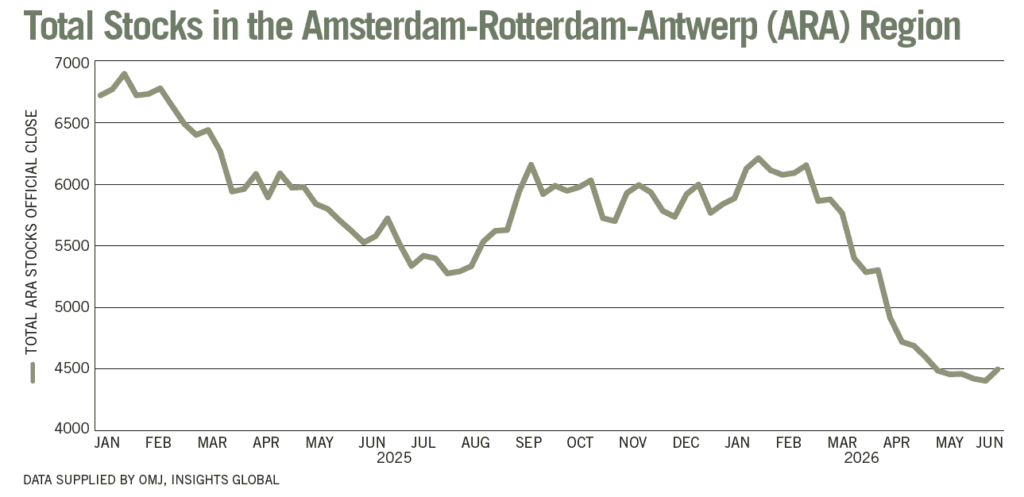
European stocks are the next to fall and were insulated from an initial draw down due to continued tanker arrivals of product which had passed out of the Persian Gulf before 28/2/2026. Those arrivals continued until early April.
However, Amsterdam, Rotterdam and Antwerp (ARA) stocks are now down to the lowest level since 2014 at 4,457,000 tonnes.
The last to fall is the United States.
US distillate stocks have held fairly stable and just are 6.3mb below the level seen at the same time last year, with commercial crude stocks just 2.7mb below the level seen at the same time last year.
However, petrol stocks are much lower, at 15.8mb below the level seen at the same time last year. As a result, there is potential for US petrol prices to rally over the summer, as the driving season moves up a gear in July, and the hurricane season kicks in later in August.
But what does this all mean for European refined product prices?
During Q2, prices weakened as stocks were drawn down. However, it is likely stocks will continue to fall during July, and it will probably be August before the first cargoes of refined product from the Persian Gulf reach Europe. In addition, the traffic flow through the Straits of Hormuz could be intermittent. As a result, the refined product market could tighten in Q3, and prices post an occasional spike.
MARCH
9th March: War intensifies and Kuwait follows Iraq in shutting down production with lack of exports leaving storage tanks nearly full. The Sitra refinery in Bahrain is attacked and an oil tanker is also attacked near Iraq.
WTI CRUDE SURGES 27%
10th March: President Trump speaks with the Russian President, who is reported to have put forward proposals for a quick settlement of the Iranian conflict, including easing sanctions on Russian oil exports.
11th March: US claims it has destroyed 16 Iranian mine-laying ships.
12th March: Iran attacks two ships overnight in waters off the Iraqi oil export port of Basra.
17th March: The Shad gas field in the UAE is closed following an attack the day before. An attempted Iranian attack on the Shaybah oil field in Saudi Arabia, fails. The Majnoon oil field in Iraq is also attacked.
18th March: Germany’s parliament postpones the renewable energy directive (RED III) and greenhouse gas savings (GHG) quota bill from its weekly agenda.
19th March: An attack by Israel, on Iran’s South Pars gas field is followed by Iran attacking Qatar’s Ras Laffan LNG processing plant and the key Saudi oil export port of Yanbu on the Red Sea.
20th March : Mina al-Ahmadi refinery in Kuwait is attacked by Iran.
25th March: US drafts a 15-point peace plan to end the conflict.
26th March: Iranian Foreign Minister Abbas Araghchi says: “There are no talks with the US.”
30th March: Iranian-backed Houthis in Yemen join the war, firing missiles at Israel and warning they will block tankers entering the Straits of Bab el-Mandeb at the entrance to the Red Sea.
APRIL
7th April: In a social media post on Easter Sunday, President Trump makes aggressive threats to bomb Iranian bridges and power plants if Iran does not open the Straits of Hormuz.
Ukrainian drone attacks cause major fires at the key Russian Black Sea port of Novorossiysk.
8th April: United States and Iran agree to a two-week ceasefire. Iran says there will also be a two-week window of safe travel via the Straits.
Saudi Arabia confirms that the recent drone attack by Iran on the Saudi East-West pipeline that pumps oil to the Red Sea port of Yanbu reduced supply by 700,000 bpd.
The latest report shows fuel oil stocks in ARA have fallen to a nine-year low.
13th April: Peace talks between the US and Iran fail after 21 hours, with the US reacting by announcing a blockade of the Straits of Hormuz, cutting off all shipping traffic to and from Iran.
14th April: A sanctioned tanker linked to China attempts to break through the blockade.
Virgin Atlantic airline warns of jet fuel shortages after May
15th April : IEA warns that shortages could occur if the Straits of Hormuz remain closed for another three weeks.
16th April: Ryanair warns of jet fuel shortages after mid-May.
18th April: Iranians open fire on an Indian tanker which had been cleared to transit.
19th April: US opens fire on a cargo ship which ignored US warnings not to enter the Straits.
23rd April: More than 400 oil tankers, including 75 VLCCs, are enroute to the US. Record US crude exports are expected but a large number of these tankers have rerouted from the Middle East
24th April : Jet Kero remains the product of concern, with stocks down 32% on the year.
29th April: 40,000 bpd Rosneft Tuapse refinery in Russia is struck by Ukrainian drones for the third time in two weeks, triggering a fire.
UAE announces its withdrawal from OPEC and OPEC+ effective 1 May. Phillips 66 finalises Lindsey refinery acquisition but will not resume crude processing.
MAY
1st May : ARA stocks fall to 4.59mt, the lowest since December 2014. Fuel oil stocks fall 93kt to a nine-year low, jet kerosene stocks fall 27kt and are at a six-year low.
5th May : U.S. escorts two US-flagged merchant ships through the Straits of Hormuz, reportedly exchanging fire with the Iranians. Iran attacks the oil storage terminal at Fujairah
6th May: Repsol announces the opening of a new 200,000t/yr hydrotreated vegetable oil (HVO) unit at its Puertollano refinery in Spain.
8th May : Maersk completes its first full voyage using 100% ethanol with a dual-fuel methanol engine. Iranians attack three US warships sailing through the Straits of Hormuz
13th May: Iran’s IRGC expands the definition of the Strait of Hormuz to a significant operational area from Jask to Siri Island, taking the area to 200-300 miles from the previous 20-30 miles.
18th May : Iran attacks a nuclear power station in the UAE.
19th May : US extends the waiver on the purchase of Russian oil which is already loaded on tankers.
20th May : UK Government announces it will continue to allow imports of diesel and jet fuel refined abroad from Russian crude, breaking from the EU, which issued a ban in January this year.
25th May : Prices fall sharply, due to positive signals from both the White House and Iran that a peace deal is very close.
26th May: Iranian targets in Southern Iran are attacked in a “defensive” action. The US says it has attacked missile launch sites and vessels laying mines in the Straits of Hormuz.
28th May : U.S. officials report an attack on an Iranian military site shooting down four Iranian one-way attack drones that posed a threat around the Strait of Hormuz.
Kuwait’s army says its air defences are intercepting hostile missile and drone threats.
Global oil stocks continue to fall with the weekly Fujairah stock report showing light, medium, and heavy fuel stocks all extending lower to new five-year lows.
29th May : Oil prices extend lower following news that the US and Iran have agreed to extend the ceasefire by 60 days and see “unrestricted” shipping resume through the Straits of Hormuz.
US DOE report and ARA stock reports show falling refined product stocks. US gasoline stocks are especially low and total ARA stocks now at the lowest level since 2013.
JUNE
1st June : No comment following a meeting between President Trump and advisors to discuss the proposed peace deal.
Iran and the US both engage in military activities, with Iran attacking the Ali Al Salem airbase in Kuwait, injuring several Americans and seriously damaging two US MQ-9 Reaper strike drones.
US attacks Iranian radar and drone control bases.
There is also a developing supply risk in Canada with wildfires just 12.4 miles from the 500,000 bpd oil sands production sites at Christina Lake and Kirby North
12th June: President Trump says deal with Iran is near with hopes of an agreement before the G7 meeting in Evian, France.
14th June: US and Iran reach a deal to end war in Iran.
17th June: President Trump signs MOU with Iran in Paris to end the conflict in the Persian Gulf and re-open the Straits of Hormuz.
All data and analysis provided by The Oil Market Journal.
To find out more and request a free trial: +44 (0) 28 6632 9999 info@the-omj.com www.the-omj.com
Image credits: Oil Market Journal, iStock