
Five years ago, the off-grid village of Kehelland began a groundbreaking trial supported by local distributor Mitchell & Webber, swapping kerosene heating oil for hydrotreated vegetable oil (HVO).
Timothy Rumbelow, Reach, visited the village on the fifth anniversary of the trial launch, to speak with residents, and concluded: “As the trial reaches its five-year mark, it provides rare, real-world proof that rural net zero doesn’t have to come with crippling retrofit bills.” Timothy shares more of his findings below.
The Kehelland blueprint
For the 1.7 million UK homes off the gas grid, decarbonising heat has been daunting. Government strategy has leaned toward air source heat pumps, but for older, poorly insulated rural properties – such as Cornish granite homes – heat pumps can require major retrofits and electrical upgrades, often costing around £22,000 per property.
In late 2020, family-run Mitchell & Webber, led by brothers Robert and John Weedon, pioneered the first UK domestic HVO conversion in Scorrier before beginning a larger trial in Kehelland where homes, businesses, the primary school, and the Methodist Church would convert existing oil boilers to run on HVO.
The switch from using fossil heating oil can deliver an immediate reduction in carbon emissions compared to kerosene, and offers significant savings. In fact, the total carbon saved over the five-year trial is in excess of 500 tonnes, and this can be achieved with minimal disruption – no new radiators, no deep retrofits, and no planning permission.
HVO is produced from certified sustainable waste fats and oils, so it does not contribute to deforestation. It is non-toxic, biodegradable, and burns cleanly; heating technicians consistently report cleaner nozzles and boilers when running on the renewable fuel.
Moreover, there are no upfront costs, as there is no need for changes to be made to an existing boiler system when using a HVO blend.
‘Seamless and clean’: what the residents say
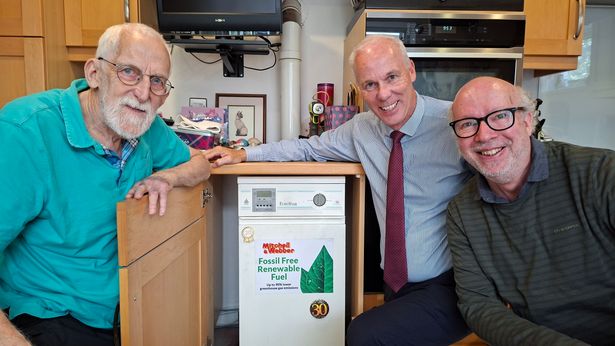
Feedback has been overwhelmingly positive, proving that practical, affordable solutions are often the most popular. Kehelland resident Dave Biggs said: “HVO has proven to be highly effective and efficient. The projected cost to insulate our property is in the tens of thousands of pounds. By adopting HVO, we’ve transitioned to a cleaner fuel without incurring substantial rebuilding expenses.”
For others, their homes’ architecture made HVO the only logical choice. Stephen and Nicky Thomas explained: “Considering our granite property’s unique characteristics, any alternative heating solution would be financially prohibitive and excessively disruptive.”
Claire and Andrew Waterhouse added that the switch has allowed her household to reduce its carbon footprint by nearly five metric tonnes annually while keeping their existing combi boiler.
You can hear directly from the residents here:
Taking the fight to Westminster, and a visit from Whitehall
Armed with five years of data, Kehelland residents are pushing for policy change. In January 2026, the community joined the Cornwall March to Westminster to submit findings to the government’s consultation on Alternative Solutions for Rural Heat Decarbonisation.
Currently, HVO for home heating is taxed more heavily than kerosene, which has kept running costs artificially high. The community, alongside the UK and Ireland Fuel Distributors Association ( UKIFDA) and trade body OFTEC, is calling for a Renewable Liquid Heating Fuel Obligation to level the playing field.
Representatives from the Department for Energy, Security and Net Zero visited Kehelland in April to see first-hand how households, businesses, and community buildings have switched to HVO using existing oil systems.
Hosted by Mitchell & Webber – a 130-year-old, family-run distributor – the visit highlighted the challenges facing older off-grid homes across Cornwall, Devon, Somerset, and Dorset, where solid stone or granite walls make alternative systems costly and disruptive.
A practical solution for rural homes
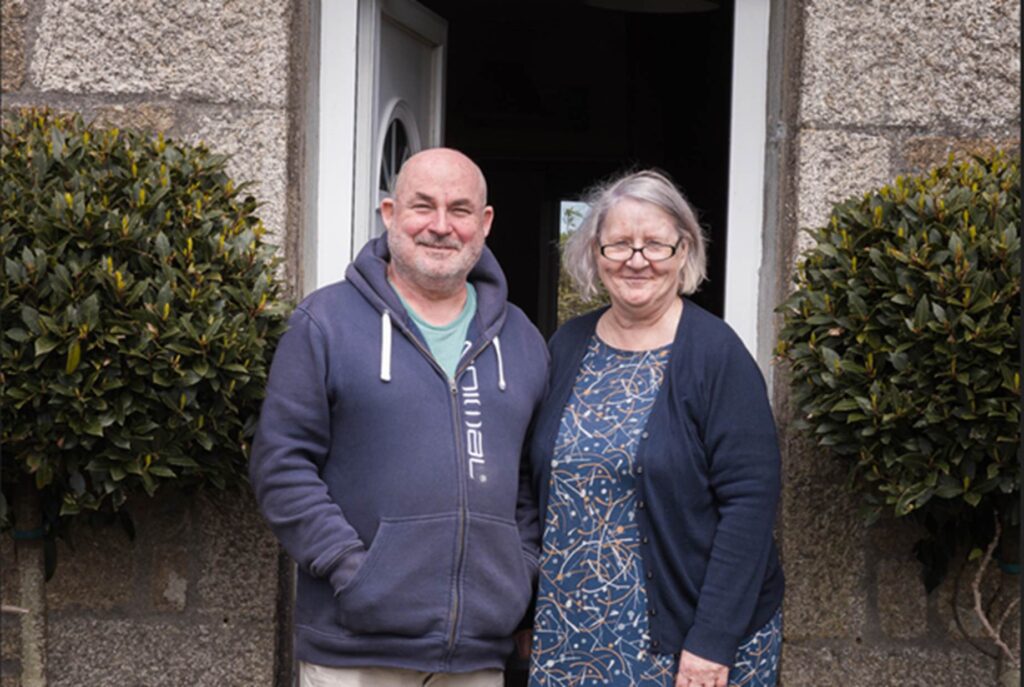
Stephen and Nicky Thomas live in a late-1800s granite property, which is why they concluded that a heat pump would be unrealistic due to cost and disruption. Their 22-year-old boiler currently runs on a 20% HVO blend. “You cannot force people to have certain things that do not work in their own homes,” said Nicky, who also pointed to limited rural electricity capacity and the risks of full electrification without upgrades.
Steph and Nigel Uren have used 100% HVO for five years, alongside solar, an EV charger, and a Tesla battery. When they explored a heat pump in 2022, they were quoted around £10,000 just to bring three-phase power to their home, plus thousands more for radiators. “We’ve been running on HVO for five years now,” said Steph. “It’s been beneficial financially, the house is warm, and we have constant hot water. It’s brilliant. Everyone in rural areas could benefit from HVO. It needs sorting.”
Long-term resident David Biggs, who has lived in the village for 41 years, said visiting officials appeared impressed, noting HVO’s ability to limit consumer disruption while helping households decarbonise.
Calls on government to act
John and Robert Weedon, directors of local fuel supplier Mitchell and Webber, share the residents’ frustration while remaining resolutely optimistic that a solution can be found.
John Weedon said: “We’re confident in this solution and see many reasons to stay positive. The new Prime Minister, Andy Burnham, has stated that the government hasn’t been listening, and that needs to change. The new DESNZ minister has also talked about the need to not impose unnecessary cost on households as part of efforts to achieve net zero.
“The use of HVO for heating fits well with these ideas and I know letters from Kehelland residents are already landing on Mr Burnham’s doormat.”
Robert added: “The only way the government will make progress quickly with off-gas grid decarbonisation is to listen to the Kehelland residents and support the deployment of HVO for heating. It ticks all the right boxes, and we’ll continue to work with colleagues from OFTEC and UKIFDA until we succeed in getting this supported – we’ve come too far to give up now.”
Looking ahead
Mitchell & Webber continues campaigning with industry partners for wider support of renewable liquid fuels, especially for the 1.7 million homes reliant on heating oil. For many residents, the project is about protecting homes and the environment for future generations, and Kehelland has become a model for another route forward.
As Kehelland marks five years, it stands as a powerful blueprint: with the right renewable fuel, we can decarbonise rural heat without tearing homes apart – one clean-burning boiler at a time.
Fuel Oil News, Editor Margaret Major joined the anniversary visit to Kehelland, and will be sharing more customer insights in the September issue of Fuel Oil News. Visit here to ensure you receive a copy of the magazine.
Images provided by Mitchell & Webber.