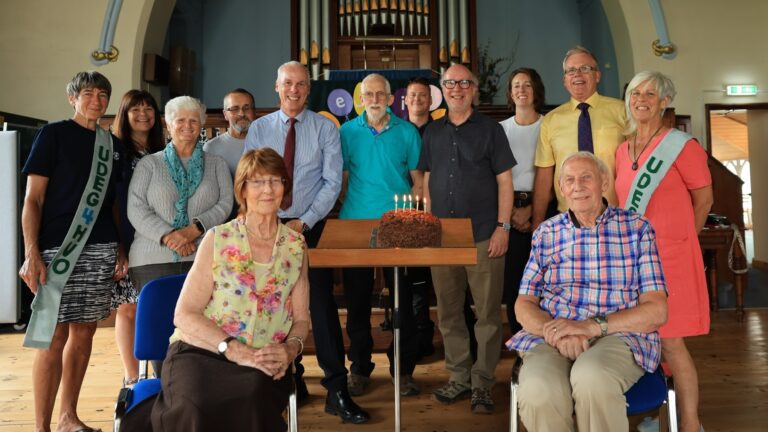
There were two birthdays being marked in the Cornish village of Kehelland on the day of my visit. One was the fifth anniversary of a project that has seen local households and community buildings use renewable liquid fuel in place of conventional heating oil.
The other belonged to a boiler.
In the home of long-time Kehelland resident Dave Biggs sits an oil boiler that has just turned 30. It has spent the latter part of its life participating in a project intended to explore a very different future for rural heating.
Opening it up on the anniversary visit revealed a boiler still running cleanly. Dave’s verdict on its prospects was characteristically succinct: “It’ll outlive me!”
A light-hearted moment, but one that suggests a much bigger question.
If a heating system is still working effectively after three decades, what should decarbonising that home look like? Does reaching net zero necessarily mean replacing existing equipment, or can changing what goes into it also have a role?
Kehelland has spent five years exploring that question.
The project began with homes converting from kerosene to 100% hydrotreated vegetable oil (HVO). The majority of the participating households subsequently moved to a 20% HVO blend for the latter three years of the trial.
Fuel Oil News has followed Kehelland throughout that journey. We have reported on politicians and policymakers visiting the village; on residents taking their case to Westminster; on consultations, legislation and repeated calls for a policy framework that could enable renewable liquid heating fuels to play a role in reducing emissions from off-grid homes.
Five years on, however, perhaps the most interesting evidence is not contained in reports or policy submissions. It is in the homes of the people who have actually lived with the change.
“We want to decarbonise”
Spend time talking to Kehelland residents and one thing quickly becomes clear: this is not a community resistant to change.
Solar panels are visible on roofs. Electric vehicles sit on driveways. Batteries store locally generated electricity.
Several of the residents involved in the HVO project had already invested their own money in reducing their environmental impact before the trial began. Others had investigated heat pumps and considered what further changes they could make.
They are not questioning the need to decarbonise.
They are questioning whether every home can – or should – be expected to follow exactly the same route to get there.
Dave is particularly candid about his own motivation: “We want to decarbonise, but we’re also motivated by self-interest,” he says.
For him, that means considering the sizeable investment that would be required to make his home suitable for an air source heat pump alongside the likely period over which that investment would deliver a return.
“I don’t want to spend my life savings to fit an air source heat pump,” he explains.
The issue is not simply financial. At his stage of life, Dave also questions the disruption involved in significantly altering the fabric of a home in which the existing heating system continues to perform its job.
His experience with HVO has been entirely different. There was no wholesale alteration of the house and no change required to the way the couple lives.
Over the five years, Dave believes his fuel consumption has fallen by around 25–30% while achieving the same level of comfort – an observation based on his own consumption rather than a controlled efficiency comparison.
“We get more bang for our buck,” he says.
He also highlights the absence of the familiar kerosene smell.
There is currently a premium for using HVO and Dave says that is a price he is prepared to pay to reduce the impact of heating his home.
Doing more, not less
A short walk through the village brings us to the home of Steph and Nigel.
Their story is perhaps the clearest rebuttal to any suggestion that choosing a renewable liquid fuel represents an unwillingness to embrace other low-carbon technologies.
Approaching retirement, the couple decided to use money they had saved to reduce their environmental impact. First came an electric vehicle. Then solar panels. They were sufficiently impressed with the solar installation that battery storage followed, with electricity generated on the roof helping to charge the car.
Heating was the next consideration.
The couple looked seriously at an air source heat pump, but the practical implications for their older bungalow quickly mounted.
They were told significant retrofit work would be required. Radiators would need replacing and their concrete floors presented further challenges. On top of the building work, their single-phase electricity supply would need upgrading to three-phase.
That electrical upgrade alone was quoted at around £10,000, with the required retrofit adding tens of thousands more. For them, it became financially unrealistic. Then they heard about the Kehelland project and the change required to use HVO was minor by comparison.
Five years later, their environmental ambitions have not diminished. Their home combines renewable liquid fuel, solar power, battery storage and an electric vehicle.
Steph’s assessment of the HVO element is not a technical one.
“It’s a damn good idea,” she says.
More importantly, perhaps, theirs is a home that demonstrates why the debate does not always divide neatly into competing technologies. Different solutions are already working alongside one another.
“Why would you throw away something that works?”
At the home of Claire and Andrew Waterhouse, another working boiler has remained in place.
Involved with the Kehelland project from its earliest days, they initially used 100% HVO before moving to the 20% blend, in their 26 year-old boiler.
They too report using less fuel than when they heated with conventional kerosene. They have also noticed the lack of smell during deliveries and the cleanliness of the boiler.
Asked what disadvantages they had encountered from making the change, their answer was simply: “Nothing.”
For Claire, there is another sustainability question. “Why remove a functioning heating system, with all the materials and waste that entails, if there is an alternative way to reduce its carbon impact?” she asks.
The couple recycle, minimise waste where they can and want to live as sustainably as possible. Ripping out a working system was difficult for them to reconcile with those aims.
Andrew also brings another perspective. Having spent more than two decades working in the electricity sector, he is conscious of the demands that widespread electrification could place on rural networks.
Again, his argument is not against electrification. It is for recognising the practical constraints that may determine how quickly – and how affordably – different homes and communities can adopt it.
Homes built for another age
Those constraints become particularly tangible at another of the homes we visited.
Stephen and Nicky Thomas live in a property built in 1865. Its Cornish granite walls are around two-and-a-half feet thick. It has concrete floors and the characteristics of a house built more than 150 years before anyone contemplated low-temperature heating systems or national net zero targets.
For two years they ran their boiler on 100% HVO and for the past three have used the 20% blend.
They estimate that their fuel consumption has fallen by around a third compared with their previous kerosene use and, like the others, comment repeatedly on the absence of smell and how cleanly the boiler has run.
Stephen, an accountant, has also looked closely at the economics of alternative options. For their particular property, he says, the numbers simply did not stack up.
Yet the motivation to take part in the project was environmental from the outset.
“It was a no-brainer to get away from burning fossil fuel,” he says. “If nobody does something, nothing gets done.”
Nicky is equally emphatic about the need to act.
Their frustration is that a technology they have used successfully for five years still does not have a clear route to wider deployment.
“We’ve got the proof that it works,” they say. “It’s staring people in the face.”
That is their conclusion from five years living with the fuel. It doesn’t establish that renewable liquid fuel is the answer for every property or determine its role in national decarbonisation.
But it is their real-world experience that they believe deserves to be considered.
Beyond the front door
The Kehelland project has never been confined to individual homes. The village school is using HVO, providing not only heat but a welcome opportunity to talk to pupils about reducing dependence on fossil fuels.
The local church provides another, very different, example. Community buildings are often used intermittently. They can sit empty for long periods before suddenly needing to be brought up to temperature for a service, meeting or event.
For those responsible for such buildings, the ability to produce heat quickly and only when required matters.
During our visit, the church boiler was being serviced. Its design includes around 30 baffles which would, ordinarily, take time to remove and clean. Kevin King, the Mitchell & Webber technician working on it, described how, since the boiler had been operating on HVO, they have emerged remarkably clean.
Elsewhere in the village, residents make the same observation in less technical terms: cleaner boilers, less soot and no kerosene smell. Five years of those small, everyday experiences have shaped their views every bit as much as carbon calculations.
Five years of being heard — but are they being listened to?
If enthusiasm for the fuel remains strong, so too does frustration.
Residents recall a steady stream of visitors to Kehelland over the five years. MPs have come. Government officials have come. Select Committees have come. Representatives from local and national government have listened to their experiences.
Residents have written letters, answered questions and travelled to Westminster to submit their evidence personally.
The pattern, as they see it, has become familiar. Visitors arrive interested and leave sounding positive. Then very little appears to change.
“We’ve had so many visits and from all levels of government,” Dave comments. “They all say how good it is. They all go away very positive.
“We continue decarbonising our homes and village and nobody seems to be listening.”
That frustration should not obscure the unresolved questions around greater use of renewable liquid heating fuels.
Affordability matters. So does sustainable feedstock availability. Decisions around where limited renewable fuels deliver greatest value across heat, transport and aviation are legitimate policy considerations.
The experience of one village cannot determine national energy policy. But neither should the wider questions make the experience of Kehelland and all those participating in this national project, irrelevant.
Evidence, not a verdict
Perhaps that is the real significance of reaching the five-year milestone.
Kehelland does not prove that every oil-heated home should switch to HVO. Neither does it settle questions about future supply, price or the best allocation of renewable fuel resources.
It also does not undermine the important role heat pumps and electrification will play in decarbonising UK heating.
What it does provide is something much harder to recreate in a model.
It offers five years of experience from people who genuinely want to reduce their carbon emissions, but whose homes, finances and individual circumstances have shaped what is practical for them.
Some are enthusiastic adopters of electrification in other aspects of their lives. Some live in properties where extensive retrofit would be difficult. Some are thinking about the length of time over which a substantial investment would pay back. Some simply question the sustainability of removing equipment that still has years of useful service ahead.
Their reasons differ, but there is remarkable consistency in one respect – they want to decarbonise.
What they are asking for is a choice of credible ways to do it.
There is an understandable temptation in debates around heat to look for a single winner: electrification or renewable liquid fuels; replacement or adaptation; one technology versus another.
The lived experience in Kehelland suggests the transition may be considerably less tidy.
The people I met were not demanding that heat pumps disappear from the solution. In fact, one resident summed up the mood by arguing that, given the urgency of reducing emissions, “we need to throw everything we can at decarbonisation”.
It is difficult to disagree with the principle.
Five years after Kehelland first became a testing ground for renewable liquid heating, its residents are still heating their homes, still looking for ways to reduce their environmental impact and still waiting to see how their experience will be reflected in the future of off-grid heat.
They don’t speak in the language of energy models and policy frameworks. They talk about granite walls and concrete floors; savings and payback periods; warm homes, working boilers and the disruption they can live with.
They talk about wanting to decarbonise – and wanting some choice about how they do it.
After five years, perhaps the most important evidence to come out of Kehelland is not simply what has happened inside its boilers.
It is what the people living alongside them have to say.
Image credit: