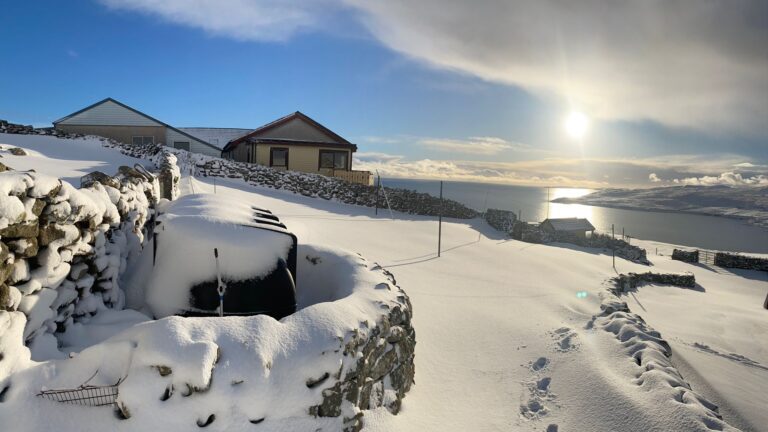
Every heating season follows a familiar pattern. Temperatures drop, customers notice their tanks are running low and orders flood in within a matter of days, especially after the first cold night.
Distributors scramble to meet demand, routes are stretched, drivers work overtime and the phones don’t stop ringing.
It is a cycle the industry knows well. But this year, the data suggests the conditions are in place for that pressure to be particularly pronounced.
What the numbers are telling us
Across our monitored tank population in the UK, average fill levels in September were 61%, down from 65% at the same point last year.
The number of tanks below the alert threshold customers have set for themselves has risen from 8% to 11% of the monitored base. These are households whose tanks have dropped below the level at which they have chosen to be alerted, suggesting a reorder decision is getting closer.
Summer refilling activity was also noticeably weaker. Average fill levels gained just three percentage points between March and September, compared with five percentage points over the same period last year. Overall, refill volumes across the monitored base were down by 14%.
The sharp price increases seen during 2026 are likely to have played an important part. UKIFDA reported in March, that wholesale kerosene prices had more than doubled year on year, reaching a three-and-a-half-year high.
Faced with that pressure, many customers appear to have delayed spring and summer refills rather than topping up when their tanks were still at comfortable levels.
UK customers typically order more frequently than their continental counterparts, so the regular ordering cycle can absorb some of that shortfall before tanks reach critical levels. But the margin looks narrower than usual this year.
For context, the picture on the continent is even more stark. In Germany, where tanks are typically larger and customers order less frequently, average monitored fill levels have dropped to 49%, compared with 61% last year. Nearly a quarter of monitored tanks there have already fallen below the alert levels set by their owners.
Different markets have different ordering patterns, but the underlying lesson is the same: when customers defer filling, more demand can ultimately arrive in a shorter period.
Why this matters for distributors
For UK distributors, the operational risk is straightforward. If temperatures fall sharply, a larger-than-usual proportion of customers could need fuel at around the same time.
Fixed fleet capacity then meets compressed demand. And the trigger is not the price. It’s the first cold night.
Most distributors are extremely good at responding to seasonal peaks. Decades of experience, well-run fleets and strong customer relationships mean the sector is accustomed to dealing with sudden increases in orders.
But responding comes at a cost.
Emergency deliveries are expensive. Unplanned route changes reduce efficiency. Overtime increases. Customer service teams come under pressure. And, when a large number of customers call within the same few days, even the best-run operation may find itself deciding which deliveries are most urgent and how best to manage expectations.
The deeper issue is that a purely reactive model leaves much of the timing of demand outside the distributor’s control. The weather changes, customers realise they are getting low and the calls begin.
Better visibility creates an opportunity to influence that sequence.
From visibility to action
Knowing more about customer tank levels does not remove the winter peak, but it can give distributors more scope to manage how that demand reaches them.
There are three areas where better use of data can make a particular difference.
Identifying customers approaching reorder point
Traditional seasonal marketing tends to address a customer base as a whole. Tank-level data allows distributors to focus instead on customers whose circumstances suggest they may genuinely need fuel soon.
That creates an opportunity for more relevant communication: a notification, email, text message or proactive call to a customer whose tank is approaching a predetermined level, perhaps combined with information about expected colder weather.
The value is not simply in communicating more often, but in communicating at the point when the message is useful.
Bringing appropriate demand into quieter periods
Early November is generally less pressured than the depths of winter. If distributors can identify customers likely to need fuel a number of weeks ahead, there may be an opportunity to encourage some of that demand forward.
That does not necessarily require discounting. It could be as simple as letting a customer know that a vehicle will already be delivering in their area, suggesting a planned top-up or using targeted campaigns to highlight the benefit of ordering before colder weather arrives.
For the distributor, a partial fill incorporated into an existing route can be considerably more efficient than an urgent delivery made later in the season.
Spread across a customer base, small changes in ordering behaviour can help flatten what would otherwise become a much sharper peak.
Prioritising by remaining range
When demand does increase, data can also support better decisions about which deliveries genuinely need to happen first.
Order date alone does not necessarily indicate urgency. A customer with 10% remaining in a smaller tank may have only a few days of fuel left, while another with 30% in a larger tank may have considerably longer.
Combining current tank level with historic consumption allows distributors to estimate remaining range and identify customers at greatest risk of running out.
That turns tank data into practical operational information: helping dispatch teams prioritise the most time-sensitive deliveries while making better use of available fleet capacity.
More relevant customer communication
Greater visibility also changes the relationship between distributor and customer.
Rather than waiting for customers to identify their own need and make contact, suppliers have an opportunity to communicate at a point when that communication is genuinely relevant.
Digital channels can play an important role here. Data from one UK distributor’s connected customer base shows that more than 80% of end customers open their monitoring app at least once a month during heating season, with more than 57% checking weekly.
That creates a regular point of contact through the monitoring app which can also be complemented by other channels including email, SMS and outbound calls.
Early adopter partners using targeted in-app campaigns have also recorded engagement rates of around 20–25%, based on clicks and interactions with those campaigns. The important point is not the channel itself. It is the ability to combine knowledge of a customer’s actual position with timely, relevant communication.
For distributors, that moves customer engagement away from blanket seasonal reminders towards something much more targeted: identifying who is likely to need fuel, when they are likely to need it and whether there is an opportunity to meet that demand more efficiently.
A managed peak
None of this eliminates winter volatility. Cold weather will always increase heating oil consumption and there will always be periods when fleets, drivers and customer service teams are working at full capacity.
But there is a significant difference between a managed peak and an unmanaged one.
The September data suggests UK customers are entering this heating season with lower average tank levels, more tanks approaching reorder thresholds and less summer replenishment behind them than a year ago.
That does not guarantee an exceptional winter rush; weather and customer behaviour will ultimately determine how demand develops. It does, however, suggest that distributors have good reason to use the visibility they have now.
Those able to identify approaching demand, communicate proactively with customers and make delivery decisions around actual need have an opportunity to spread some of the pressure before it arrives.
The winter peak cannot be controlled entirely. But, with better data, distributors can do more than simply wait for it.
Image credit: FoxInsights