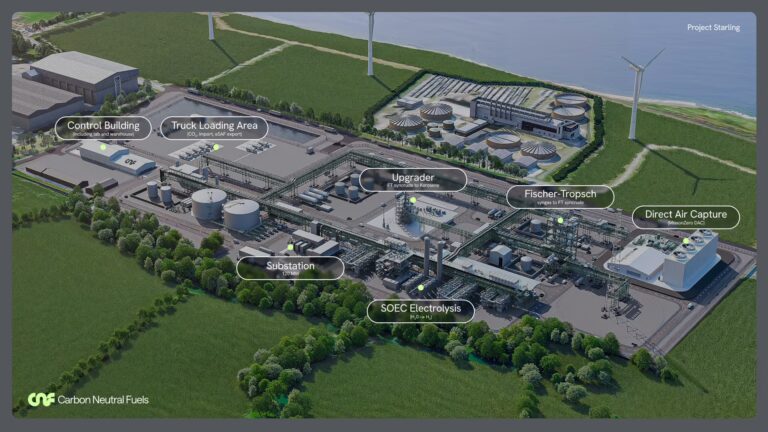
The new FlexSAF design would allow the facility to produce both synthetic aviation fuel (eSAF) and advanced bioSAF using shared processing infrastructure, providing greater flexibility to respond to feedstock availability and market demand.
The development comes as the UK seeks to expand domestic SAF production to meet increasing mandated supply requirements, with the Government’s SAF mandate rising to 10% of aviation fuel supplied by 2030 and 22% by 2040.
Two pathways, one production facility
The proposed design combines two distinct production routes: eSAF manufactured using biogenic CO₂, water and renewable electricity, and advanced bioSAF produced from biomethane. Both feed into a shared Fischer–Tropsch synthesis and upgrading process, avoiding the need for two separate production facilities.
CNF says the approach should reduce production costs per tonne while allowing the balance between the two fuel types to be adjusted, within the technical limits of the equipment. Further process improvements would recycle naphtha and tail gas by-products into the production system to maximise the proportion of output converted into aviation fuel.
Alasdair Lumsden, Co-Founder and Director of Carbon Neutral Fuels, said: “Making eSAF and advanced bioSAF in one plant allows us to shift the balance as the market develops (within the limits of the equipment), a kind of agility which is rare in these large production facilities, and which matches our ethos of creating the right design for the location.”
He added: “Aviation in the UK needs every scalable route to low-carbon fuel it can get. FlexSAF gives us two, and the scaling means a lower cost for every tonne of homegrown SAF.”
Supporting domestic fuel production
The proposed facility would occupy a 40-acre brownfield site at Siddick, near Workington, formerly used by Eastman Chemical. CNF estimates the project could create more than 500 construction jobs and over 150 permanent skilled roles. The company has secured £7.4 million through the Department for Transport’s Advanced Fuels Fund and £3 million from travel company Trailfinders.
Engineering work is progressing with io consulting, with a full planning application expected in spring 2028 and initial fuel production targeted for the final quarter of 2031.
Addressing future fuel supply challenges
The FlexSAF approach highlights the growing importance of feedstock flexibility and production efficiency as the renewable liquid fuels market develops.
While SAF production is primarily focused on aviation, the expansion of domestic production capacity and development of alternative feedstock pathways have wider implications for the liquid fuels sector, where availability, sustainability and competing uses for renewable feedstocks remain significant considerations.
If successfully developed, Project Starling could provide an example of how flexible production technologies might help diversify future renewable fuel supply.
Image supplied by CNF