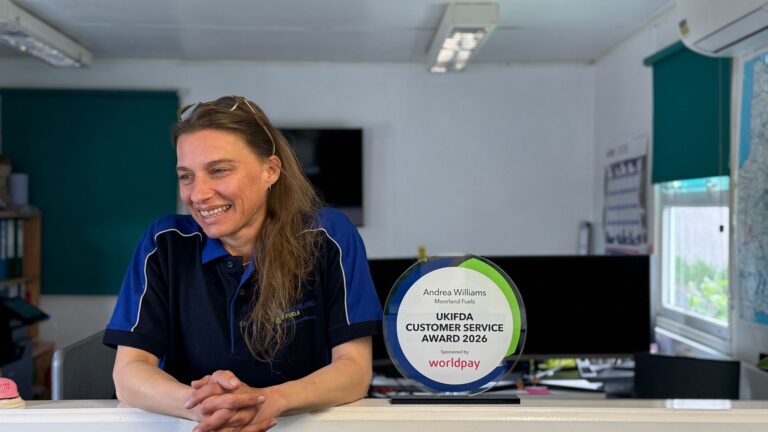
Following on from her ‘A Day in the Life’ feature, Fuel Oil News caught up with Andrea to learn more about her role at Moorland Fuels, what the award means to her, and how she views customer service in the downstream industry.
Congratulations on winning the award. What does this recognition mean to you and the team?
I feel incredibly honoured that my colleagues and our company recognised my efforts and that the wider industry agrees.
We have gone through a multitude of transitions within the business, and this award has proven that our ambition, outlook and attitude is starting to build a solid foundation to grow over the next few years.
Customer service is often what sets businesses apart in a competitive market. What do you think has been the key to your success?
Honesty, reliability and a willingness to go above and beyond. Our motto of ‘what matters to you, matters to us’ is not just words since, as an employee-owned business, every co-owner has a real invested interest in succeeding and retaining custom.
I am not after a quick win but retaining customers for the long term. It is about having the customers’ best interests in mind and acting accordingly.
Speed and proactiveness are key factors in my success, alongside patience. Great customer service happens when you take your time, relax, and have the product and procedure knowledge in place.
Fuel distribution customers often rely on suppliers at critical times. How important are trust and reliability in building long-term relationships?
There are a multitude of great fuel companies in the UK, and we all supply the same product.
Short-term thinking purchasers will always go for price over anything else, long-term thinking purchasers want to build the relationship.
The question is not how important a long-term relationship is but how to build it. Demonstrate your reliability through actions and trust will follow.
A long-term relationship, whether B2B or with a domestic customer, gives the customer the security of a flawless process due to account knowledge and a hassle-free delivery.
Reliability is essential in successfully building relationships for the long term.
Every customer-facing role brings challenges, even at the best of times. I am sure, like others, you have seen an increase in unhappy customers as a result of recent price rises; how are you approaching those difficult conversations?
My team strives to be informative and factual with our customers, and this resonates.
A lot of the unhappiness comes from a place of uncertainty and not knowing how the industry works.
In a time where prices are volatile, cost is one of the biggest pain points for the customers, but this is exactly where excellent customer service, and a proactive account manager can make a difference.
My team is constantly looking at how we can improve consumption, efficiency and management of fuel deliveries, tailored individually to each account.
Did the unjustified statements by politicians about the industry’s behaviour and their use of words like ‘profiteering’ and ‘price-gouging’ increase customer challenges?
Those statements absolutely did not help.
We had negative comments on our social media from people who are not even customers!
My team had hoarse voices in the first few weeks in March, due to the sheer amount of time spent talking to customers on the phone, explaining and clarifying any developments on the fuel market.
Being transparent and upfront has helped our customers understand the industry better, how pricing works and the challenges facing suppliers.
How important is it that frontline staff are empowered to solve problems quickly for customers?
Speed is of the essence! Leaking tank – environmental disaster; delivery not going today – idle time on site and loss of profits; vulnerable elderly customer without heating – danger of ill-health or death.
My team needs to be able and capable to deal with any problem straight away. We are a closeknit team across all departments and the team can act very quickly if needed.
When problems occur regarding fuel or the delivery of fuel, time is a key factor in finding a solution.
Being employee owned, every team member has a proactive attitude and even though we still have a traditional hierarchy in place, whoever takes the call or enquiry, is going to own the process from start to finish.
Every team member has access to all resources and possibilities, which means there is no delay in timelines when dealing with problems.
Technology is changing how businesses interact with customers. How has it improved service, and where is the human touch still most important?
Technological advances mean that we have the possibility to connect quickly and keep the customer up-to-date with text messages and emails about their deliveries and enquiries.
We can update customers a lot faster and more efficiently than ever before. But humans communicate with the mind and the body, not just words alone. Words alone only cover 7% of the communication.
As most of our sales are over the phone, the team is losing a big part of communication with the lack of body language, which makes up 55% of the total communication. The remaining 38% of communication is determined by tone of voice, pitch, volume and pace. Having the opportunity to speak to the customer directly will give you far more influence over and control of the communication than the written word alone.
A calming voice, an empathetic comment and just lending an open ear to the customer can make or break a relationship.
The energy transition is changing customer expectations and creating new conversations. How is customer service evolving as businesses and households consider lower-carbon energy options?
Customer service in our industry is undergoing a fundamental shift as the transition to lower-carbon energy changes both what customers need and how they interact with providers.
“good communication is the bridge between confusion and clarity”
Customer service needs to be highly personalised, advisory and continuous.
Our business is very much in the heart of Devon. Servicing mainly rural locations, often with difficult access due to the territory we are working in. This means that a high proportion of customers have no access to main energy supplies. We have seen a few transitioning to heat pumps, solar and wind solutions. The numbers are still small, but the conversation is there.
If you could change one thing across the sector to improve the customer experience, what would it be?
What I would like to have is a crystal ball to predict any issues or driver delays. Unforeseen changes to well laid out plans is the biggest point of frustration for the customer and the business.
Finally, what advice would you give to anyone starting out in customer service who wants to build an award-winning career?
Find the right team to learn from! Think outside the box and be creative. Talk and listen to a variety of people, with different backgrounds, experiences and lives!
The younger generations are used to digital messaging across all platforms, but the art of conversation is getting lost.
Communication is key to excellent customer service and, especially if things do not go to plan, a reassuring human voice to calm the situation is far more effective than a written message.
Clear expressions, active listening and empathy are the skills to hone. In the words of Nat Turner: good communication is the bridge between confusion and clarity!
Image credit: Moorland Fuels