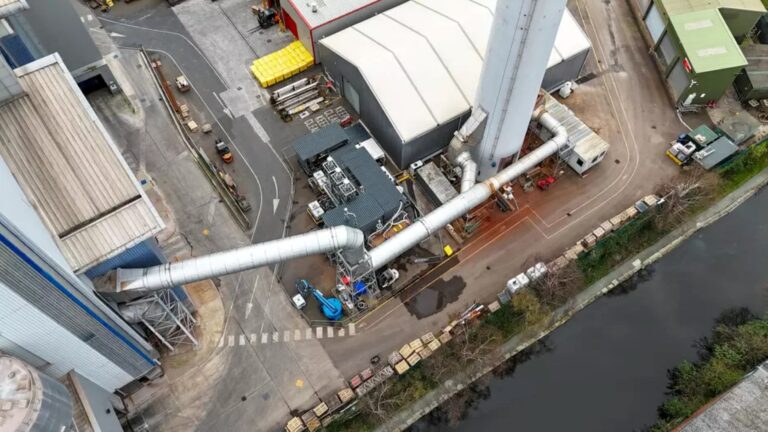
Developed by clean technology company C-Capture, the system uses an alternative solvent chemistry to the amine-based solvents commonly used in conventional post-combustion carbon capture.
In traditional systems, amine solvents absorb CO₂ from industrial exhaust gases before being heated to release the captured carbon dioxide and allow the solvent to be reused. While proven, the process can be energy intensive and brings operational challenges including solvent degradation and corrosion.
C-Capture’s alternative is designed to perform the same basic function without using amines, with the company claiming advantages in energy efficiency, cost and safety.
The technology was originally developed by researchers at the University of Leeds and is now being tested under live operating conditions at Sheffield.
Beyond industrial clusters
For Veolia, however, the significance of the trial extends beyond the technology itself.
Much of the UK’s current carbon capture investment is focused on large industrial clusters where emitters can share transport and storage infrastructure. Veolia argues that greater attention will also be needed for dispersed and land-locked industrial assets that sit outside those areas.
The UK Government has committed up to £21.7 billion over 25 years to support carbon capture and storage, but Veolia says more than half of emissions occur outside designated clusters, creating a need for technologies and business models that can also work at smaller or more geographically isolated sites.
The modular nature of the Sheffield system could therefore prove important if it allows carbon capture technology to be retrofitted to existing industrial facilities without fundamentally changing their operations.
Donald Macphail, chief operating officer – treatment at Veolia UK, said carbon capture should be viewed as one of a range of tools available to address residual emissions that cannot yet be eliminated.
“Carbon capture is one of the tools available to help decarbonise residual emissions where they cannot yet be avoided,” he said, while stressing that it should complement rather than replace measures such as waste prevention, recycling, circular economy solutions and other measures to reduce fossil carbon entering the waste stream.
Trial will test commercial viability
The project is currently at the demonstration stage. Although up to one tonne of CO₂ is being separated from the facility’s flue gases each day, the captured carbon dioxide is currently being released again as engineers assess the performance, safety and efficiency of the process. The two-year trial is intended to establish how effectively the solvent can capture CO₂, how efficiently it can be regenerated and reused, and whether the technology can ultimately be scaled economically.
Greg Searle, commercial director at C-Capture, said the Sheffield project was an important step in demonstrating the technology under real-world conditions and highlighted its potential for challenging applications such as energy-from-waste.
If the economics can be proven at scale, systems of this kind could widen the role of carbon capture beyond the UK’s major industrial clusters and offer another route for businesses facing hard-to-abate emissions.
The longer-term opportunity may also extend beyond storage. Veolia points to the potential for captured CO₂ to be utilised locally in low-carbon fuels and materials, creating a possible future role for carbon capture and utilisation alongside conventional CCS.
For now, however, the Sheffield project is less a demonstration of a finished decarbonisation solution than a test of an important question: whether carbon capture can become practical, affordable and replicable for the many industrial sites that will never sit conveniently alongside a carbon dioxide pipeline.
Image supplied by Veolia