
While this helps maintain customer relationships and sales volumes, it also increases exposure to the possibility of bad debt and late payments.
Credit insurance can help businesses mitigate this risk. This article, written in collaboration with Attis Credit Solutions – a specialist broker in the fuel distribution sector – examines the benefits and importance of credit insurance, while highlighting the role of effective internal credit control as a complementary measure to strengthen overall risk management.
“Credit insurance and internal credit control should be viewed as complementary tools rather than alternatives.”
Credit insurance explained
Credit insurance (also known as trade credit insurance) is a risk management tool that protects businesses against the risk of their customers failing to pay for goods or services rendered on credit.
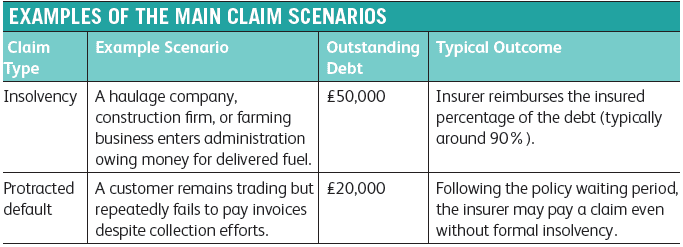
In the event of a debtor’s insolvency or protracted default, insurers typically reimburse a large proportion of the outstanding debt, with indemnity levels typically around 90%, although coverage can vary by policy.
Importantly, claims may still be paid even where a debtor has not formally become insolvent but has simply failed to pay within the specified period (protracted default cover). As credit insurance is primarily designed for business-to-business transactions, cover applies to commercial customers rather than domestic consumers.
Key providers
The fuel sector is served by a wide range of credit insurance providers. However, the largest portfolios of fuel distribution clients are typically held by AIG, Allianz Trade, Atradius, QBE, and Bondaval.
Alongside these insurers, specialist brokers play a pivotal role in advising FODs and arranging cover with insurers on their behalf.
Premium rates and coverage
There is no standard premium rate for credit insurance, as costs vary according to various factors such as business size (varying significantly between a large oil company and a small distributor), insured turnover, claims history, and the quality of the debtor base.
However, premiums typically range from 0.05% to 0.15% of insured turnover, averaging 0.1%. For example, a distributor with £30 million of insured turnover might expect to pay an annual premium of between £15,000 and £45,000.
Claims and payout timeline
Insolvency is the most common type of credit insurance claim. Once the required documentation (such as proof of debt and copies of invoices) has been submitted, claims are typically settled within around 30 days. However, many insurers also provide a quick small claims service, allowing lower-value claims (typically between £15,000-£20,000) to be processed and paid more quickly.
Advances in digital platforms and automation over the past 5-10 years have significantly streamlined the claims process, replacing paper-based systems and enabling policyholders to manage credit limits, applications, reporting, and claims online, reducing the administrative burden.
Rejected claims
Whilst around 98% of insurance claims are typically paid – according to Attis – claims can be rejected. This is usually due to procedural rather than credit-related issues. The most common reason is failure to comply with policy conditions, particularly failing to report overdue accounts within the Maximum Extension Period (MEP). All credit insurance policies include an MEP, setting a limit on how long a debtor can remain overdue (for example, 30 days beyond the due date).
The second most common reason is administrative error, typically arising from insuring the incorrect legal entity due to variations or inconsistencies in company names. Accurate identification of the insured debtor is essential, and policies require precise matching of the correct legal entity.
Credit insurance fraud
In recent years, there has been a noticeable rise in attempted fraud in the fuel sector, although these risks are not limited to the industry. While credit insurance policies can provide cover for certain fraud-related losses, protection depends on the specific circumstances and policy wording, therefore FODs need to stay vigilant.
A common method of fraud involves the impersonation or “hijacking” of legitimate companies, where fraudsters use stolen or altered business details to obtain credit, arrange fuel deliveries, or set up fuel cards. This may include changes to registered information or addresses to redirect goods away from the genuine business.
Another increasingly common tactic is “long firm fraud”, where a business is set up and initially trades normally, building trust through prompt payments, before gradually accumulating higher credit limits and ultimately defaulting once significant exposure has been built.
Credit risk for distributors
FODs often deliver large fuel volumes and allow payment later (e.g. 30 days after delivery), leaving them exposed to the risk of customer insolvency and late payment during the credit period. For SME FODs in particular, a limited number of customer defaults or delayed payments can quickly strain cash flow and working capital, increasing the risk of broader financial strain across the supply chain.
Examples of the main claim scenarios are shown in the table below:
Benefits of credit insurance
The key benefit of credit insurance is that it reduces the financial impact of customer non-payment, protecting FODs offering credit terms by covering a large proportion of their exposure in the event of insolvency or protracted default.
Credit insurance enables FODs to offer customers short-term credit without requiring payment upfront, helping to maintain strong customer relationships and support sales. This is particularly important in the sector, where invoice values are often high due to the cost and volume of fuel supplied, while operating margins can be relatively tight.
Another key benefit of credit insurance is that it supports growth by allowing FODs to extend credit more confidently to larger or higher-risk customers. By reducing exposure through insurance, businesses are less constrained by internal credit limits and can trade with key accounts that might otherwise be restricted. This enables distributors to pursue larger opportunities and expand their customer base while maintaining protection against potential loss.
“For SMEs in particular, the value of credit insurance extends beyond claims payments.”
WHAT COULD A BAD DEBT COST?
Scenario
- Customer credit limit: £50,000
- Insolvency occurs
- Credit insurance cover: 90%
Outcome
- Potential uninsured loss: £50,000
- Insured recovery: £45,000
- Net loss retained by distributor: £5,000
Without insurance: full £50,000 exposure.
Broker benefits
While FODs may choose to deal directly with underwriters, the effectiveness of credit insurance can be enhanced by working with a specialist broker that understands the credit risks specific to the sector.
Specialist brokers support distributors throughout the credit insurance process, from initial market reviews through recommending suitable underwriters to negotiating pricing, policy terms, and levels of cover.
A broker can also undertake a regular review of a distributor’s existing arrangements to ensure cover remains appropriate for the size and nature of the business.
In appointing a broker, FODs should look for one who:
- Offers specialist sector knowledge
- Engages with both clients and underwriters on an ongoing basis
- Compares insurers to secure competitive terms that may not be available when dealing directly with underwriters
Credit risk management at a glance
- Credit insurance typically covers around 90% of insured debt following insolvency or protracted default
- Premiums generally range from 0.05%–0.15% of insured turnover
- Around 98% of claims are paid, with most rejected claims resulting from procedural errors
- Insurance works best alongside strong internal credit control procedures
- Monitoring payment behaviour and acting early on overdue accounts reduces exposure
- Fraud risks are increasing, making customer verification and due diligence more important than ever
- Specialist brokers can provide access to market intelligence as well as insurance cover
Internal credit control
Effective risk management relies not only on credit insurance but also on strong internal credit control processes. Rigorous internal procedures ultimately complement insurance by instilling good credit discipline into a company.
Regular monitoring of customers, including late payments, bounced direct debits, and deteriorating payment behaviour, enables businesses to respond quickly and manage exposure more effectively. This may include placing overdue accounts on stop and suspending further sales until payment issues have been resolved.
FODs may also use external credit checking tools. Credit reference agencies such as Creditsafe and Experian provide valuable insight, including credit scores, payment histories, County Court Judgments (CCJs) and financial information.
However, their assessments are largely based on historic and publicly available data. In contrast, underwriters often supplement financial information with wider payment experience and ongoing market intelligence, providing an additional layer of insight that can help distributors identify potential risks and avoid bad debts. For SMEs in particular, the value of credit insurance extends beyond claims payments.
“Ultimately, credit insurance is about more than recovering bad debts.”
Summary and recommended actions
Credit insurance provides valuable protection against credit-related risks for FODs who extend credit to their customers, offering greater cashflow certainty and peace of mind should a customer become insolvent or fail to pay.
However, credit insurance and internal credit control should be viewed as complementary tools rather than alternatives. The most effective approach combines appropriate insurance cover with robust internal procedures, including customer vetting, credit limits, payment monitoring, and prompt action on overdue accounts.
FODs should also ensure they understand the requirements of their policy and remain vigilant to emerging fraud risks. Working closely with specialist brokers and insurers can provide access not only to financial protection, but also to valuable market intelligence and risk information that supports better credit decisions.
Ultimately, credit insurance is about more than recovering bad debts. When combined with strong internal credit control, it enables FODs to protect cash flow, support sustainable growth, and trade with greater confidence.
Attis Credit Solutions is a specialist broker advising FODs and arranging cover with insurers on their behalf. With an estimated 80% market share in the fuel distribution sector, Attis provides dedicated expertise for energy sector clients ranging from nationwide companies to regional distributors.
An industry working together
Attis also supports clients through its ‘Credit Circle’ network, which brings together credit managers and finance directors each quarter to share best practice and intelligence on delinquent debtors. This helps distributors identify risks early and avoid exposure to known problem accounts. The network also supports fraud prevention through the sharing of intelligence, training, and practical tools such as fraud checklists, helping businesses recognise suspicious activity and mitigate potential risks at an early stage.
At-a-glance fraud checklists
Attis Credit Solutions has put together these useful checklists, helping distributors identify potential fraud risks before extending credit or making deliveries.
FRAUD CHECKLIST – PHYSICAL DELIVERY AND CARDS
- Companies House, Credit Report and Application Form Checks
- Be cautious where a company facing strike-off suddenly files accounts showing unexpectedly strong performance.
- Use a Credit Reference Agency (i.e. Creditsafe/Experian) to flag accounts that have been cloned
- Look for changes of directors or significantly backdated dates of appointment
- Review recent director changes and understand the reasons behind them
- Look for unusual Companies House activity, including multiple changes or sudden filings.
- If there is a change of registered office, check google maps for new office. Is it miles from the previous office? Does it appear commercially reasonable? If it still arouses suspicion then consider additional verification including independent checks of the trading location such as visiting in person or contacting businesses in close proximity
- Review payment history and trading performance information within credit reports
- Bank account verification via Creditsafe/Experian or own bank
- Look at credit reports exception analytics for alerts such as a high volume of Director changes, a high volume of applications or address changes
- Maintain a documented due diligence record for every new credit customer
- Look for handwriting matches on applications forms, spelling mistakes etc.
- Fraudsters may send in multiple applications but not change handwriting – keep copies of past spotted fraudulent applications to check against
- Call the company from their website contact details if different to application form details to check it is them applying
- Ensure the sales team confirms what the fuel will be used for – does the business need fuel?
- Independently verify contact details, particularly where only a mobile number is provided
OTHER POSSIBLE CHECKS
- Is the opportunity inbound or have they been prospected?
- Is the registered office and delivery address different? Search on Google, maps etc. to check legitimacy
- Is the delivery address a long distance from either registered or trading address? – preferably insist cards are delivered to registered address.
- Request original utility bills and/or photo ID
- Check bank sort code / bank address
- Be cautious where a website appears incomplete or consists only of a placeholder domain
- Poor-quality website imagery or copied content can indicate a recently created or fraudulent business
- Is the website SSL certified or not secured?
- Check website SSL by right clicking and checking meta data to see when created.
- Are email addresses Gmail, Yahoo etc. rather than company email addresses?
- www.whois.com can be used to check websites, email addresses and when registered
- Use CIFAS fraud checks (https://www.cifas.org.uk/)
- Check the company and cross reference directors on LinkedIn
- Be aware of cloned LinkedIn accounts – use reverse image checks to check for stolen images or cloned businesses/people.
- Use Google to check for news on the business
- Consider integrating https://seon.io/ which automates checking of the device ID, mobile number, IP address, email against known fraud databases.
EARLY WARNING SIGNS OF CREDIT RISK
- Sudden increases in fuel volumes
- Requests for unusually high credit limits
- Changes in ownership, directors or registered address
- Persistent late payments or bounced direct debits
- Multiple delivery locations
- Reluctance to provide supporting documentation
- Generic email addresses rather than company domains
POSSIBLE RED FLAGS
Incentivise staff to spot fraudulent applications (including drivers who can be very perceptive) using this useful checklist:
- A frequently used story: “We want to switch from fuel cards to bulk, as we no longer wish to use fuel cards.”
- An unrealistic annual usage quantity when compared with the type of business
- Driver feedback on the delivery site such as newly installed tanks or no company livery
- Multiple or frequently changing delivery locations
- A customer showing little interest in pricing or commercial terms
- Large credit card payments
- Requests to change delivery details after an order has been placed
- Large, unexpected orders taken at month end as fraudsters understand pressure on sales departments to meet targets
- Unusually large orders taken at the beginning of the month which is when fraudsters believe they have the longest timeframe before you chase for payment
- Challenger bank accounts feature frequently in fraud cases and may justify additional due diligence
If spotting any red flags, consider adding online selfie/liveness check with https://seon.io/ or similar organisations.
Delivering Insight is your monthly business‑critical briefing. Designed to give SME distributors clear, actionable guidance to work smarter and more profitably. Although larger distribution groups may have in-house HR teams, fleet managers, compliance officers and analysts, many SME FODs operate without those resources. Delivering Insight is your virtual support team – a growing knowledge base that builds into a valuable reference library for your business, helping you make informed decisions that safeguard your business today and strengthen it for the future.