For fuel distributors, ensuring depot staff and drivers know how to respond effectively is an important part of operational preparedness.
Barton Petroleum’s experience of Spill First Responder training, delivered by Compass Environmental Consultancy through the Oilshield scheme, highlights the value of combining practical instruction with the right equipment and support.
Building confidence through practical training
For Howard Marriott, Group Transport Manager at Barton Petroleum, the decision to arrange Spill First Responder training for depot operational staff was prompted by both previous experience and the opportunity offered through Oilshield.
“We had an incident in one of our depots a few years ago and, although it was handled well, we wanted to ensure all depot operational staff across the company were aware of the actions needed to minimise the impact of a spillage,” he explained.
Joining the Oilshield scheme provided a further incentive, with the training offered as part of its risk management programme. Barton welcomed the opportunity to strengthen its spill preparedness across the business.
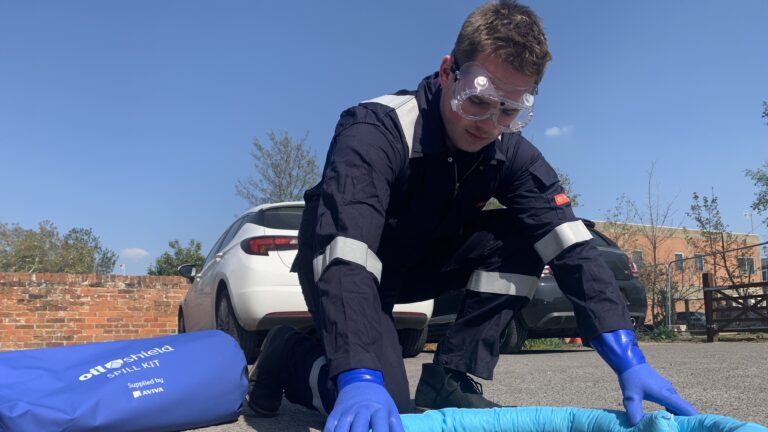
The course combined a theory session in the training room with a practical exercise in the depot, using water to demonstrate spill response techniques. For Howard, this hands-on element was particularly valuable, helping staff understand how quickly a seemingly minor incident can escalate.
He added that one of the biggest lessons was recognising how limited the consequences of a spill can be when it is tackled early and correctly.
Recognising the risks and acting quickly
Effective spill response starts with understanding the potential hazards and taking appropriate action without delay. From a depot and transport management perspective, these include identifying the product involved, assessing the presence of vapours, preventing fuel from entering drains or watercourses, and managing slip and skid risks. Appropriate personal protective equipment (PPE) is also essential to reduce the risk of skin contamination.
Stewart Ower, Risk Management and Spill Response Lead for Oilshield, explained that spillages can occur during fuel deliveries for several reasons, including driver error, equipment failure or problems with the receiving tank or associated infrastructure.
Drivers are often well placed to take the initial emergency measures needed to limit the impact. Shutting down the delivery, where safe to do so, and using spill kit materials to contain the loss close to its source can help bring the situation under control.
“Prompt and effective action can prevent or minimise damage, protect company reputation and avoid a large insurance claim,” said Stewart.
He stressed that one of the most important rules is not to hose down a spill or flush it into drains, onto lawns or elsewhere, as this simply spreads the contamination. Instead, the priority is to stop the source of the spill where safe, contain it and prevent it from reaching vulnerable areas.
Where oil has affected soil, gravel or grass, visibly contaminated material may need to be removed promptly. Particular care is needed where a spill threatens a property, as contaminated soil close to a building can increase the risk of damage and oil vapour entering living spaces.
Any spill should be reported immediately to the Depot Manager so that further advice and support can be obtained. Stewart confirmed that Oilshield’s support is available 24 hours a day, 365 days a year.
A proportionate response
While acting quickly is essential, Stewart emphasised that an effective response must also be appropriate to the circumstances. Among the common misconceptions is the belief that a spill will eventually disappear or that covering contaminated ground with topsoil will resolve the problem.
At the other extreme, excessive use of spill kit materials can generate unnecessary volumes of contaminated waste and increase clean-up costs.
“An appropriate response is proportionate to the circumstances and identified risks,” he explained. “It should be safe, timely, proportionate, effective and cost efficient. No two spills are the same, the spill setting can change the picture completely.”
Training helps employees assess the situation, understand the risks and make informed decisions rather than relying on assumptions. It also reinforces the importance of acting promptly while ensuring that the response remains safe and proportionate.
Supporting a wider safety culture
Barton Petroleum’s commitment to safety and environmental responsibility is reflected in its platinum status across all depots under the UKIFDA Depot Certification Scheme. For Howard, however, maintaining high standards also means ensuring staff are prepared to deal with incidents should they occur.
He said: “Although we hold platinum status in all our depots as part of the UKIFDA Depot Certification Scheme, which demonstrates our commitment to environmental responsibility and best practice, we feel that spill response training is something that should still be conducted, but hopefully never needed!”
The training provided to Barton’s depot staff is accredited by the International Spill Accreditation Scheme (ISAS), which Stewart explained supports the development of in-house spill first responder capability.
As joint owners of Oilshield, Compass provides the training as part of the scheme’s risk management offering. Spill First Responder training is available at no cost to Oilshield customers, who also receive ADR-compliant spill kits for use on tankers.
Stewart believes this combination of training and equipment can deliver significant benefits. Preventing just one major spill could more than offset the investment, while helping to protect customers, the environment, insurers and distributors’ claims experience and reputation.
Training beyond the depot
Spill preparedness also extends to drivers, who may be the first to encounter an incident during a delivery. Compass delivers Driver CPC training that includes the same Spill First Responder module, alongside online training resources designed to address risks associated with liquid fuel deliveries.
These initiatives are developed in response to the types of claims encountered by Oilshield, many of which Stewart said are behaviour-driven and therefore avoidable. The aim is to help drivers assess delivery risks, respond appropriately to spills and avoid injury during the delivery process.
The training and resources form part of Oilshield’s value-added initiatives and are exclusive to its customers, giving distributors access to practical support designed around the risks they face.
Preparedness that pays off
For Barton Petroleum, the training has helped reinforce the importance of early intervention, sound judgement and practical spill response skills. For the wider downstream fuel industry, the message is clear: while preventing every incident may not be possible, ensuring staff know how to respond can make a significant difference.
By combining accredited training, appropriate equipment and access to specialist support, distributors can improve their readiness to protect people, property and the environment when a spill occurs.
Image credit: Compass Environmental Consultancy