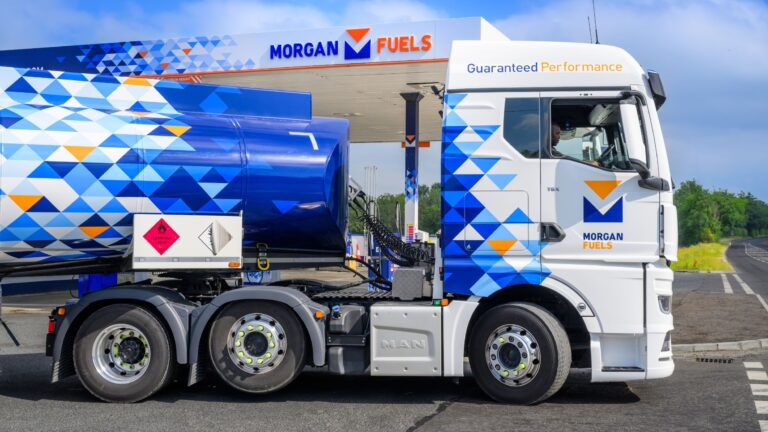
What has not changed is its determination to remain independent. FON editor Margaret Major speaks with father-and-son team, Hugh and Michael Morgan, about family ownership, customer loyalty, changing heating-oil buying patterns, renewable fuels and where the next opportunities lie.
Forty-five years after establishing Morgan Fuels, CEO Hugh Morgan may have stepped away from much of the day-to-day management, but retirement it isn’t.
He still drives tankers, spends time working in the yard and garage and, when FON caught up with him, was enjoying getting back to the practical side of the business.
“I started out serving my time as a diesel fitter before becoming a truck driver,” he explains. “So, I’m enjoying a different end of it now rather than sitting at the desk and dealing with people all the time.”
With Sales Director Michael increasingly taking responsibility for the business alongside an established management team, Hugh has the opportunity to take more of a back seat.
But there is little sign that his interest in where Morgan Fuels goes next has diminished.
The business celebrating a 45th anniversary this year, bears little resemblance in scale to the operation Hugh began building from its early filling-station and domestic fuel roots.
The first filling station was purchased in 1981, with the help of Hugh’s siblings, Mary, Stephanie, Pauline and Eamon. From this humble start, the business grew rapidly.
Expanding initially into home heating oil, its activities now encompass bulk fuel, fuel cards and associated fleet services, with the company reporting that its fuel-card operation reaches 18 European countries.
An innovator from the outset, Hugh established the first unmanned bunkering sites in Ireland as Morgan Fuels helped pioneer commercial fleet bunkering and fuel card networks across Ireland and the UK. Today, the company operates an extensive network of over 7,500 refuelling sites across Ireland, the UK, and mainland Europe.
Yet one characteristic has remained resolutely unchanged: ownership. In an industry that has seen considerable consolidation, Morgan Fuels remains family owned and funded. Eamon is still actively involved as Hugh’s second-in-command, while Mary also continues to play a vital role.
Independent by choice
Hugh says approaches have been made over the years. “The business is not for sale. I keep telling everybody that it’s not for sale,” he says.
“We’re still family-based and family-funded. We don’t have any outside investors. There’s no equity in the company belonging to anybody else. It’s ourselves, and that’s where we hope to stay.”
Independence, for Hugh, is about much more than simply retaining the family name above the door. It gives the business the freedom to act.
With no outside investors to consult, he describes decisions as being made by the management team “around this table” – something that allows the company to react quickly to changing markets and opportunities.
It is an approach that appears to have shaped Morgan’s growth. While there have been some smaller acquisitions, Hugh describes the vast majority of the business as having grown organically.
There was never, he suggests, a rigid masterplan stretching decades into the future.
Instead, each development has led to the question of what comes next.
“We never really dwell on any success,” Hugh says. “I don’t see it as success. I see it as a job done then ask where we go next.”
Growing people as well as the business
For Hugh, the description “family business” also extends beyond ownership.
Some members of the Morgan Fuels team have been with the company for more than two decades, while others joined from school or began work in the company’s filling stations before progressing through the organisation.
Hugh points to people who have moved into senior sales and management positions, including employees who have spent almost their entire working lives with the company. “I always like to take everybody with me,” he says.
That long-term approach to people has become increasingly valuable as the business itself has become more complex.
Technology has transformed almost every part of fuel distribution and fleet management since Morgan Fuels began, but Hugh is happy to surround himself with people whose expertise complements his own.
The result, he says, is a management team that understands the business, knows what is expected and can act quickly.
A European business with local roots
One of the biggest areas of evolution has been fuel cards. Hugh is particularly proud that Morgan Fuels has built its own network rather than operating as a white-label reseller.
“We have built our own network,” he says. “We’re not a white-label card. We don’t depend on the other card companies or the multinationals. We brand our own cards.”
Today, Morgan Fuels reports a network extending across 18 countries, with further opportunities being pursued in Europe.
There is also scope to grow the wider services surrounding the fuel-card customer, continuing a diversification that has taken Morgan Fuels well beyond its original distribution operation.
Heating oil stays close to the heart
Yet despite that expansion, ask Hugh about domestic heating oil and the conversation immediately returns to Morgan Fuels’ beginnings.
“It would still be very close to my heart because a lot of the customers have been buying from us for 45 years, and now their families are buying from us,” he says.
“It would be a smaller end of the business now, but it’s still very close to my heart to keep it going and make sure those customers are looked after, because they are the people that helped me to put it there.”
The domestic market has changed considerably in those 45 years.
Greater price transparency and online buying platforms have made parts of the customer base increasingly price-driven. Morgan’s response has been to continue emphasising the personal relationship.
Hugh accepts that price matters, particularly while household budgets are stretched, but believes service still provides independent distributors with an opportunity to differentiate themselves. That becomes particularly important in volatile markets.
Buying less, more often
Asked about current issues, Michael suggests price volatility is a significant concern, and one that is impacting buying patterns. “The only issue is the volatility of the price,” he says.
For domestic customers, the impact is evident in the size of orders coming through. “We’re not seeing 1,000-litre fills; we’re seeing 300, 400-litre fills,” he explains. “People can’t afford to fill 1,000 litres anymore and some are waiting to see if the price comes back.”
The result is customers buying what they can afford and returning for another smaller delivery later. For distributors, that behaviour has its own economics. Sending a tanker and driver to the same customer more frequently inevitably increases the cost of delivering each litre, making smaller purchases a more expensive way to buy fuel even though they may be the only realistic option for some households.
It is a clear example of the pressures experienced by both supplier and customer.
A question of consistency
The conversation around changing customer demand inevitably turns to the longer-term question of decarbonisation.
Hugh is clear that the fuel distribution sector has a role to play in reducing emissions, but his concern is with what he sees as a lack of consistency in the way different sectors are being asked — and enabled — to decarbonise.
For domestic homes, he sees energy efficiency and improved insulation as an obvious part of the answer, reducing both consumption and household cost.
He would also like to see policymakers provide greater scope for lower-carbon liquid fuels alongside other technologies rather than closing down options prematurely.
“We all need to play a big part in it,” he says, but argues that government needs to create the conditions that allow businesses and consumers to make lower-carbon choices.
A particular frustration is the apparent contrast between policies that constrain the future use of liquid fuels in domestic heating while supporting continued growth in aviation.
Hugh points to airport expansion in both Ireland and the UK and questions the proportionality of limiting options for individual rural households while allowing aviation capacity — and therefore demand for aviation fuel — to increase.
Policymakers have frequently identified aviation as a sector where alternatives to liquid fuel are particularly difficult, creating a strong case for prioritising finite renewable feedstocks for sustainable aviation fuel. Hugh does not dispute the need to decarbonise aviation, but questions whether prioritising renewable liquid fuels for such sectors should mean overlooking their potential to decarbonise existing oil-heated homes.
For him, the issue is choice and proportionality. If renewable liquid fuels can reduce emissions from existing heating systems without requiring wholesale replacement of the technology, he believes their potential contribution should be considered alongside electrification and improvements to building efficiency.
That emphasis on keeping options open is also reflected in Morgan Fuels’ own approach to lower-carbon fuels.
The company’s recent RFAS accreditation provided the original reason for FON’s conversation, but the discussion makes clear that the decision reflects a broader change in customer requirements.
Morgan Fuels was already supplying HVO before gaining its recent RFAS accreditation. What has changed, Michael explains, is the number of commercial customers seeking independently assured traceability and certification.
Michael describes that pressure as increasingly coming “down the chain”, with larger organisations placing requirements on contractors and suppliers that ultimately reach businesses purchasing fuel from Morgan.
“I think it’s another step in the right direction to give these customers what they need,” he says of the accreditation.
The requirement is being seen among both bulk and fuel-card customers. However, Michael cautions against interpreting that as evidence that fleets are switching wholesale to HVO.
For many hauliers, its price premium remains difficult to absorb, meaning use may be restricted to selected vehicles or contracts where lower-carbon fuel is specifically required.
It gives Morgan’s transition activity a distinctly pragmatic character: have the product, infrastructure and assurance ready as demand develops, while recognising the commercial realities customers face.
The next 45 years
Ask where the next major opportunity lies and Europe comes quickly to the fore.
“I think Europe’s a huge opportunity for us,” says Michael. With the business now established in Poland, Romania is among the markets where Morgan sees further potential.
But Morgan Fuels’ history suggests its future is unlikely to follow a predetermined path. New services, new fuels and new customer requirements will emerge; some will become significant businesses and others will not. What has mattered throughout, says Hugh, is retaining the ability to react.
“You have to be sharp,” he says. “You have to be on the ball and make that decision quickly.”
That way of working remains very much part of the business, even as responsibility increasingly passes to the next generation. Hugh may have stepped away from much of the day-to-day management, but remains involved, while Michael and the wider management team are increasingly charged with deciding what comes next.
It feels less like the handover of a finished business than the continuation of a way of working. And, whatever the next opportunity proves to be, Hugh is clear that one principle should remain unchanged.
“You might be selling lubricants, HVO, gas – whatever you’re selling, at the end of the day the customer needs the product, and you have to deliver it in the best possible way.
“Without the customer, the business doesn’t exist.”
Forty-five years on, Morgan Fuels may operate across 18 countries and deliver considerably more than the heating oil on which much of the business was built, but Hugh’s measure of the business remains remarkably consistent: look after the customer, make decisions quickly and keep moving.
“I don’t see it as success,” he says. “I see it as a job done then ask where we go next.”
Increasingly, that question will be Michael’s to answer. The independence that allowed Hugh to build Morgan Fuels his way is also what gives the next generation the freedom to decide where it goes next.
Image credit: Morgan Fuels