His focus and the next stage are about ensuring the new operating model delivers for the people within it and the customers they serve. In a candid conversation with Fuel Oil News, he explains why listening, trust and empowerment will be central to NWF Fuels’ next phase of growth as the business builds the technology, culture and wider energy offer needed for long-term growth.
Paul Wilkinson’s first weeks at NWF Fuels have not been spent at a desk in the company’s head office in Crewe.
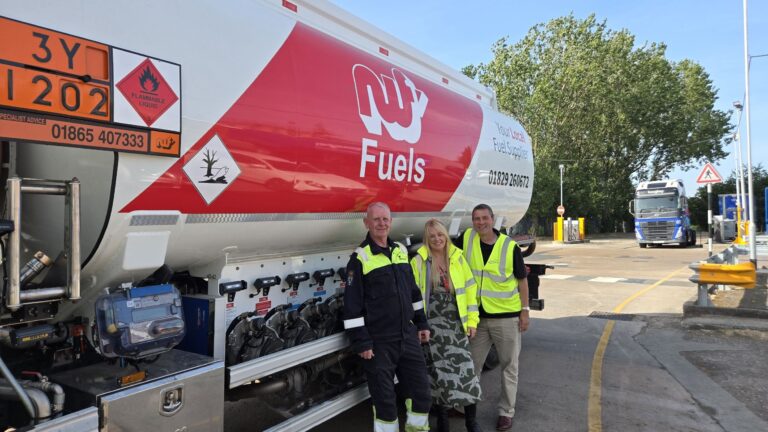
He has been visiting depots, meeting teams and getting out in a tanker – an experience he describes as memorable, but also reflects a long-standing belief about leadership.
“If you want to understand the nuances of the business and what is working and what is not, that won’t be done from a desk in Crewe,” he says. “To get the true picture, I like being out there.”
It is a simple statement, but one that captures both Paul’s approach and the shape of the task he has taken on in becoming managing director for NWF. He has inherited an evolving business in which much of the structural heavy lifting has already been done.
Central functions have been brought together, a national depot footprint has been built through acquisition and the operating model has been reshaped. The next stage is to realise the benefits of those developments to make the structure work as effectively as possible for the people inside it and the customers it serves.
Making the structure work
Paul is clear that major change needs time to settle before its full benefits can be realised. Centralisation can create efficiency and remove some of the burden from depots, allowing local teams to concentrate on the last mile – the customers and deliveries. However, it can also weaken connections.
“The challenge is working out how best to reconnect them, because you do not want to go back to the original model,” he explains. “The original model was right for its time but a business needs to evolve with the market. You have to consider how you can not only take cost out but also reinvest it in the right way.”
“Every time you centralise, you realise that some of the parts you have taken away need to be reconnected.”
That final point is important. Paul does not dismiss the commercial realities of a listed company or the need to deliver growth and shareholder return. He simply suggests that cost reduction is not the end of the strategy and that sustainable growth depends on reinvestment in both the customer relationship and the workforce.
“You neglect either of those at your peril,” he says. “You cannot focus on one and discount the other. Frontline, customer-facing people are the ones best placed to demonstrate the differences between organisations.”
This is the heart of the two-stage strategy that emerged from the conversation. The first phase created scale, structure and central capability. The second is about empowering the people, particularly through giving frontline colleagues the confidence and authority to succeed for themselves and the business.
Differentiating a commodity business
Paul sees a clear parallel between fuel distribution and the pharmaceutical wholesale businesses in which he spent much of his career. Both are high-volume, low-margin environments in which the underlying product offers limited scope for differentiation.
“Whatever people may want to think, what goes into our tankers and ends up with our customers – whether it is heating oil or commercial diesel – is no different from anybody else’s,” he says. “Once you accept that, you focus on the offering. What is the differentiator between us and our competitors? It cannot be the product and, for me, it cannot simply be price either.”
Price matters, he acknowledges, but it is a differentiator any competitor can remove overnight. A market that competes only by cutting price risks a race to the bottom, with the customer experience ultimately suffering because there is no margin left to invest in it.
NWF is therefore developing what Paul describes as a strong roadmap for the coming months, with changes intended to make the benefits of choosing NWF more tangible and improve how customers interact with the business. Not yet ready to reveal the detail, Paul simply says: “Watch this space.”
Empowerment is everything
Paul arrives with experience of organisations far larger than NWF, but also with the perspective of an entrepreneur who built a European business from his kitchen table. That combination, he believes, means he understands enough of finance, commercial activity and operations to ask the right questions without pretending to be the expert in every room.
“I am not afraid to employ talent that is way cleverer than me,” he says. “It comes back to people.”
His clearest expression of that philosophy is his approach to delegation. At Movianto, where he was brought in at the beginning of the pandemic to deliver the UK Government’s COVID vaccine storage and distribution response, the organisation had to create new warehouse facilities and recruit 600 people under intense pressure and away from public view.
“What we built will remain my proudest professional moment,” he says. “It was only possible because of empowerment and delegation, listening and taking feedback, and challenging it when I still did not believe it was correct. I encourage my teams to do exactly the same with each other and with me.”
That does not mean an absence of direction. Paul sees his role as setting strategy, mentoring and supporting the leadership team, rather than becoming the point through which every decision must pass. “I see myself as a support function to the team.”
Listening – and acting
Paul deliberately entered the sector without a fixed view of what he would find. After almost 30 years in healthcare, he wanted to avoid simply repeating the answers that had worked elsewhere. His first weeks have therefore been built around listening to people in customer service, finance, depots and tankers.
He has found a strong core of people who care deeply about the customer journey – a foundation on which the next phase can be built.
“Their views are an untapped resource,” he says. “Some leaders forget to ask. Others ask but do not really listen, or do not want to act. Unless you are willing to act on the information you get back, do not ask the question.”
Across different sites and roles, six or seven recurring themes have emerged. That consistency has helped the leadership team identify where action can have the most impact. It is important to Paul that, where a request cannot be met, the business must still explain why.
This is particularly important for tanker drivers, who may spend much of the working day alone and have fewer natural opportunities to share their experience. NWF intends to create more ways for those colleagues to be heard, alongside clearer career paths, training and investment in the next generation of drivers.
Paul is excited by the opportunity to turn NWF into the employer of choice he believes it can become. “There is some work to do but if you don’t believe you can do it, I don’t understand why anybody would want to lead anything.”
“My style has always been about getting other people to make the decision, own it and do what they are supposed to do. Empowerment is everything.”
Technology in support of people
One of his early observations is the opportunity to close a perceived technology gap within the business. The investment he envisages is not limited to a new customer interface, nor is it about using artificial intelligence to remove people from the organisation.
“AI used in a positive way can enhance the workplace and enhance the customer journey,” he says. “We cannot uninvent technology.”
The opportunity extends across customer service, supplier interaction and operations. Like many established businesses, NWF is rich in data but has not yet fully realised its potential. Paul wants to combine internal information with weather patterns, customer usage and external factors to improve planning and decision-making.
Better preparation, in his view, ultimately becomes better customer service. It also gives colleagues better tools with which to do their jobs. This reinforces rather than contradicts the people strategy: technology should remove friction, improve judgement and allow the human interaction to carry more value.
Integration before expansion
NWF’s growth has been shaped by acquisition, creating a broad depot network and significant national coverage. Paul remains open to further purchases where they make strategic and logistical sense but believes the original objective of achieving scale has largely been met.
The priority now is to generate a return from the investment already made by bringing acquired companies, systems and people into one cohesive organisation. It is another expression of the structure-first, people-next theme: acquisition creates the footprint; integration creates the value.
He is equally wary of treating volume as an automatic route to profitability. Additional volume frequently brings additional operational cost, he argues, so the expected improvement in margin does not necessarily materialise. Market share will remain an important measure, but the quality of that growth – how customers are won, retained and served – matters more than the headline number alone.
More than fuel in a tank
Looking further ahead, Paul believes NWF must participate actively in the wider energy discussion. He does not foresee the short-term disappearance of heating oil, diesel or other fossil fuels, but he is equally clear that domestic heating oil is not a growth market and that changing customer expectations cannot be ignored.
“We have to be at the centre of the broader energy discussion; otherwise, change will happen around us and we will have no influence on the outcome,” he says. “We need to become more than a company that puts fuel in a tank – a trusted place customers can turn to when they are considering what the future looks like.”
That may, over time, mean a broader range of energy solutions and advice. Paul stresses that this does not diminish the importance of the market NWF serves today. It is a recognition that consumers are increasingly seeking different combinations of affordability, convenience and lower-carbon choices, and that a long-term energy business needs to respond.
It is a challenge that Paul suggests is made harder by regulatory uncertainty. Repeated shifts in net zero targets and policy direction make organisations nervous about committing capital when the rules may change again. He sees a legitimate role for industry collaboration here: not to dictate the outcome, but to ensure the sector’s operational knowledge and the needs of its customers are considered as policy develops.
What success would look like
Asked what he would want to have achieved three years from now, Paul begins with the responsibility of a listed business: a stable return to shareholders. He quickly moves, however, to what must sit beneath that result – a fully embedded culture, effective use of technology and a customer experience differentiated by much more than price.
Paul is also keen to encourage leaders to emerge from within all areas of the business. He wants progression to be visible from the tanker driver upwards and believes leaders should be developing people capable of taking on greater responsibility. “If a tanker driver cannot see progression, what is their motivation to go above and beyond?” he asks.
His definition of success also includes a more diverse and genuinely inclusive workforce. Paul has previously created employment opportunities for people from disadvantaged backgrounds, with a particular focus on people with Down syndrome, and is looking forward to creating similar opportunities within NWF Fuels.
“The talent that is untapped is absolutely immense,” he says. “A real inclusive culture within the business – I would like to achieve that.”
An inward focus – for now
Whilst the conversation conveyed a high level of ambition, Paul is careful not to present himself as someone who has arrived with instant answers for an industry he is still learning. He has deliberately focused inward during his first months, rather than immediately building a wider industry profile.
“I have not come here to make an impression on the industry,” he says. “I am focused on the people within the business I am leading. If some of the things we develop work, the industry will follow.”
The immediate task is to get the vision that has been developed by Paul and the leadership team moving, then empower that team to take it forward. Only then does he expect to spend more time looking outward and building a broader view of the sector.
It is a fitting summary of both the strategy and the leadership style. The structure has been created. The next stage will be judged by whether its people feel heard, trusted and equipped to use it – and whether customers can feel the difference.
Image credit: NWF